License and attribution
© 2026 MORI University.
Except where otherwise noted, this textbook is licensed under a Creative Commons Attribution 4.0 International License (CC BY 4.0): https://creativecommons.org/licenses/by/4.0/
You are free to share (copy and redistribute in any medium or format) and to adapt (remix, transform, and build upon) this material for any purpose, including commercially. You must give appropriate credit, provide a link to the license, and indicate if changes were made. You may do so in any reasonable manner, but not in any way that suggests MORI University endorses you or your use.
Suggested attribution: “Algebra: Expressions, Equations, and Models (U02), MORI University, 2026, licensed under CC BY 4.0.”
About the text. All teaching text, worked examples, exercises, answers, and figures were written or drawn new for MORI University. Other open textbooks were consulted only for scope and accuracy, and no text was copied from them. No material comes from share-alike (CC BY-SA) sources. Government data (from NIST, the US Department of Labor, the National Park Service, the US Geological Survey, the US Access Board, and the US Energy Information Administration) is in the US public domain and is credited where used.
About the numbers. Every calculation in this book, and every point on every figure, was checked by computer before publication. Prices, wages, bills, and measurements in the examples are illustrative unless a source is named. The few real figures are US data, each labeled with its source, the period it covers, and the date it was retrieved. Figures like electricity prices change every month, so recheck them before you rely on them.
Corrections. If you find an error, please report it to MORI University so it can be fixed for every reader.
Preface
Welcome. Algebra is a way of writing down what you already know how to do.
If you’ve ever worked out how many hours you need to work to cover the rent, compared two phone plans, or figured out when your savings will reach a goal, you’ve done algebra in your head. This book gives that thinking a written form. A letter stands for an amount you don’t know yet, an equation records what you know about it, and a few careful steps tell you what it must be. Then you check the answer, and say what it means.
Who this book is for. This book is for first-time algebra learners and for anyone returning to it, perhaps after years away, perhaps after a bad experience in school. Many adults were taught algebra as a set of tricks to memorize. Here, every step has a reason, and the reason is always stated. If you’ve been told you “aren’t a math person,” this book was written with you in mind.
What you need first. This book follows U01 Ratios, Proportions, and Percent. You should be comfortable with fractions, decimals, rates, and percents. If you’re unsure, don’t worry: Chapter 1 is an arithmetic bridge that reviews the operations, fractions, decimals, and order of operations that algebra relies on, with pointers to the U01 chapters where each idea is taught in full. Throughout the book, a note such as “(U01 Chapter 5)” tells you where to look back.
What you need to have. You need paper and a pencil, and a basic calculator, such as the one on your phone. Graph paper helps from Chapter 10. A free spreadsheet program is useful for the final project but is never required. Money is in US dollars, and measurements are mostly in US customary units, with metric where you’d meet it.
How the book is built. The book moves in four stages:
- Foundations (Chapters 1 to 3): the arithmetic bridge, signed numbers, and what a variable is. Every letter stands for a quantity with a unit.
- Expressions (Chapters 4 and 5): evaluating formulas, and rewriting expressions in equivalent forms.
- Equations and inequalities (Chapters 6 to 9): solving by balancing and undoing, handling harder equations, rearranging formulas, and working with limits and ranges.
- Lines and models (Chapters 10 to 14): graphs, slope and intercept, systems of two equations, and linear models of real situations, ending with a project in which you build, check, and report a model for a decision in your own life.
A promise about precision. Every number in this book has been checked. When we round, we tell you. Every worked example ends with a check, and you’ll learn to check your own answers the same way: by substituting back, by estimating, and by asking whether the answer makes sense. We also say what kind of statement each claim is: a measurement, a calculation, an assumption, or a model. A model is only as good as its assumptions, and Chapters 13 and 14 show you how to state them.
A note on language. In this book, “3 times as much” always means multiplying by 3. We never write “3 times more,” because readers take it in different ways (U01 Chapter 1). We also write units with every quantity, because an answer like “12” is only half an answer. Twelve what?
Where this leads. This book is the prerequisite for U07 Mechanics: Motion, Force, and Work, where slope becomes speed and models describe motion. It also supports U03 Geometry: Measure, Diagonals, and Scale, U04 Statistics: Samples, Center, and Spread, U08 Energy Systems: Power, Efficiency, and Budgets, U10 JavaScript: Values, Functions, and Arrays, U12 Data Analysis: Tables, Missing Values, and Honest Charts, U23 Draft a Business Idea with Visible Assumptions, U29 Economics: Choices, Markets and Price Changes, and F24 Personal Finance and Consumer Decision-Making, which all use its equations, graphs, and models.
How to use this book
Each chapter follows the same pattern, so you always know where you are:
- Learning goals: what you’ll be able to do by the end.
- Start here: a plain explanation of why the idea matters.
- Short sections, each ending with “Good stopping point.” One section takes about 10 to 20 minutes.
- Worked examples, solved one step at a time. Each step is named, and each example ends with a Check and an In words line saying what the answer means.
- Check yourself questions after each section, with answers right below. Cover the answer, try the question, then look.
- A practical activity using things from your own life: receipts, bills, a pay stub, a map, or a measuring tape.
- Common mistakes, described so that you can recognize them in your own work.
- Going further: optional depth that you can skip on a first reading.
- A summary, with the chapter’s key terms. Every key term is also in the glossary at the back.
- Nine review questions, then explained answers that show the reasoning, not just the result.
A suggested pace. If you can study for about 30 minutes, three or four times a week, you can finish a chapter in a week or two and the whole book in about four months. Chapters 1 to 9 are best taken in order. Chapters 10 to 13 build on each other and on Chapter 6. Chapter 14, the project, takes longer, and it’s best spread over a week or two.
When you get stuck. Go back one step. Most difficulties in algebra come from something earlier: a sign rule (Chapter 2), the order of operations (Chapter 1), or a fraction (U01 Chapter 2). Read the worked example again with a pencil, and redo each step yourself before reading the next one. Then try the “Check yourself” question again a day later. Getting stuck isn’t a sign that you can’t do this. It’s a normal part of learning, and it means you’ve found the next thing to practice.
Using a calculator. Use one whenever the arithmetic is long, but estimate first so that you’ll notice a slipped key. Chapter 1 explains how calculators apply the order of operations, and when to use the parentheses keys.
Figures. Chapters 10 to 14 include graphs. Each one is drawn from the same numbers as the text, and each one has a caption saying what it shows. You’ll draw many graphs of your own, too.
Course learning objectives
By the end of this book, you will be able to:
- Carry out arithmetic with whole numbers, fractions, decimals, exponents, and signed numbers, following the order of operations.
- Define variables precisely, with units, and translate everyday situations into algebraic expressions.
- Evaluate expressions and formulas, and use tables of values to see how they behave.
- Rewrite expressions in equivalent forms by combining like terms, expanding, and factoring out common factors.
- Solve linear equations, including those with variables on both sides, parentheses, fractions, and decimals, and check every solution by substitution.
- Recognize equations with no solution or infinitely many solutions, and judge whether a solution makes sense in its situation.
- Rearrange formulas to solve for any variable, and use them for practical calculations.
- Solve linear inequalities, show their solution sets on a number line, and interpret them as limits, budgets, and ranges.
- Plot points and graph linear relationships from tables and equations, and read graphs in both directions, honestly.
- Calculate and interpret slope as a rate of change, and the intercept as a starting value, with units.
- Solve systems of two linear equations by graphing, substitution, and elimination, and interpret break-even points.
- Build linear models of real situations, stating assumptions, checking residuals, and giving a valid range.
- Plan, build, check, and report a linear model for a real decision, explaining what the results mean and what would change them.
Chapter 1 · Arithmetic Bridge: Operations, Fractions, and Order of Operations
U02 Algebra: Expressions, Equations, and Models · MORI University · Foundation level
Time needed: about 90 minutes in total, in six short sections. Each section ends at a good place to stop. You need: a pencil, paper, and a calculator. A phone calculator is fine, and Section 1.5 asks you to test it.
Learning goals
By the end of this chapter, you will be able to:
- Use each of the four operations with its inverse operation to undo and check a calculation.
- Move between fractions, decimals, and percents when a calculation needs it.
- Read and compute an exponent as repeated multiplication.
- Evaluate an arithmetic expression using the order of operations, including grouping symbols.
- Test whether a calculator follows the order of operations, and enter calculations so that it gives the right answer.
- Estimate an answer before calculating, and use the estimate to catch mistakes.
Start here
Algebra has a reputation it doesn’t deserve. Many adults remember it as a blur of letters and rules, and decided long ago that it “wasn’t for them.” If that’s you, you’re very welcome here. This book starts from arithmetic you already use and goes one small step at a time. Every rule comes with a reason, and every answer comes with a check.
Here’s the first idea. Algebra is arithmetic with a placeholder. When you think, “The bill is $40 plus $12 for every extra hour,” you’re already doing algebra. The only new thing is that we’ll write “every extra hour” as a letter, so we can work with it before we know the number.
To work well with placeholders, you need the arithmetic underneath to be steady. This chapter is a short bridge. It reviews the four operations, fractions and decimals, and powers. It spends the most time on one thing algebra depends on completely: the order of operations, the agreed order for doing the steps in a calculation.
If you studied U01 Ratios, Proportions, and Percent, much of this will feel familiar. Chapters 1 to 3 of U01 cover whole numbers, fractions, and decimals in more depth. Use them whenever a step here feels shaky.
1.1 Four operations and their inverses
You know the four operations: adding, subtracting, multiplying, and dividing. Algebra relies on one fact about them more than any other. Each operation has an inverse operation that undoes it.
| Operation | Undone by | Example |
|---|---|---|
| Add 7 | Subtract 7 | 12 + 7 = 19, and 19 − 7 = 12 |
| Subtract 7 | Add 7 | 12 − 7 = 5, and 5 + 7 = 12 |
| Multiply by 4 | Divide by 4 | 12 × 4 = 48, and 48 ÷ 4 = 12 |
| Divide by 4 | Multiply by 4 | 12 ÷ 4 = 3, and 3 × 4 = 12 |
This is why you can check a subtraction by adding, or a division by multiplying. In Chapter 6 it becomes the main tool for solving equations. To find an unknown number, you undo whatever was done to it, one step at a time.
Worked Example 1.1 · Undoing a shopping total
You paid $23 at a market. You bought 3 bags of apples at the same price, and a $5 loaf of bread. What did one bag of apples cost?
Step 1: Say what was done to the unknown price. The bag price was multiplied by 3. Then $5 was added. That gave $23.
Step 2: Undo the last step first. Subtract the bread: $23 − $5 = $18.
Step 3: Undo the multiplying. Divide by 3: $18 ÷ 3 = $6.
Check: 3 × $6 + $5 = $18 + $5 = $23. ✓
In words: one bag of apples cost $6.
Notice the order. The price was multiplied first and then had $5 added. To undo it, you subtract first and then divide. It’s like getting dressed. Socks go on before shoes, but shoes come off before socks. Chapter 6 uses exactly this idea.
Zero and one. Two numbers behave specially, and algebra uses them all the time.
- Adding 0 changes nothing: 9 + 0 = 9. Multiplying by 1 changes nothing: 9 × 1 = 9.
- Multiplying by 0 always gives 0: 9 × 0 = 0.
- You can’t divide by 0. 12 ÷ 0 has no answer. If it had one, call it n, then n × 0 would have to equal 12, and no number times 0 gives 12. A calculator shows “Error” for this, and that’s the right response.
Check yourself 1.1 A taxi charged $19. The fare was $4 plus $2.50 for each mile. How many miles was the ride? Undo the steps, then check. Answer: $19 − $4 = $15, and $15 ÷ $2.50 = 6 miles. Check: $4 + 6 × $2.50 = $4 + $15 = $19. ✓
Good stopping point.
1.2 Fractions, decimals, and percents in one page
Algebra uses fractions constantly, often as division written with a bar. Here is a one-page summary. U01 Chapters 2, 3, and 8 teach each part in full.
A fraction is a division. 3/4 means 3 ÷ 4 = 0.75. A fraction bar works as a division sign. In algebra we usually write division as a fraction rather than with ÷. Written on one line, a fraction uses a slash, and parentheses take over the grouping job of the bar: (18 + 6)/(4 × 2) is the one-line way to write 18 + 6 over 4 × 2. This book writes fractions on one line, so watch for those parentheses.
Equivalent fractions. Multiplying or dividing the top and bottom by the same nonzero number gives the same value: 3/4 = 6/8 = 75/100.
Adding and subtracting. You need a common denominator:
- 1/2 + 1/3 = 3/6 + 2/6 = 5/6.
Multiplying. Multiply the tops, and multiply the bottoms:
- 2/3 × 3/4 = 6/12 = 1/2.
Dividing. Multiply by the reciprocal (flip the second fraction):
- 3/4 ÷ 1/8 = 3/4 × 8/1 = 24/4 = 6. That means six eighths fit in three quarters.
Decimals and percents.
- A percent is a number of hundredths: 0.75 = 75/100 = 75%.
- To change a percent to a decimal, divide by 100: 6% = 0.06.
Worked Example 1.2 · Three-quarters of a recipe, two ways
A recipe uses 2/3 cup of oats, and you want to make 3/4 of the recipe.
Step 1: As fractions. 3/4 × 2/3 = 6/12 = 1/2 cup.
Step 2: As decimals. 0.75 × 0.6667 ≈ 0.50 cup.
Check: Both methods give one half. ✓
Fractions often give exact answers, and decimals are often quicker on a calculator. Use whichever fits the job, but know how to move between them. A decimal like 0.6667 is rounded. The exact value is 2/3 = 0.666…, with the 6s repeating forever.
Check yourself 1.2 Compute 5/6 − 1/4, and write 3/8 as a decimal and as a percent. Answer: 10/12 − 3/12 = 7/12. 3/8 = 3 ÷ 8 = 0.375 = 37.5%.
Good stopping point.
1.3 Exponents: repeated multiplication
An exponent is a small raised number that says how many times to multiply a number by itself. The number being multiplied is the base.
Here the base is 2 and the exponent is 3. We read 2³ as “2 to the third power” or “2 cubed.” We read 5² as “5 squared.”
| Expression | Means | Value |
|---|---|---|
| 3² | 3 × 3 | 9 |
| 4³ | 4 × 4 × 4 | 64 |
| 10⁴ | 10 × 10 × 10 × 10 | 10,000 |
| 1.5² | 1.5 × 1.5 | 2.25 |
| 7¹ | 7 | 7 |
A common slip. 3² is 3 × 3 = 9, not 3 × 2 = 6. The exponent counts the copies. It isn’t something you multiply by.
Why “squared” and “cubed”? The names come from shapes. A square floor tile that is 3 feet on each side has an area of 3 × 3 = 3² = 9 square feet. A box 2 feet on each side holds 2 × 2 × 2 = 2³ = 8 cubic feet. The units show it too: square feet are ft², and cubic feet are ft³. U03 Geometry: Measure, Diagonals, and Scale uses these often.
Powers of ten move the decimal point. 10³ = 1,000, so 4.2 × 10³ = 4,200. A thousand watts is a kilowatt and a thousand meters is a kilometer, so you meet powers of ten every time you use a metric unit.
Check yourself 1.3 Find 6², 2⁵, and 0.3². Answer: 36; 2 × 2 × 2 × 2 × 2 = 32; 0.3 × 0.3 = 0.09.
Good stopping point.
1.4 The order of operations
What is 3 + 4 × 2?
If you work left to right, you get 7 × 2 = 14. If you multiply first, you get 3 + 8 = 11. Both can’t be right. If different people got different answers from the same written calculation, no one could share a formula. So mathematicians use one agreed order, called the order of operations.
- Grouping symbols first. Work inside parentheses ( ), brackets [ ], and other groupings, such as the top and bottom of a fraction bar. Start with the innermost group.
- Exponents.
- Multiplication and division, from left to right, as they appear.
- Addition and subtraction, from left to right, as they appear.
So 3 + 4 × 2 = 3 + 8 = 11.
Grouping symbols are how you override the order. (3 + 4) × 2 = 7 × 2 = 14. If you want something done first, put it in parentheses.
Same level, left to right. Multiplication and division share a level, and you do them in the order they appear. The same goes for addition and subtraction. So:
- 12 ÷ 3 × 2 = 4 × 2 = 8 (not 12 ÷ 6 = 2).
- 10 − 4 + 3 = 6 + 3 = 9 (not 10 − 7 = 3).
About memory aids. You may have learned “PEMDAS” (“Please Excuse My Dear Aunt Sally”). It’s a useful reminder of the four levels. But it can mislead, because M comes before D and A comes before S. That suggests multiplying always comes before dividing, which isn’t true. If you use PEMDAS, picture it as P, E, MD, AS, with the paired letters sharing a level.
Worked Example 1.3 · A step at a time
Evaluate 20 − 3 × 2² + 8 ÷ 4.
Step 1: Grouping. There are none.
Step 2: Exponents. 2² = 4, giving 20 − 3 × 4 + 8 ÷ 4.
Step 3: Multiply and divide, left to right. 3 × 4 = 12 and 8 ÷ 4 = 2, giving 20 − 12 + 2.
Step 4: Add and subtract, left to right. 20 − 12 = 8, and 8 + 2 = 10.
Check: Redo it with parentheses that show the agreed order: 20 − (3 × 4) + (8 ÷ 4) = 20 − 12 + 2 = 10. ✓
Worked Example 1.4 · A fraction bar groups
Evaluate (18 + 6)/(4 × 2).
Step 1: The fraction bar groups the top and the bottom. On one line, the parentheses show that grouping. Work out each one first. Top: 18 + 6 = 24. Bottom: 4 × 2 = 8.
Step 2: Divide. 24 ÷ 8 = 3.
Check: If you ignore the grouping and work 18 + 6 ÷ 4 × 2 left to right, you get 18 + 3 = 21. That isn’t what the fraction means. ✓ (The answer 3 is right. The 21 shows why the bar matters.)
Worked Example 1.5 · An everyday total
A plumber charges a $65 call-out fee plus $48 an hour. A job takes 2.5 hours, and the parts cost $37. Write one calculation for the bill and evaluate it.
Step 1: Write it. 65 + 48 × 2.5 + 37.
Step 2: Multiply first. 48 × 2.5 = 120.
Step 3: Add. 65 + 120 + 37 = $222.
Check: Fee $65, labor $120, parts $37. $65 + $120 = $185, and $185 + $37 = $222. ✓ The order of operations matches how the bill really works. You multiply the hours by the rate before adding the fixed charges.
Check yourself 1.4 Evaluate (a) 5 + 6 × 3, (b) (5 + 6) × 3, (c) 36 ÷ 6 ÷ 2, (d) 2 × 3². Answer: (a) 5 + 18 = 23. (b) 11 × 3 = 33. (c) 6 ÷ 2 = 3. (d) 2 × 9 = 18. In (d), the exponent applies only to the 3.
Good stopping point.
1.5 Calculators and the order of operations
Not every calculator follows the order of operations. Many basic calculators, and some phone calculators in portrait mode, work immediately. They do each operation as soon as you press the next key. On those calculators, 3 + 4 × 2 gives 14.
Scientific calculators, spreadsheets, and most phone calculators follow the agreed order. They give 11.
Test yours now. Type 3 + 4 × 2 = and see what you get.
- 11: your calculator follows the order of operations. You can type expressions as written, using parentheses where needed.
- 14: it works immediately. Enter calculations in the right order yourself. Do the multiplications first, write down the results, and then add.
Worked Example 1.6 · Entering a fraction
To find (18 + 6)/(4 × 2) on a calculator that follows the order of operations, type it with parentheses:
Step 1: Enter. ( 18 + 6 ) ÷ ( 4 × 2 ) =
Step 2: Read. The display shows 3.
Check: Typing 18 + 6 ÷ 4 × 2 gives 21, the wrong answer from Worked Example 1.4. ✓ On a calculator, a fraction bar needs parentheses around the top and around the bottom.
Spreadsheets follow the order of operations and use
* for multiply, / for divide, and ^ for powers. The plumber’s bill would
be =65+48*2.5+37. U02 uses ordinary math notation, but
you’ll see the spreadsheet form in Chapter 14, where a spreadsheet is an
optional tool.
Check yourself 1.5 How would you enter 100/(2 + 3) on a calculator? What answer should you get? Answer: 100 ÷ ( 2 + 3 ) = 20. Without the parentheses, 100 ÷ 2 + 3 gives 53.
Good stopping point.
1.6 Estimate first, then calculate
A quick estimate catches most serious mistakes, such as a slipped decimal point, a missed key, or a wrong order of operations. The habit is simple. Round to easy numbers, work out a rough answer, and compare it with the exact one.
Worked Example 1.7 · Is the receipt right?
A receipt shows 4 items at $7.95, plus 2 items at $12.10, for a total of $56.00. Is that plausible?
Step 1: Round. $7.95 is about $8, and $12.10 is about $12.
Step 2: Estimate. 4 × $8 + 2 × $12 = $32 + $24 = $56.
Step 3: Calculate exactly. 4 × $7.95 = $31.80, and 2 × $12.10 = $24.20. $31.80 + $24.20 = $56.00.
Check: The estimate and the exact total agree. ✓
The estimate wasn’t just close. It happened to be exact, because rounding $7.95 up and $12.10 down balanced out. Usually an estimate is only close, and that’s enough to tell you whether to trust the answer. If the calculator had said $5.60 or $560, the estimate would have caught it straight away.
Check yourself 1.6 Estimate 49 × 21 and 612 ÷ 29. Then calculate both exactly. Answer: Estimates: 50 × 20 = 1,000 and 600 ÷ 30 = 20. Exact: 1,029 and about 21.1.
Good stopping point.
Practical activity · Your calculator and a real bill
Time: 20 minutes. Materials: your calculator and a bill or receipt with at least one “rate × amount” line, such as hours × rate, gallons × price, or a quantity of items.
- Test your calculator with 3 + 4 × 2 and with 2 + 3² (or 2 + 3^2). Write down whether it follows the order of operations.
- From your bill, write the whole total as one calculation, such as fixed fee + rate × amount + tax. Use parentheses where they’re needed.
- Estimate the total by rounding.
- Evaluate your calculation exactly, step by step, on paper.
- Check against the bill. If it doesn’t match, look for the reason, such as a discount, tax, or rounding on each line. That reason is information, not failure.
Common mistakes
- Working strictly left to right. 3 + 4 × 2 is 11, not 14. Multiply before you add.
- Multiplying before dividing every time. They share a level. Work left to right: 12 ÷ 3 × 2 = 8.
- Reading an exponent as multiplication. 3² = 9, not 6.
- Losing the fraction bar on a calculator. Put parentheses around the top and around the bottom.
- Undoing steps in the wrong order. Undo the last step first, like taking off shoes before socks.
- Dividing by zero. It has no answer. If a calculation leads there, go back and check the setup.
Going further (optional) · Why everyone agrees on the order
The order of operations isn’t a law of nature. It’s a convention, an agreement, much like driving on the right side of the road in the US. Its value comes from everyone using the same one. It grew from how people wrote polynomials, where expressions like 3x² + 5x + 2 are easiest to read when multiplication binds tighter than addition. You can write any calculation unambiguously by adding parentheses. When in doubt, add them. Extra parentheses never change a correct answer.
Summary
- Each operation has an inverse that undoes it. To undo several steps, undo the last one first.
- You can’t divide by zero.
- A fraction bar means division and groups the top and the bottom.
- An exponent counts how many copies of the base are multiplied.
- Order of operations: grouping, then exponents, then multiply and divide left to right, then add and subtract left to right.
- Test your calculator, use parentheses, and estimate before you trust any answer.
Key terms: inverse operation · exponent · base · order of operations · grouping symbols · estimate · convention
Review questions
Questions 1 to 6 practice single skills. Questions 7 to 9 combine them.
- Evaluate 7 + 3 × 5 − 2.
- Evaluate 48 ÷ 4 ÷ 2 and 48 ÷ (4 ÷ 2).
- Evaluate 4³ and 3 + 2⁴.
- Compute 2/5 + 1/4, and 3/5 ÷ 3/10.
- Evaluate (30 − 6)/(2 × 3), and say how you’d enter it on a calculator.
- Write 0.4, 1/8, and 120% in the other two forms (fraction or decimal, and percent).
- A gym charges a $25 sign-up fee and $18 a month. You’ve paid $187 so far. Undo the steps to find how many months you’ve paid for, and check.
- Two friends evaluate 10 − 2 × 3 + 4. One gets 28 and the other gets 8. Who is right? What did the other one do?
- An electrician charges $90 to visit plus $55 an hour, and the parts cost $43.50. Write one calculation for a 3-hour job, estimate it, evaluate it, and check.
Explained answers
1. Multiply first: 3 × 5 = 15. Then work left to right: 7 + 15 − 2 = 20.
2. Left to right: 48 ÷ 4 = 12, and 12 ÷ 2 = 6. With the parentheses, 4 ÷ 2 = 2 comes first, and 48 ÷ 2 = 24. The parentheses change the answer.
3. 4³ = 4 × 4 × 4 = 64. In 3 + 2⁴, the exponent comes first: 3 + 16 = 19.
4. 2/5 + 1/4 = 8/20 + 5/20 = 13/20. 3/5 ÷ 3/10 = 3/5 × 10/3 = 30/15 = 2.
5. Top: 30 − 6 = 24. Bottom: 2 × 3 = 6. 24 ÷ 6 = 4. Enter it as ( 30 − 6 ) ÷ ( 2 × 3 ).
6. 0.4 = 4/10 = 2/5 = 40%. 1/8 = 0.125 = 12.5%. 120% = 1.2 = 6/5.
7. Undo the fee: $187 − $25 = $162. Undo the monthly charge: $162 ÷ $18 = 9 months. Check: $25 + 9 × $18 = $25 + $162 = $187. ✓
8. Multiply first: 2 × 3 = 6. Then 10 − 6 + 4 = 8, so the second friend is right. The first friend got 28 by working left to right: 10 − 2 = 8, then 8 × 3 = 24, then 24 + 4 = 28.
9. The calculation is 90 + 55 × 3 + 43.50. Estimate: 90 + 55 × 3 + 40 = 90 + 165 + 40 = 295. Exact: 55 × 3 = 165, and 90 + 165 + 43.50 = $298.50. Check: the estimate of about $295 is close. ✓
Connections
- U01 Chapters 1 to 3 cover whole numbers, fractions, and decimals in depth. U01 Chapter 8 covers percent.
- Chapter 2 adds negative numbers to the order of operations.
- Chapter 4 uses the order of operations to evaluate formulas with letters in them.
- Chapter 6 turns “undo the last step first” into a method for solving equations.
Sources consulted for scope and accuracy: OpenStax, Prealgebra 2e (Chapter 1, “Whole Numbers,” and Section 2.1, “Use the Language of Algebra”), https://openstax.org/details/books/prealgebra-2e, CC BY 4.0. All examples and exercises are original to MORI University. Prices and fees are illustrative.
Chapter 2 · Signed Numbers: Below Zero, Debts, and Directions
U02 Algebra: Expressions, Equations, and Models · MORI University · Foundation level
Time needed: about 90 minutes in total, in five short sections. Each section ends at a good place to stop. You need: a pencil and paper, a calculator, and a ruler or a strip of paper to draw number lines on.
Learning goals
By the end of this chapter, you will be able to:
- Use negative numbers to describe amounts below zero, such as temperatures, debts, and elevations below sea level.
- Place signed numbers on a number line, put them in order, and find their absolute value.
- Add and subtract signed numbers, and explain each answer as a movement on the number line.
- Multiply and divide signed numbers, and explain why the sign rules hold.
- Evaluate expressions that mix signed numbers with the order of operations, including the difference between −3² and (−3)².
Start here
At 6 p.m. the thermometer reads 5 °F. By 6 a.m. it has dropped 12 degrees. What does it read now?
You can’t take 12 from 5 using only the numbers you count with. But you know the answer anyway: it’s 7 degrees below zero. You’ve already used negative numbers for years, on a thermometer, in an overdrawn bank account, or in a parking garage with levels below the street. This chapter makes that everyday sense exact.
Algebra needs negative numbers all the time. Equations can have negative answers, a graph has a left side and a bottom half, and a line can slope downward. Take this chapter slowly. Every rule here comes from a picture you can draw, and you can check every answer with one.
2.1 Numbers below zero
A negative number is less than zero. It’s written with a minus sign in front, as in −7. A positive number is greater than zero, as in 7 (or +7). Zero itself is neither positive nor negative. Together, these are called signed numbers. The whole numbers and their negatives (…, −3, −2, −1, 0, 1, 2, 3, …) are the integers.
Negative numbers describe the opposite direction from some agreed zero.
| Situation | Zero means | Positive | Negative |
|---|---|---|---|
| Temperature | 0 degrees | above zero | below zero |
| Bank balance | nothing owed, nothing saved | money you have | money you owe (overdrawn) |
| Elevation | sea level | above sea level | below sea level |
| Change in a price | no change | went up | went down |
| Building floors | street level | floors above | basement levels |
Real example (elevation). According to the US National Park Service, Badwater Basin in Death Valley National Park is the lowest point in North America, at 282 feet (86 m) below sea level. As a signed number, its elevation is −282 ft. Telescope Peak, visible from the basin, rises to 11,049 ft (3,368 m), or +11,049 ft. (Source: NPS, “Badwater Basin,” retrieved October 22, 2026.)
The sign carries information. When a news report says “the price changed by −$0.15,” the minus sign tells you it went down. When you use signed numbers, say what zero means, and which direction is positive.
Check yourself 2.1 Write each as a signed number: (a) a debt of $40, (b) 3 floors below the lobby, (c) a rise of 6 degrees. Answer: (a) −$40 (b) −3 (c) +6 degrees.
Good stopping point.
2.2 The number line, order, and absolute value
A number line puts every number in its place. Zero is in the middle, positive numbers are to the right, and negative numbers are to the left.
  -6 -5 -4 -3 -2 -1   0   1   2   3   4   5   6
---+---+---+---+---+---+---+---+---+---+---+---+---+--->
Order. A number further to the right is greater. So 3 > −5 (read “>” as “is greater than”), and −2 > −6. That second one surprises some people. But −2 °F is warmer than −6 °F, and owing $2 is better than owing $6. The symbol “<” means “is less than”: −6 < −2. Chapter 9 uses these symbols in inequalities.
Opposites. Two numbers the same distance from zero on opposite sides are opposites. The opposite of 4 is −4, and the opposite of −4 is 4. That means a minus sign can be read as “the opposite of.” So −(−4) = 4. The opposite of the opposite of 4 is 4 again.
Absolute value. The absolute value of a number is its distance from zero. It’s never negative. It’s written with vertical bars:
- |7| = 7, and |−7| = 7.
- |0| = 0.
Absolute value answers “how far?” or “how much?” without the direction. A debt of $250 and savings of $250 have the same absolute value. They are the same size, in opposite directions.
Worked Example 2.1 · Ordering temperatures
Five overnight lows in one week, in °F, were −3, 4, −8, 0, and −1. Put them in order from coldest to warmest, and find which day was furthest from zero.
Step 1: Place them on a number line. From left to right: −8, −3, −1, 0, 4.
Step 2: Read off the order. Coldest to warmest: −8, −3, −1, 0, 4.
Step 3: Distances from zero. |−8| = 8, |−3| = 3, |−1| = 1, |0| = 0, |4| = 4. The furthest from zero is −8 °F.
Check: −8 is furthest left, so it’s the smallest, and it has the largest absolute value. ✓ (For negative numbers, the larger the absolute value, the smaller the number.)
Check yourself 2.2 Which is greater, −12 or −9? Find |−12| and the opposite of −12. Answer: −9 is greater, because it’s further right. |−12| = 12. The opposite of −12 is 12.
Good stopping point.
2.3 Adding and subtracting signed numbers
Adding is moving. On a number line, start at the first number. Adding a positive number moves you right. Adding a negative number moves you left.
- 5 + 3: start at 5, move 3 right, and land on 8.
- 5 + (−8): start at 5, move 8 left, and land on −3.
- −4 + (−2): start at −4, move 2 left, and land on −6.
- −4 + 9: start at −4, move 9 right, and land on 5.
Money gives the same answers. Think of positive numbers as deposits and negative numbers as charges. A balance of $5 plus a charge of $8 leaves −$3, which means you’re $3 overdrawn. Owing $4 and then owing $2 more means you owe $6.
A quick rule for adding.
- Same signs: add the absolute values and keep the sign. −4 + (−2) = −6.
- Different signs: subtract the smaller absolute value from the larger, and take the sign of the one with the larger absolute value. −4 + 9: 9 − 4 = 5, and 9 has the larger absolute value, so the answer is +5.
Subtracting means adding the opposite. Subtracting a number gives the same answer as adding its opposite:
- 5 − 8 = 5 + (−8) = −3. (This is the thermometer from Start here: 5 °F, then 12 degrees colder, is 5 − 12 = −7 °F.)
- −4 − 6 = −4 + (−6) = −10.
- 3 − (−5) = 3 + 5 = 8.
That last one looks strange at first. Why should subtracting a negative make a number bigger? Think about debt. If a bank removes a $5 charge from your account, which is subtracting −5, your balance goes up by $5. Taking away a debt is the same as gaining money.
Subtraction as distance. The difference new − old tells you how far and in which direction you moved. This is the “change” idea from U01 Chapter 9.
Worked Example 2.2 · From the lowest point to a peak
How much higher is Telescope Peak (11,049 ft) than Badwater Basin (−282 ft)?
Step 1: Higher minus lower. 11,049 − (−282).
Step 2: Add the opposite. 11,049 + 282 = 11,331 ft.
Check: You climb 282 ft to reach sea level, and then 11,049 ft more. 282 + 11,049 = 11,331. ✓
In words: the peak is 11,331 feet, a little over 2 miles (11,331 ÷ 5,280 ≈ 2.15), above the basin. That matches the NPS description of the peak as “over two miles” above you.
Worked Example 2.3 · A bank balance
An account holds $120. Then come a $75 charge, a $90 charge, and a $40 deposit. Finally the bank reverses an earlier $35 fee, which takes a −35 away. What’s the final balance?
Step 1: Write it as signed numbers. 120 + (−75) + (−90) + 40 − (−35).
Step 2: Work left to right. 120 − 75 = 45. 45 − 90 = −45. −45 + 40 = −5. −5 + 35 = 30.
Check: Total money in: 120 + 40 + 35 = 195. Total money out: 75 + 90 = 165. 195 − 165 = 30. ✓
In words: the final balance is $30. The account dipped to −$45, meaning it was overdrawn by $45, partway through.
Check yourself 2.3 Compute (a) −7 + 12, (b) −7 − 12, (c) 4 − (−9), (d) −15 + (−6). Answer: (a) 5 (b) −19 (c) 13 (d) −21.
Good stopping point.
2.4 Multiplying and dividing signed numbers
Positive × negative. Multiplication is repeated addition, so 3 × (−4) = (−4) + (−4) + (−4) = −12. In words, three charges of $4 make a charge of $12. Since 4 × (−3) = −12 as well, the order doesn’t matter.
Negative × negative. What is (−3) × (−4)? Look at a pattern, where each step lowers the first number by 1:
| Calculation | Result |
|---|---|
| 3 × (−4) | −12 |
| 2 × (−4) | −8 |
| 1 × (−4) | −4 |
| 0 × (−4) | 0 |
| (−1) × (−4) | 4 |
| (−2) × (−4) | 8 |
| (−3) × (−4) | 12 |
Each time the first number goes down by 1, the result goes up by 4. The pattern only continues smoothly if (−1) × (−4) = 4, (−2) × (−4) = 8, and so on. So a negative times a negative is positive.
A story helps too. A leaky tank loses 4 gallons an hour, a change of −4 each hour. Three hours ago is time −3. Three hours ago, the tank held 12 gallons more than it does now: (−3) × (−4) = +12.
The sign rules.
| Signs | Product or quotient | Examples |
|---|---|---|
| positive and positive | positive | 6 × 2 = 12, 6 ÷ 2 = 3 |
| positive and negative | negative | 6 × (−2) = −12, 6 ÷ (−2) = −3 |
| negative and positive | negative | (−6) × 2 = −12, (−6) ÷ 2 = −3 |
| negative and negative | positive | (−6) × (−2) = 12, (−6) ÷ (−2) = 3 |
In short: same signs give positive, and different signs give negative. Division follows the same rules as multiplication, because division undoes multiplication. Since (−3) × (−2) = 6, it must be true that 6 ÷ (−2) = −3.
Many factors. Count the negative factors. An even number of them gives a positive product. An odd number gives a negative one.
- (−1) × (−2) × (−3) = −6, with three negatives, so negative.
- (−2) × (−2) × (−5) × (−1) = 20, with four negatives, so positive.
Worked Example 2.4 · An average daily change
Over 5 days, a stock price changed by −$1.20, +$0.40, −$0.80, −$0.60, and +$0.20. What was the average daily change?
Step 1: Add the changes. −1.20 + 0.40 − 0.80 − 0.60 + 0.20 = −2.00.
Step 2: Divide by the number of days. −2.00 ÷ 5 = −0.40.
Check: 5 × (−0.40) = −2.00. ✓
In words: on average, the price fell $0.40 a day. (An average hides variation. Two of the five days were rises. U01 Chapter 11 discusses this.)
Check yourself 2.4 Compute (a) (−8) × 5, (b) (−8) × (−5), (c) −42 ÷ 7, (d) −42 ÷ (−6). Answer: (a) −40 (b) 40 (c) −6 (d) 7.
Good stopping point.
2.5 Signed numbers and the order of operations
The order of operations from Chapter 1 doesn’t change. Grouping comes first, then exponents, then multiplying and dividing, then adding and subtracting. Negative signs add two things to watch for.
1. Use parentheses around negative numbers. Write 6 × (−2), not 6 × −2. Both mean the same, but the parentheses keep the signs readable.
2. An exponent applies only to what it touches.
- (−3)² means (−3) × (−3) = 9. The base is −3.
- −3² means −(3 × 3) = −9. The base is 3, and the minus sign is applied afterward. You can read it as “the opposite of 3 squared.”
These two really are different, and calculators treat them differently too. To square a negative number on a calculator, type the parentheses: ( −3 ) x² or (−3)^2.
Squares are never negative. Any number times itself gives zero or a positive number, because the signs are the same. This matters in Chapter 4.
Worked Example 2.5 · A mixed expression
Evaluate −2 × (5 − 9)² + 12 ÷ (−4).
Step 1: Grouping. 5 − 9 = −4, giving −2 × (−4)² + 12 ÷ (−4).
Step 2: Exponent. (−4)² = 16, giving −2 × 16 + 12 ÷ (−4).
Step 3: Multiply and divide. −2 × 16 = −32, and 12 ÷ (−4) = −3, giving −32 + (−3).
Step 4: Add. −32 + (−3) = −35.
Check: Enter it on a calculator that follows the order of operations, with parentheses: −2 × (5 − 9)^2 + 12 ÷ (−4) gives −35. ✓
Worked Example 2.6 · An average temperature
The lows for four days were −6, 2, −9, and −3 °F. Find the mean, which is the total divided by 4.
Step 1: Write it with grouping. (−6 + 2 + (−9) + (−3))/4.
Step 2: The top. −6 + 2 = −4. −4 − 9 = −13. −13 − 3 = −16.
Step 3: Divide. −16 ÷ 4 = −4 °F.
Check: If every day had been −4, the total would be 4 × (−4) = −16. ✓
Check yourself 2.5 Evaluate (a) −5², (b) (−5)², (c) 10 − 3 × (−2), (d) (−1)³. Answer: (a) −25 (b) 25 (c) 10 − (−6) = 16 (d) −1.
Good stopping point.
Practical activity · A signed-number diary
Time: 20 minutes, plus a minute a day for a week if you want. Materials: a weather app or thermometer, or a bank statement, or a step counter.
- Choose one quantity that goes up and down, such as the overnight low, a balance, or the gap between your step count and a goal (steps − goal).
- Say what zero means and which direction is positive. Write it down.
- Record seven values, or use seven from a statement or app history.
- Find each day’s change (today − yesterday) as a signed number.
- Add the changes. Check that the total equals last value − first value. (It always should. Can you explain why?)
- Find the average daily change, and say in one sentence what it means.
Common mistakes
- Thinking −9 is greater than −2. Further left on the number line is smaller.
- Subtracting a negative the wrong way. 3 − (−5) = 3 + 5 = 8. Taking away a debt adds money.
- Getting the sign wrong when adding different signs. −4 + 9 is +5, because 9 has the larger absolute value.
- Confusing −3² with (−3)². The first is −9 and the second is 9. Use parentheses to square a negative.
- Applying the multiplying rule to adding. “Two negatives make a positive” is a multiplication rule. −4 + (−2) is −6, not 6.
- Leaving out what zero means. “−3” means nothing until you say −3 of what, measured from where.
Going further (optional) · Why does −(−a) = a?
There’s a neat reason. By definition, a number plus its opposite is zero: a + (−a) = 0. Now look at −a. Its opposite, written −(−a), is the number that adds to −a to give zero. But we already know a + (−a) = 0, so a is that number. Every number has exactly one opposite, so −(−a) = a. The same kind of reasoning, using the distributive property from Chapter 5, shows why (−1) × (−1) must be 1. Mathematics doesn’t just declare the sign rules. They’re forced by the rules we already accept for ordinary numbers.
Summary
- Negative numbers sit below zero. Say what zero means and which direction is positive.
- On the number line, further right is greater. Absolute value is the distance from zero.
- Adding a negative moves left. Subtracting means adding the opposite: a − b = a + (−b).
- Multiplying or dividing: same signs give positive, and different signs give negative.
- An exponent applies to what it touches: −3² = −9, but (−3)² = 9.
Key terms: negative number · positive number · signed numbers · integers · number line · opposites · absolute value
Review questions
Questions 1 to 6 practice single skills. Questions 7 to 9 combine them.
- Put in order from least to greatest: 3, −7, 0, −1.5, −12, 8.
- Find |−18|, |4.5|, and the opposite of −0.25.
- Compute (a) −13 + 8, (b) −13 − 8, (c) 6 − (−11), (d) −2.5 + (−4.5).
- Compute (a) (−9) × (−4), (b) 54 ÷ (−9), (c) (−2) × (−3) × (−5).
- Evaluate −4² + (−4)².
- Evaluate (−20 + 4 × 2)/−3.
- The temperature at 5 a.m. was −11 °F. By 2 p.m. it was 14 °F. How much did it rise? What was the average rise per hour?
- New Orleans has points about 8 ft below sea level (USGS lists −8 ft as Louisiana’s lowest elevation). Badwater Basin is at −282 ft. How much lower is Badwater Basin? Write it as a subtraction of signed numbers.
- A checking account starts at $45. During a week there are charges of $60 and $28, a deposit of $50, and a $35 overdraft fee. What’s the final balance? At what point, if any, was the account overdrawn?
Explained answers
1. −12, −7, −1.5, 0, 3, 8.
2. |−18| = 18, |4.5| = 4.5, and the opposite of −0.25 is 0.25.
3. (a) Different signs: 13 − 8 = 5, and the larger absolute value is negative, so −5. (b) −13 + (−8) = −21. (c) 6 + 11 = 17. (d) −7.
4. (a) Same signs: 36. (b) Different signs: −6. (c) Three negatives, so negative: 2 × 3 × 5 = 30, giving −30.
5. −4² = −16, and (−4)² = 16. −16 + 16 = 0.
6. Top: 4 × 2 = 8, and −20 + 8 = −12. Then −12 ÷ (−3) = 4.
7. 14 − (−11) = 14 + 11 = 25 degrees. From 5 a.m. to 2 p.m. is 9 hours, so 25 ÷ 9 ≈ 2.8 degrees per hour on average. Check: −11 + 25 = 14. ✓
8. −8 − (−282) = −8 + 282 = 274 ft. Badwater Basin is 274 feet lower. Check: −282 + 274 = −8. ✓ (Source: USGS, “Highest and Lowest Elevations,” retrieved October 22, 2026.)
9. 45 − 60 = −15, so the account is overdrawn by $15 straight away. Then −15 − 28 = −43, −43 + 50 = 7, and 7 − 35 = −28. The final balance is −$28, overdrawn by $28. It was overdrawn after the first charge, came back above zero after the deposit, and was overdrawn again after the fee. Check: in 45 + 50 = 95, out 60 + 28 + 35 = 123, and 95 − 123 = −28. ✓ (Order matters here. If the deposit had come first, the balance would never have gone below zero until the fee.)
Connections
- U01 Chapter 9 uses new − old for change. This chapter lets that change be negative.
- Chapter 4 evaluates formulas where the letters can stand for negative numbers.
- Chapter 9 uses < and > in inequalities, and explains why multiplying by a negative flips them.
- Chapters 10 and 11 use negative numbers for points left of and below the origin, and for downward slopes.
- Other MORI books: F24 Personal Finance and Consumer Decision-Making covers overdrafts and fees. U07 Mechanics: Motion, Force, and Work uses signed numbers for direction.
Sources consulted for scope and accuracy: OpenStax, Prealgebra 2e (Chapter 3, “Integers”), https://openstax.org/details/books/prealgebra-2e, CC BY 4.0; US National Park Service, “Badwater Basin,” https://www.nps.gov/places/badwater-basin.htm (retrieved October 22, 2026); US Geological Survey, “Highest and Lowest Elevations,” https://www.usgs.gov/educational-resources/highest-and-lowest-elevations (retrieved October 22, 2026). All examples and exercises are original to MORI University. Temperatures, balances, and price changes are illustrative.
Chapter 3 · Variables and Quantities: Letters That Stand for Amounts
U02 Algebra: Expressions, Equations, and Models · MORI University · Foundation level
Time needed: about 85 minutes in total, in five short sections. Each section ends at a good place to stop. You need: a pencil and paper. A bill, a menu, or a price list will help with the activity.
Learning goals
By the end of this chapter, you will be able to:
- Tell a quantity (an amount with a unit) from a bare number, and name its unit.
- Use a variable to stand for a quantity that can change or isn’t known yet, and tell variables from constants.
- Translate a description in words into an algebraic expression, keeping the order right in phrases such as “5 less than.”
- Read and write algebra notation: multiplication without a sign, fraction bars, and powers.
- Define a variable with a clear sentence that gives its meaning and its unit.
Start here
A taxi company advertises: “$3.50 to get in, then $2.25 a mile.” How much is a ride?
You can’t give one number, because it depends on the distance. But you can describe how to get the price for any ride: take the miles, multiply by $2.25, and add $3.50. Writing that recipe once, in a short form, is what algebra is for.
If we let m stand for the number of miles, the fare in dollars is
That short line holds every possible fare. A 4-mile ride is 3.50 + 2.25 × 4 = $12.50. A 10-mile ride is 3.50 + 2.25 × 10 = $26.00. The letter m is a variable: it stands for an amount that can vary. This chapter is about using letters like this carefully, so they always mean something definite.
3.1 Quantities, units, and variables
A quantity is something you can measure or count, with a unit: 4 miles, $12.50, 3 hours, 2 cups. U01 Chapters 1 and 5 showed that a number without its unit is only half a fact. Algebra keeps that rule.
A variable is a letter (or a short name) that stands for a quantity whose value can change, or isn’t known yet. In the taxi example, m stands for “the length of the ride in miles.” It isn’t a mystery number hidden by a code. It’s a placeholder for whatever the distance turns out to be.
Variables are used in two main ways:
- To describe a relationship that holds for many values. The fare is 3.50 + 2.25m for any m.
- To stand for one unknown value that we want to find. “The fare was $17. How far was the ride?” Here m is one particular number, and Chapter 6 shows how to find it.
Why letters? Words would work, as in fare = 3.50 + 2.25 × miles. Spreadsheets often do exactly that, with cell names. Letters are just shorter, and short is easier to work with once you start rearranging. But every letter in this book has a meaning, and you’ll always be told what it is.
Check yourself 3.1 Which of these are quantities with units? (a) 8 (b) 8 gallons (c) $45 a week (d) the number of people in a room. Answer: (b) and (c) are quantities with units. (d) is a count, so its unit is “people.” (a) is a bare number.
Good stopping point.
3.2 Constants and variables
In 3.50 + 2.25m, the numbers 3.50 and 2.25 stay the same for every ride. They are constants. The letter m changes from ride to ride.
Whether something counts as a constant depends on the situation. The $2.25 rate is constant for this taxi company. But if you were comparing companies, the rate would change from one company to the next, and you might give it a letter too. The general fare would then be
where F is the fixed starting charge in dollars, r is the rate in dollars per mile, and m is the distance in miles. Letters that stand for numbers you choose for a particular situation, like F and r here, are sometimes called parameters. Chapter 11 uses them to describe straight-line graphs.
Common letters, and why they’re chosen. Any letter will do, but a good letter reminds you what it means:
| Letter | Typical meaning |
|---|---|
| t | time |
| d | distance |
| C | cost |
| n | a count (number of items) |
| x, y | general unknowns, or the two axes of a graph |
| h | hours, or height |
Capital and small letters are different variables. C and c are not the same. Some books use C for a total cost and c for a cost per item.
Check yourself 3.2 A plumber charges $65 to visit and $48 an hour. Write the charge for h hours. Which parts are constants? Answer: 65 + 48h dollars. The constants are 65 (dollars) and 48 (dollars per hour). The variable is h, in hours.
Good stopping point.
3.3 Writing expressions from words
An algebraic expression is a combination of numbers, variables, and operations, such as 3.50 + 2.25m, 2x − 5, or n/4. It doesn’t contain an equals sign. (An equation does, and Chapter 6 deals with equations.)
Here is a translation guide. Let n be a number.
| Words | Expression |
|---|---|
| a number plus 7; 7 more than a number; a number increased by 7 | n + 7 |
| a number minus 7; 7 less than a number; a number decreased by 7 | n − 7 |
| 7 minus a number; a number subtracted from 7 | 7 − n |
| 7 times a number; the product of 7 and a number | 7n |
| a number divided by 7; the quotient of a number and 7 | n/7 |
| twice a number | 2n |
| half of a number | n/2 or 1/2n |
| the square of a number | n² |
| 3 more than twice a number | 2n + 3 |
| twice the sum of a number and 3 | 2(n + 3) |
Watch the order in subtraction. “7 less than a number” means you start with the number and take 7 away: n − 7. It’s written in the opposite order to the words. Test it with a real number. 7 less than 10 is 3, and 10 − 7 = 3, while 7 − 10 = −3. Subtraction and division aren’t reversible like addition and multiplication: n + 7 = 7 + n, but n − 7 ≠ 7 − n. (The symbol ≠ means “is not equal to.”)
Watch the grouping. “Twice the sum of a number and 3” says to make the sum first, so you need parentheses: 2(n + 3). “3 more than twice a number” doubles first and then adds: 2n + 3. Test with n = 5. The first gives 2 × 8 = 16, and the second gives 10 + 3 = 13. They’re different.
Worked Example 3.1 · A phone plan
A phone plan costs $30 a month, plus $10 for each gigabyte (GB) of data over 5 GB. Write an expression for the monthly bill when you use g gigabytes, where g is more than 5.
Step 1: Find the data over the limit. That’s g − 5 gigabytes.
Step 2: The extra charge. $10 for each of those: 10(g − 5) dollars.
Step 3: Add the base price. 30 + 10(g − 5) dollars.
Check: Try g = 8. There are 3 GB over the limit, so the bill should be $30 + $30 = $60. The expression gives 30 + 10 × (8 − 5) = 30 + 30 = 60. ✓
In words: the bill is $30 plus $10 for every gigabyte above 5. The expression only applies when g is above 5. For g at or below 5, the bill is just $30. Stating where an expression applies is part of writing it, and Chapter 13 returns to this.
Worked Example 3.2 · Tickets
Adult tickets cost $14 and child tickets cost $9. Write an expression for the total cost of a adult tickets and k child tickets.
Step 1: Each kind separately. Adults: 14a dollars. Children: 9k dollars.
Step 2: Add. 14a + 9k dollars.
Check: 2 adults and 3 children: 28 + 27 = $55. Using the expression, 14 × 2 + 9 × 3 = 28 + 27 = 55. ✓
Check yourself 3.3 Write expressions for (a) 12 less than a number x, (b) a number x subtracted from 12, (c) the cost of p pounds of apples at $1.80 a pound, plus a $2 bag. Answer: (a) x − 12 (b) 12 − x (c) 1.80p + 2 dollars.
Good stopping point.
3.4 Algebra notation
A few writing habits make algebra compact. They take a little getting used to.
Multiplication without a sign. A number written right next to a letter means multiply: 7n means 7 × n. Two letters together also mean multiply: rt means r × t. We avoid the × sign in algebra because it looks too much like the letter x. When a multiplication sign is needed between numbers, you may see a raised dot: 3 · 4 = 12.
The number goes first. We write 7n, not n7. The number in front is called the coefficient, and Chapter 5 uses this word a lot. If there’s no number in front, the coefficient is 1: n means 1n.
Parentheses next to something also mean multiply. 2(n + 3) means 2 × (n + 3). And (x + 1)(x − 1) means the two groups are multiplied.
Fraction bars for division. We write d/t rather than d ÷ t. The fraction bar also groups, as Chapter 1 showed: (a + b)/2 means (a + b) ÷ 2.
Powers. x² means x · x, and 3x² means 3 · x · x. The exponent applies only to the x, just as in Chapter 2, where −3² squared only the 3. If you want the whole 3x squared, write (3x)².
Juxtaposition with numbers needs care. 3x with x = 4 is 3 × 4 = 12, not 34. When you substitute a number for a letter, you’ll put the multiplication sign or parentheses back in. Chapter 4 practices this.
| Algebra | Means |
|---|---|
| 5y | 5 × y |
| ab | a × b |
| 4(x − 2) | 4 × (x − 2) |
| x/3 | x ÷ 3 |
| (x + 6)/3 | (x + 6) ÷ 3 |
| 2x² | 2 × x × x |
| (2x)² | (2 × x) × (2 × x) |
Check yourself 3.4 Write in algebra notation: (a) 6 times w, (b) p times q, divided by 2, (c) the sum of a and b, all divided by 4. Answer: (a) 6w (b) pq/2 (c) (a + b)/4.
Good stopping point.
3.5 Defining variables well
Most mistakes in real problems don’t come from arithmetic. They come from fuzzy meanings. “Let x = apples” is a weak definition. Does x mean the number of apples, the pounds of apples, or the cost of the apples?
A good variable definition says three things:
- The letter.
- Exactly what quantity it stands for.
- Its unit.
Weak: “Let t = time.” Strong: “Let t = the number of hours since the store opened.”
Weak: “Let c = coffee.” Strong: “Let c = the number of 12-ounce bags of coffee bought each month.”
Worked Example 3.3 · Setting up a cost comparison
A student is choosing between two ways to get to class. A bus pass costs $55 a month. Driving costs $0.30 a mile for fuel and wear, plus $40 a month for parking. Define variables and write an expression for each option.
Step 1: Decide what changes. The distance driven each month changes, so give it a letter. Let d = the number of miles driven in a month.
Step 2: Write each monthly cost in dollars. Bus: 55, a constant. Car: 40 + 0.30d.
Step 3: State the units. Both expressions give dollars per month.
Check: At 200 miles a month, the car costs 40 + 0.30 × 200 = 40 + 60 = $100, so the bus is cheaper. At 0 miles, the car costs $40, the parking alone, so it’s cheaper than the bus. Both results make sense. ✓
In words: the car is cheaper only if you drive very little. Chapter 12 finds the exact distance where the two cost the same.
The definitions do real work here. Because d is “miles in a month,” the $0.30 rate (dollars per mile) multiplies it, and the result is in dollars. U01 Chapter 5 showed this: units cancel the same way numbers do. Dollars per mile × miles = dollars.
Assumptions hide in definitions. The $0.30 a mile is an estimate of fuel and wear, and it’s illustrative. Your own costs will differ. When a model depends on numbers you’ve estimated, say so. Chapter 13 makes this a habit.
Check yourself 3.5 Improve this definition: “Let w = water.” Answer: One good version is “Let w = the number of gallons of water the household uses per day.” Any version that names the exact quantity and its unit is fine.
Good stopping point.
Practical activity · Your first expression
Time: 20 minutes. Materials: a bill, menu, or price list with at least one “per” price, such as per hour, per item, per gallon, or per month.
- Choose one cost that depends on an amount, such as a phone bill on data, a delivery on distance, or a lunch on the number of people.
- Define a variable with its meaning and unit, as in Section 3.5.
- Write an expression for the cost. Show which numbers are constants and what units they have.
- Test your expression with a value you know from the bill. Does it give the amount you actually paid? If not, find what’s missing, such as a tax, a fee, or a minimum charge.
- Write one sentence saying where your expression applies (for example, “only for more than 5 GB”).
Common mistakes
- Reversing “less than.” “7 less than n” is n − 7. Test with a number.
- Leaving out parentheses. “Twice the sum of n and 3” is 2(n + 3), not 2n + 3.
- Fuzzy definitions. “x = apples” doesn’t say whether x is a count, a weight, or a cost.
- Forgetting the units. Every constant in an expression has a unit, such as $2.25 per mile.
- Treating 3x as “thirty-something.” 3x with x = 4 is 12.
- Mixing up C and c. Capital and small letters are different variables.
Going further (optional) · Variables in spreadsheets and code
A spreadsheet is an algebra machine. If cell B2 holds the miles, then
a cell containing =3.50+2.25*B2 is the expression 3.50 +
2.25m, with B2 playing the part of m. Change B2 and
the fare updates. Programming languages work the same way, with names
like miles instead of single letters. U10 JavaScript:
Values, Functions, and Arrays builds on this. The habit from
Section 3.5 carries straight over. A good name, like
milesDriven, does the job of a good definition.
Summary
- A quantity is a number with a unit. A variable is a letter standing for a quantity that can change or isn’t known yet.
- Constants stay fixed in a situation. Parameters are constants you’d change for a different situation.
- Translate words carefully: “less than” reverses the order, and “the sum of …, times” needs parentheses.
- Notation: 7n means 7 × n, a fraction bar means divide, and x² means x · x.
- Define every variable with its letter, its meaning, and its unit.
Key terms: quantity · variable · constant · parameter · algebraic expression · coefficient · variable definition
Review questions
Questions 1 to 6 practice single skills. Questions 7 to 9 combine them.
- Write an expression: (a) 9 more than y, (b) 9 less than y, (c) the product of 9 and y, (d) y divided by 9.
- Write an expression: (a) 5 less than 3 times x, (b) 3 times the result of x less 5.
- Write in words: (a) 2x + 1, (b) x/2 − 4.
- Which are equal for every value of n? (a) n + 4 and 4 + n. (b) n − 4 and 4 − n. (c) 4n and n · 4. Test with n = 10.
- Write a strong definition for a variable in “The number of ___ in ___,” for a cost that depends on gallons of gasoline.
- A gym charges a $25 joining fee plus $18 a month. Write an expression for the total paid after m months. Name the constants and their units.
- A caterer charges $150 to set up, plus $22 for each guest. Define a variable, write an expression for the total charge, and check it for 40 guests.
- A rental car costs $45 a day plus $0.20 per mile over 100 miles. Write the cost of a one-day rental driven d miles, where d is more than 100, and check it for 250 miles. What is the cost if d = 60?
- A friend writes “the cost of n concert tickets at $35 each, plus a $6 fee per ticket” as 35n + 6. Test this with 2 tickets. Is it right? If not, fix it and explain the difference in words.
Explained answers
1. (a) y + 9 (b) y − 9 (c) 9y (d) y/9.
2. (a) 3x − 5. (b) 3(x − 5). Test with x = 10: (a) gives 25 and (b) gives 15, so they’re different.
3. (a) “1 more than twice x.” (b) “4 less than half of x.” Other wordings with the same meaning are fine.
4. (a) Both give 14, and addition can be done in either order, so they’re always equal. (b) 6 and −6, which are not equal. (c) Both give 40. Multiplication can be done in either order, so they’re always equal.
5. For example: “Let g = the number of gallons of gasoline bought in a week.”
6. 25 + 18m dollars. The constants are 25 (dollars, once) and 18 (dollars per month). m is the number of months.
7. Let g = the number of guests. Charge = 150 + 22g dollars. For 40 guests: 150 + 22 × 40 = 150 + 880 = $1,030. Check: 40 guests at $22 is $880, and $880 + $150 = $1,030. ✓
8. The miles over 100 are d − 100. Cost = 45 + 0.20(d − 100) dollars. For 250 miles: 45 + 0.20 × 150 = 45 + 30 = $75. At d = 60, nothing is charged for miles, so the cost is $45. The expression would give 45 + 0.20 × (−40) = $37, which is wrong, because the expression only applies when d is over 100.
9. With 2 tickets, the true cost is 2 × ($35 + $6) = $82. The friend’s expression gives 35 × 2 + 6 = $76, so it’s wrong. It charges the $6 fee only once. The correct version is 35n + 6n, which is the same as 41n (Chapter 5 shows why). In words, each ticket really costs $41.
Connections
- U01 Chapter 5 introduced rates and units. Every constant like “$2.25 per mile” is a rate.
- Chapter 4 substitutes numbers into expressions to evaluate them.
- Chapter 5 shows when two different-looking expressions, like 35n + 6n and 41n, always give the same value.
- Chapter 12 compares the bus and car expressions from Worked Example 3.3.
- Other MORI books: U10 JavaScript: Values, Functions, and Arrays uses named variables in code.
Sources consulted for scope and accuracy: OpenStax, Elementary Algebra 2e (Section 1.1, “Use the Language of Algebra”), https://openstax.org/details/books/elementary-algebra-2e, CC BY 4.0; Common Core State Standards, Grade 6 Expressions and Equations (6.EE), https://www.thecorestandards.org/Math/Content/6/EE/. All examples and exercises are original to MORI University. Prices and rates are illustrative.
Chapter 4 · Evaluating Expressions and Formulas
U02 Algebra: Expressions, Equations, and Models · MORI University · Foundation level
Time needed: about 90 minutes in total, in five short sections. Each section ends at a good place to stop. You need: a pencil, paper, and a calculator. A thermometer or weather app helps with one example.
Learning goals
By the end of this chapter, you will be able to:
- Evaluate an expression by substituting numbers for its variables, using parentheses to keep the meaning.
- Evaluate expressions with negative values and powers without sign errors.
- Use everyday formulas, such as perimeter, pay with overtime, and temperature conversion.
- Build a table of values to see how an expression changes.
- Carry units through a calculation so the answer has the right unit.
Start here
In Chapter 3, you wrote the taxi fare as 3.50 + 2.25m. Writing it was the first half of the job. The second half is using it: put in a distance, get out a price. That’s called evaluating.
Evaluating is mostly the arithmetic from Chapters 1 and 2: the order of operations and signed numbers. The new skill is the act of replacing a letter with a number without changing what the expression means. One habit makes this almost error-free, and this chapter is built around it: when you substitute, put the number in parentheses.
4.1 Substitution
To substitute means to replace a variable with a particular value. To evaluate an expression means to substitute and then calculate its value.
Worked Example 4.1 · A first evaluation
Evaluate 5x − 3 when x = 4.
Step 1: Rewrite with parentheses where x was. 5(4) − 3.
Step 2: Follow the order of operations. Multiply first: 20 − 3.
Step 3: Finish. 17.
Check: 5x means “5 lots of x”, and 5 lots of 4 is 20. Then 3 less is 17. ✓
Why the parentheses? Without them, 5x with x = 4 could be misread as 54. Writing 5(4) keeps the hidden multiplication visible.
Worked Example 4.2 · Two variables
Evaluate 14a + 9k (the ticket cost from Chapter 3) when a = 3 and k = 4.
Step 1: Substitute both. 14(3) + 9(4).
Step 2: Multiply. 42 + 36.
Step 3: Add. 78. That’s $78.
Check: 3 adults at $14 is $42, and 4 children at $9 is $36. Together that’s $78. ✓
One value for each letter, everywhere. If a letter appears twice, it gets the same value both times. In x + 2x with x = 5, both are 5: 5 + 2(5) = 15.
Check yourself 4.1 Evaluate (a) 7 + 3y when y = 6, (b) (p + q)/2 when p = 9 and q = 15. Answer: (a) 7 + 3(6) = 7 + 18 = 25. (b) (9 + 15) ÷ 2 = 24 ÷ 2 = 12.
Good stopping point.
4.2 Negative values and powers
Parentheses really matter when the value is negative. Chapter 2 showed that −3² = −9 but (−3)² = 9. When you substitute a negative number, the parentheses keep it whole.
Worked Example 4.3 · Squaring a negative value
Evaluate x² − 4x when x = −3.
Step 1: Substitute with parentheses. (−3)² − 4(−3).
Step 2: The power first. (−3)² = 9.
Step 3: The multiplication. 4(−3) = −12.
Step 4: Combine. 9 − (−12) = 9 + 12 = 21.
Check: x² − 4x can also be worked out as x(x − 4) (Chapter 5 explains why). That gives (−3)(−7) = 21. ✓
If you had written −3² instead of (−3)², you’d have got −9 − (−12) = 3, which is wrong. The parentheses prevent that mistake.
Worked Example 4.4 · A subtraction with a negative value
Evaluate 10 − 2t when t = −5.
Step 1: 10 − 2(−5).
Step 2: 2(−5) = −10.
Step 3: 10 − (−10) = 20.
Check: With t negative, 2t is negative, and taking away a negative should make the result larger than 10. 20 is larger. ✓
Check yourself 4.2 Evaluate (a) 3n² when n = −2, (b) −n² when n = 4, (c) 5 − x when x = −8. Answer: (a) 3 × (−2)² = 3 × 4 = 12. (b) −(4²) = −16. (c) 5 − (−8) = 13.
Good stopping point.
4.3 Everyday formulas
A formula is an equation that shows how one quantity is calculated from others, such as P = 2l + 2w. The letter on the left is the quantity you want. The expression on the right tells you how to get it. Evaluating a formula is evaluating its right side.
Worked Example 4.5 · Fencing a garden
The perimeter of a rectangle (the distance around it) is P = 2l + 2w, where l is the length and w is the width. How much fencing does a garden 12 feet long and 7.5 feet wide need?
Step 1: Substitute. P = 2(12) + 2(7.5).
Step 2: Calculate. 24 + 15 = 39.
Step 3: Add the unit. P = 39 feet.
Check: Walking around the garden, you pass 12 + 7.5 + 12 + 7.5 = 39 feet. ✓
Worked Example 4.6 · Pay with overtime
Under the US Fair Labor Standards Act, most hourly workers who work over 40 hours in a week must be paid at least 1.5 times their regular rate for the extra hours, according to the US Department of Labor (retrieved October 22, 2026). Some jobs are exempt, and state rules can add more. For someone covered by that rule, with a regular rate of r dollars an hour, working h hours where h is over 40, weekly pay is
Find the pay for 46 hours at $18 an hour (an illustrative rate).
Step 1: Substitute. 40(18) + 1.5(18)(46 − 40).
Step 2: Parentheses. 46 − 40 = 6.
Step 3: Multiply. 40 × 18 = 720. Then 1.5 × 18 = 27 and 27 × 6 = 162.
Step 4: Add. 720 + 162 = $882.
Check: The overtime rate is $27 an hour, and 6 hours of overtime at $27 is $162. Regular pay is $720. Together that’s $882. ✓
In words: the 6 extra hours earned $162, which is $54 more than 6 regular hours (6 × $18 = $108) would have.
Worked Example 4.7 · Converting a temperature
The US National Institute of Standards and Technology (NIST) gives the conversion between Celsius and Fahrenheit as an exact rule:
where C is the temperature in degrees Celsius and F is the same temperature in degrees Fahrenheit. (1.8 is the same as 9/5.) A forecast for a European trip says 25 °C. What’s that in °F?
Step 1: Substitute. F = 1.8(25) + 32.
Step 2: Multiply. 1.8 × 25 = 45.
Step 3: Add. 45 + 32 = 77. So 25 °C is 77 °F, a warm day.
Check: Two known points: water freezes at 0 °C, which is 1.8(0) + 32 = 32 °F, and boils at 100 °C (at sea level), which is 180 + 32 = 212 °F. 25 °C is a quarter of the way from freezing to boiling, and a quarter of 180 is 45, so 32 + 45 = 77. ✓
Negative Celsius values work too. For −10 °C: F = 1.8(−10) + 32 = −18 + 32 = 14 °F.
Worked Example 4.8 · A price with sales tax
U01 Chapter 9 showed that adding a percent is the same as multiplying by 1 plus the percent as a decimal. As a formula, the total paid for an item priced at p dollars, with a sales tax rate of s (written as a decimal), is
Find the total for a $64 jacket with a 6.5% sales tax rate. (Sales tax rates differ from place to place. This one is illustrative.)
Step 1: Write the rate as a decimal. 6.5% = 0.065.
Step 2: Substitute. T = 64(1 + 0.065).
Step 3: Parentheses first. 1 + 0.065 = 1.065.
Step 4: Multiply. 64 × 1.065 = 68.16. The total is $68.16.
Check: The tax alone is 64 × 0.065 = $4.16, and $64 + $4.16 = $68.16. ✓
In words: the formula does “price plus tax” in a single multiplication. That’s handy when a spreadsheet has a whole column of prices.
A formula is a promise about units. In T = p(1 + s), s must be a decimal, not a percent. Substituting s = 6.5 would give 64 × 7.5 = $480, an absurd total that tells you something is wrong. Many formulas carry a hidden instruction like this, so read the definitions that come with them.
Check yourself 4.3 (a) A rectangle is 3.2 m by 1.8 m. Find its perimeter. (b) Convert 40 °C to °F. (c) Use T = p(1 + s) to find the total for a $25 item with an 8% tax rate. Answer: (a) 2(3.2) + 2(1.8) = 6.4 + 3.6 = 10 m. (b) 1.8(40) + 32 = 72 + 32 = 104 °F. (c) 25(1.08) = $27.00.
Good stopping point.
4.4 Tables of values
Evaluating an expression once gives one answer. Evaluating it several times, for a run of values, shows how it behaves. A table of values lists inputs and the outputs they give.
Worked Example 4.9 · Taxi fares
Make a table of the taxi fare 3.50 + 2.25m for 0 to 5 miles.
| Miles, m | Fare, 3.50 + 2.25m (dollars) |
|---|---|
| 0 | 3.50 |
| 1 | 5.75 |
| 2 | 8.00 |
| 3 | 10.25 |
| 4 | 12.50 |
| 5 | 14.75 |
Step 1: Evaluate the first line, m = 0: 3.50 + 2.25(0) = 3.50.
Step 2: Evaluate the others the same way, or notice a pattern: each extra mile adds $2.25.
Check: Check one row directly. For m = 5: 2.25 × 5 = 11.25, and 11.25 + 3.50 = 14.75. ✓
In words: the fare starts at $3.50, before you’ve gone anywhere, and climbs by the same $2.25 for every mile. A constant step like this is the mark of a linear expression. Chapters 10 and 11 turn this table into a straight-line graph and give the $2.25 step its proper name, the slope.
Reading a table backward. A table also answers questions the other way round. Which ride costs $10.25? Find 10.25 in the fare column and read across: 3 miles. That’s really solving an equation, 3.50 + 2.25m = 10.25, by looking it up. Chapter 6 shows how to solve such equations directly, for values that aren’t in the table. Looking up an answer in a table works, but only for the rows you happened to make.
Choosing the inputs. Pick inputs that make sense for the situation. Negative miles mean nothing for a taxi, so the table starts at 0. For temperatures, negative inputs are perfectly sensible. Spacing matters too. Steps of 1 mile suit a short ride, while steps of 10 suit a long trip. The question you’re asking should decide the table.
Compare a table of n²:
| n | 0 | 1 | 2 | 3 | 4 | 5 |
|---|---|---|---|---|---|---|
| n² | 0 | 1 | 4 | 9 | 16 | 25 |
Here the steps grow: +1, +3, +5, +7, +9. This expression isn’t linear. Most of this book is about linear expressions, where the steps stay the same.
Check yourself 4.4 Make a table of 20 − 4x for x = 0, 1, 2, 3, 4, 5. What’s the step? Answer: 20, 16, 12, 8, 4, 0. The step is −4 each time, so the values fall by 4.
Good stopping point.
4.5 Units in formulas
U01 Chapter 5 showed that units multiply and cancel like numbers. Formulas are where this pays off. If you carry the units through, the answer arrives with the right unit, and a wrong unit warns you of a mistake.
Worked Example 4.10 · Distance from speed and time
A cyclist rides at 12 miles per hour for 2.5 hours. The formula is d = rt, where r is the speed and t is the time. How far is the ride?
Step 1: Substitute with units. d = (12 mi/h)(2.5 h).
Step 2: Multiply the numbers. 12 × 2.5 = 30.
Step 3: Multiply the units. mi/h × h = mi. The hours cancel.
Answer: 30 miles.
Check: At 12 miles an hour, 2 hours is 24 miles and another half hour is 6 more. That’s 30. ✓
Mixed units have to be converted first. If the time were 90 minutes, you’d need to write it as 1.5 hours before using 12 mi/h. Otherwise you’d get 12 × 90 = 1,080 “mile-minutes per hour,” which is nonsense, and the strange unit tells you so.
Check yourself 4.5 A car uses gasoline at 0.04 gallons per mile. How much does it use on a 225-mile trip? Show the units. Answer: (0.04 gal/mi)(225 mi) = 9 gallons. The miles cancel.
Good stopping point.
Practical activity · A pocket conversion table
Time: 20 minutes. Materials: paper, a calculator, a weather app (optional).
- Use F = 1.8C + 32 to make a table for C = −10, 0, 10, 20, 30, 40.
- Look at the step in the F column. Explain why it’s always the same.
- Find today’s temperature in a city that reports Celsius, and convert it.
- A rough rule some travelers use is “double it and add 30.” Compare its results with your table. Where is it closest? Where is it furthest off?
- Write one sentence on when the rough rule is good enough and when you’d want the exact formula.
Common mistakes
- Substituting without parentheses. 5x with x = 4 is 5(4) = 20, not 54.
- Squaring a negative incorrectly. With x = −3, x² = (−3)² = 9, not −9.
- Using different values for the same letter. A letter has one value throughout an expression.
- Ignoring the order of operations. In 3.50 + 2.25m, multiply before adding.
- Mixing units. Convert minutes to hours (or similar) before using a rate in hours.
- Using a formula outside its conditions. The overtime formula only applies to hours over 40.
Going further (optional) · Why the rough temperature rule works
“Double it and add 30” replaces 1.8C + 32 with 2C + 30. The difference between them is (2C + 30) − (1.8C + 32), which Chapter 5 will show simplifies to 0.2C − 2. It’s zero when C = 10, so the rough rule is exact at 10 °C. At 20 °C it’s off by 2 °F, and at 40 °C it’s off by 6 °F. Approximations often work like this: exact at one point and drifting further away the further you go.
Summary
- To evaluate, substitute each value in parentheses, then follow the order of operations.
- Parentheses keep negative values and hidden multiplications safe.
- A formula shows how to calculate one quantity from others. Evaluate its right side.
- A table of values shows how an expression behaves. Equal steps mean the expression is linear.
- Carry units through formulas. A strange unit signals a mistake.
Key terms: evaluate · substitute · formula · perimeter · table of values · linear
Review questions
Questions 1 to 6 practice single skills. Questions 7 to 9 combine them.
- Evaluate 8 + 6w when w = 3, and when w = 0.
- Evaluate 4a − 3b when a = 5 and b = 2.
- Evaluate 2x² + 1 when x = −4.
- Evaluate (12 − y)/3 when y = −6.
- Convert −5 °C to °F using F = 1.8C + 32.
- Make a table of 15 + 5n for n = 0 to 4. What’s the step?
- A worker covered by the overtime rule earns $22 an hour and works 44 hours. Use 40r + 1.5r(h − 40) to find the pay. Check by working out the overtime part separately.
- A runner averages 8.5 minutes per mile. Using T = 8.5d, where T is in minutes and d is in miles, how long does a 3.1-mile race take? Give the answer in minutes and seconds.
- A plumber charges 65 + 48h dollars for h hours. A customer is billed for 2 hours 15 minutes. One person substitutes h = 2.15 and another substitutes h = 2.25. Which is right, what’s the correct bill, and how much would the mistake have cost or saved the customer?
Explained answers
1. 8 + 6(3) = 26. 8 + 6(0) = 8.
2. 4(5) − 3(2) = 20 − 6 = 14.
3. 2(−4)² + 1 = 2(16) + 1 = 33.
4. (12 − (−6)) ÷ 3 = 18 ÷ 3 = 6.
5. 1.8(−5) + 32 = −9 + 32 = 23 °F.
6. 15, 20, 25, 30, 35. The step is +5.
7. 40(22) + 1.5(22)(4) = 880 + 132 = $1,012. Check: the overtime rate is $33, and 4 hours at $33 is $132. Regular pay is 40 × $22 = $880. ✓
8. 8.5 × 3.1 = 26.35 minutes. 0.35 of a minute is 0.35 × 60 = 21 seconds, so the race takes 26 minutes 21 seconds.
9. 2 hours 15 minutes is 2 + 15/60 = 2.25 hours, so the second person is right. The bill is 65 + 48(2.25) = 65 + 108 = $173. Using 2.15 would give 65 + 48(2.15) = 65 + 103.20 = $168.20, which undercharges by $4.80. Minutes are not hundredths of an hour (U01 Chapter 3).
Connections
- U01 Chapter 3 (decimals) and U01 Chapter 5 (rates and units) supply the arithmetic and the unit habits used here.
- Chapter 5 shows which expressions always give the same values, which you can test with a table.
- Chapter 8 runs the temperature formula backward, from °F to °C.
- Chapters 10 and 11 graph tables of values and name the constant step the slope.
- Other MORI books: U07 Mechanics: Motion, Force, and Work uses d = rt and many more formulas, and U08 Energy Systems: Power, Efficiency, and Budgets evaluates power and energy formulas.
Sources consulted for scope and accuracy: OpenStax, Elementary Algebra 2e (Section 1.4, “Evaluate, Simplify, and Translate Expressions”), https://openstax.org/details/books/elementary-algebra-2e, CC BY 4.0; NIST Special Publication 811, Guide for the Use of the International System of Units, temperature conversion, https://www.nist.gov/pml/special-publication-811 (retrieved October 22, 2026); US Department of Labor, Wage and Hour Division, “Overtime Pay,” https://www.dol.gov/agencies/whd/overtime (retrieved October 22, 2026). All examples and exercises are original to MORI University. Pay rates, prices, and speeds are illustrative.
Chapter 5 · Equivalent Expressions: Like Terms and the Distributive Property
U02 Algebra: Expressions, Equations, and Models · MORI University · Foundation level
Time needed: about 90 minutes in total, in five short sections. Each section ends at a good place to stop. You need: a pencil and paper. A calculator is useful for testing.
Learning goals
By the end of this chapter, you will be able to:
- Explain what makes two expressions equivalent, and test a claimed equivalence by substitution.
- Identify the terms, coefficients, and like terms in an expression.
- Combine like terms to simplify an expression.
- Use the distributive property to expand an expression and to factor out a common factor.
- Simplify expressions with subtraction and negative signs in front of parentheses.
Start here
At the end of Chapter 3, a friend wrote the cost of n concert tickets at $35 each, plus a $6 fee per ticket. The correct expression was 35n + 6n. We said that’s “the same as” 41n. What does “the same” mean, when the two look so different?
It means this: whatever number of tickets you pick, the two expressions give the same cost. Try a few:
| n | 35n + 6n | 41n |
|---|---|---|
| 1 | 41 | 41 |
| 2 | 82 | 82 |
| 10 | 410 | 410 |
Two expressions that agree for every value of the variable are equivalent. Replacing an expression with a simpler equivalent one is called simplifying. It’s the main tool for the equation-solving in Chapters 6 and 7, and this chapter gives you the rules for doing it safely.
5.1 What equivalent means, and how to test it
Two expressions are equivalent if they have the same value for every allowed value of their variables. We write them with an equals sign between them, as in 35n + 6n = 41n, and read it as “always equal.”
You can’t test every value, since there are infinitely many. But you can test a few, and a single failure settles the question.
The substitution test. Pick two or three values that aren’t special (avoid 0 and 1, which hide many mistakes) and evaluate both expressions.
- If any value gives different results, the expressions are not equivalent. One counterexample is enough.
- If all the values agree, the expressions are very probably equivalent. The rules in this chapter then tell you for certain.
Worked Example 5.1 · Testing a claim
A student claims 2(x + 5) = 2x + 5. Test it.
Step 1: Pick a value. x = 3.
Step 2: Evaluate both. Left: 2(3 + 5) = 2 × 8 = 16. Right: 2(3) + 5 = 11.
Step 3: Compare. 16 ≠ 11, so the claim is false.
In words: the left side doubles the whole of x + 5, including the 5. The right side only doubles the x. Section 5.3 gives the correct expansion.
Why avoid 0 and 1? With x = 0, the claim x² = x looks fine (0 = 0), and with x = 1 it looks fine again (1 = 1). With x = 3 it fails: 9 ≠ 3. Values like 0 and 1 make different expressions look alike.
Check yourself 5.1 Test whether 3x + 4x = 7x and whether 3x · 4x = 12x, using x = 2. Answer: 6 + 8 = 14 and 7(2) = 14, which agree. 6 × 8 = 48 but 12(2) = 24, so the second claim is false. (In fact 3x · 4x = 12x².)
Good stopping point.
5.2 Terms and like terms
A term is a part of an expression that’s added to (or subtracted from) the rest. In 4x + 7 − 2x + y, the terms are 4x, 7, −2x, and y. The sign in front belongs to the term, as Chapter 2 suggested: subtracting 2x is adding −2x.
The number part of a term is its coefficient. The coefficient of 4x is 4. The coefficient of −2x is −2. The coefficient of y is 1. A term with no variable, like 7, is called a constant term.
Like terms have the same variable part, with the same powers. Only the coefficient may differ.
| Like terms | Not like terms |
|---|---|
| 4x and −2x | 4x and 4y |
| 3 and −8 | x and x² |
| 5ab and ab | 5ab and 5a |
Combining like terms. Like terms count the same kind of thing, so they can be added by adding their coefficients. “4 bags plus 3 bags is 7 bags.” In algebra, 4x + 3x = 7x.
Unlike terms can’t be merged: 4 bags plus 3 boxes is just 4 bags and 3 boxes. So 4x + 3y stays as it is.
Worked Example 5.2 · Simplifying by collecting
Simplify 4x + 7 − 2x + y − 3.
Step 1: Group the like terms. The x terms are 4x and −2x. The constants are 7 and −3. The y term is y alone.
Step 2: Combine each group. 4x − 2x = 2x. 7 − 3 = 4.
Step 3: Write the result. 2x + y + 4.
Check: Try x = 5, y = 2. Original: 20 + 7 − 10 + 2 − 3 = 16. Simplified: 10 + 2 + 4 = 16. ✓
Worked Example 5.3 · Costs of a market stall
A market stall sells p jars of jam. Each jar costs $2.40 for ingredients and $0.60 for the jar and label, and sells for $6. There’s also a $35 stall fee. Write the profit in simplest form.
Step 1: Write it in parts. Income: 6p. Costs: 2.40p + 0.60p + 35. Profit = income − costs = 6p − 2.40p − 0.60p − 35.
Step 2: Combine the p terms. 6 − 2.40 − 0.60 = 3, giving 3p − 35.
Check: With 20 jars: income $120, ingredients $48, jars $12, fee $35. Profit = 120 − 48 − 12 − 35 = $25. Simplified: 3(20) − 35 = 25. ✓
In words: each jar earns $3 after its own costs, and the first $35 of those earnings pays the stall fee. The stall breaks even at 35 ÷ 3 ≈ 11.7 jars, so the 12th jar is the first that makes a profit. The simpler form makes this easy to see. (The prices are illustrative.)
Check yourself 5.2 Simplify (a) 9a − 4 + a + 10, (b) 3m + 2n − 5m + n. Answer: (a) 10a + 6. (b) −2m + 3n.
Good stopping point.
5.3 The distributive property
The distributive property says that multiplying a sum by a number is the same as multiplying each part and then adding:
It works for subtraction too: a(b − c) = ab − ac.
You already use this in mental arithmetic. To find 6 × 23, you might think 6 × 20 + 6 × 3 = 120 + 18 = 138. That’s 6(20 + 3) = 6(20) + 6(3).
A picture. A rectangle 6 units tall and 20 + 3 units wide has area 6(20 + 3). Split it into a 6-by-20 piece and a 6-by-3 piece, and the area is 6 × 20 + 6 × 3. Same rectangle, same area.
Using the property to remove parentheses is called expanding.
Worked Example 5.4 · Expanding
Expand (a) 2(x + 5), (b) 4(3y − 2), (c) −3(a − 6).
Step 1 (a): Multiply each term by 2: 2x + 10. (This is the correct version of Worked Example 5.1.)
Step 2 (b): 4 · 3y − 4 · 2 = 12y − 8.
Step 3 (c): Multiply each term by −3: −3 · a = −3a, and −3 · (−6) = +18. Result: −3a + 18.
Check (c): Try a = 10. Original: −3(10 − 6) = −3(4) = −12. Expanded: −30 + 18 = −12. ✓
The negative multiplies every term. Part (c) is where most errors happen. The −3 has to reach the −6 too, and negative × negative is positive (Chapter 2).
Worked Example 5.5 · A group booking
A hotel charges $129 a night plus a $21 resort fee a night. For n nights, the cost is 129n + 21n, or using the distributive property in reverse, (129 + 21)n = 150n.
Check: For 3 nights: 387 + 63 = $450, and 150 × 3 = $450. ✓
In words: the resort fee is really part of the nightly price. The honest nightly cost is $150, not $129. (Prices are illustrative.) This is why combining like terms is useful outside algebra class: it shows the real rate.
Check yourself 5.3 Expand (a) 5(2x + 1), (b) −2(4 − y), (c) 1/2(6k + 10). Answer: (a) 10x + 5. (b) −8 + 2y, or 2y − 8. (c) 3k + 5.
Good stopping point.
5.4 Subtracting a group, and simplifying fully
A minus sign in front of parentheses means “subtract everything inside.” It works like multiplying by −1: −(a + b) = −a − b, and −(a − b) = −a + b.
Worked Example 5.6 · A minus sign before parentheses
Simplify 10x − (3x − 4).
Step 1: Distribute the minus sign. −(3x − 4) = −3x + 4. So the expression is 10x − 3x + 4.
Step 2: Combine like terms. 7x + 4.
Check: With x = 2: original 20 − (6 − 4) = 20 − 2 = 18. Simplified: 14 + 4 = 18. ✓
A common error is to write 10x − 3x − 4, changing only the first sign. The substitution check catches it: that gives 14 − 4 = 10, not 18.
Worked Example 5.7 · Expand, then collect
Simplify 3(2x − 1) − 2(x − 5).
Step 1: Expand each group. 3(2x − 1) = 6x − 3. −2(x − 5) = −2x + 10.
Step 2: Write it all out. 6x − 3 − 2x + 10.
Step 3: Combine. 4x + 7.
Check: With x = 4: original 3(7) − 2(−1) = 21 + 2 = 23. Simplified: 16 + 7 = 23. ✓
A routine that always works:
- Expand any parentheses, taking care with negative multipliers.
- Group like terms.
- Combine each group.
- Check with one value.
Check yourself 5.4 Simplify (a) 8 − (y + 3), (b) 5(a + 2) − 3(a − 1). Answer: (a) 5 − y. (b) 5a + 10 − 3a + 3 = 2a + 13.
Good stopping point.
5.5 Factoring out a common factor
Reading the distributive property right to left is called factoring: ab + ac = a(b + c). You look for a number (or variable) that divides every term, and take it outside the parentheses. That number is a common factor.
Worked Example 5.8 · Factoring
Factor (a) 6x + 15, (b) 12y − 8, (c) x² − 4x.
Step 1 (a): 3 divides both 6 and 15. 6x + 15 = 3(2x + 5).
Step 2 (b): 4 divides both. 12y − 8 = 4(3y − 2).
Step 3 (c): x divides both terms (x² = x · x). x² − 4x = x(x − 4). This is the step used to check Worked Example 4.3.
Check: Expand each answer and you get back the original. For (a), 3(2x) + 3(5) = 6x + 15. ✓
Why factor? The factored form often says something the expanded form hides. In Worked Example 5.3, the profit 3p − 35 can be factored as 3(p − 35/3), which shows that profit is zero at p = 35/3. A spreadsheet is easier to audit when a repeated factor, like a tax rate, appears once: 1.065(a + b + c) instead of 1.065a + 1.065b + 1.065c.
Check yourself 5.5 Factor (a) 10m + 25, (b) 7n − 7, (c) 18 − 12k. Answer: (a) 5(2m + 5). (b) 7(n − 1). (c) 6(3 − 2k).
Good stopping point.
Practical activity · Find the honest rate
Time: 20 minutes. Materials: a bill or quote that has a “per” price plus extra charges per unit, such as fees per night, per ticket, or per item.
- Write the cost for n units with every charge as a separate term, as in 129n + 21n.
- Combine like terms to get the honest rate per unit.
- Write the honest rate as a percent above the advertised rate (U01 Chapter 9). For the hotel: 21 ÷ 129 ≈ 16.3% above.
- Check your simplified expression against the real bill for one value of n.
- Write one sentence explaining why the combined form is more useful for comparing offers.
Common mistakes
- Distributing to only the first term. 2(x + 5) is 2x + 10, not 2x + 5.
- Missing a sign when distributing a negative. −3(a − 6) = −3a + 18.
- Changing only the first sign after a minus. −(3x − 4) = −3x + 4.
- Combining unlike terms. x + x² is not 2x², and 4x + 3y is not 7xy.
- Testing only with 0 or 1. These values can make different expressions look equivalent.
- Forgetting the coefficient 1. a + 9a = 10a, not 9a.
Going further (optional) · Multiplying two groups
The distributive property also multiplies two groups: (x + 2)(x + 3) means each term of the first times each term of the second. That’s x · x + 3x + 2x + 6 = x² + 5x + 6. Test with x = 4: 6 × 7 = 42 and 16 + 20 + 6 = 42. These are quadratic expressions, and they aren’t linear. They belong in a later algebra course, but the rule they use is the one from this chapter.
Summary
- Equivalent expressions agree for every value of the variable. One counterexample shows two expressions are not equivalent.
- Terms are added parts. Like terms have the same variable part and combine by adding coefficients.
- The distributive property: a(b + c) = ab + ac. Expanding removes parentheses, and factoring puts them back.
- A minus sign in front of parentheses changes every sign inside.
- Simplify by expanding, grouping, combining, and then checking with a value.
Key terms: equivalent · simplify · term · constant term · like terms · combine like terms · distributive property · expand · factor · common factor
Review questions
Questions 1 to 6 practice single skills. Questions 7 to 9 combine them.
- List the terms and coefficients of 5x − y + 8 − x.
- Simplify 6b + 3 − 2b − 9.
- Expand 7(2 − 3w).
- Expand and simplify −(4p − 1) + 6p.
- Factor 14x − 21.
- Use x = 3 to test whether (x + 4)² = x² + 16.
- Simplify 4(3x + 2) − 5(x − 1), and check your answer with x = 2.
- A shop sells t T-shirts at $18 each. Each shirt costs $7 to buy in and $2 to print, and the shop pays $150 a month for its online store. Write the monthly profit in simplest form, and say in words what the coefficient and constant mean.
- Two coworkers simplify 20 − 3(x − 4). One gets 17x − 68 and the other gets 32 − 3x. Test both with x = 5, say which is right, and explain the other’s error.
Explained answers
1. Terms: 5x, −y, 8, −x. Coefficients: 5, −1, (8 is a constant term), −1.
2. 4b − 6.
3. 14 − 21w.
4. −4p + 1 + 6p = 2p + 1.
5. 7(2x − 3).
6. Left: 7² = 49. Right: 9 + 16 = 25. Not equivalent. Squaring a sum is not the same as squaring each part.
7. 12x + 8 − 5x + 5 = 7x + 13. Check with x = 2: original 4(8) − 5(1) = 32 − 5 = 27. Simplified: 14 + 13 = 27. ✓
8. Profit = 18t − 7t − 2t − 150 = 9t − 150 dollars per month. In words: each shirt brings in $9 after its own costs (the coefficient), and the $150 store fee (the constant) has to be covered before there’s any profit. The shop needs at least 17 shirts a month, because 16 × $9 = $144 doesn’t cover the fee and 17 × $9 = $153 does.
9. With x = 5: the original is 20 − 3(1) = 17. 17x − 68 gives 85 − 68 = 17, and 32 − 3x gives 32 − 15 = 17. Both agree at x = 5! Try another value, x = 0: original 20 − 3(−4) = 32. The first gives −68 and the second gives 32. So 32 − 3x is right. The first person subtracted 20 − 3 = 17 before multiplying, ignoring the order of operations. This shows why one agreeing value isn’t proof. (x = 5 happens to be the one value where both agree.)
Connections
- U01 Chapter 6 used equivalent ratios. Equivalent expressions are the same idea for formulas: different forms, same values.
- Chapter 1 (order of operations) and Chapter 2 (signed numbers) supply the rules this chapter relies on.
- Chapters 6 and 7 simplify both sides of an equation before solving.
- Chapter 11 writes lines in the form y = mx + b, which is a simplified expression.
- Other MORI books: U23 Draft a Business Idea with Visible Assumptions uses profit expressions like 9t − 150.
Sources consulted for scope and accuracy: OpenStax, Prealgebra 2e (Sections 2.2 and 7.3, on like terms and the distributive property), https://openstax.org/details/books/prealgebra-2e, CC BY 4.0; Common Core State Standards, 6.EE.A.3–4 and 7.EE.A.1, https://www.thecorestandards.org/Math/Content/7/EE/. All examples and exercises are original to MORI University. Prices are illustrative.
Chapter 6 · Solving Linear Equations: Balance and Undo
U02 Algebra: Expressions, Equations, and Models · MORI University · Foundation level
Time needed: about 95 minutes in total, in five short sections. Each section ends at a good place to stop. You need: a pencil and paper. A calculator helps with the checks.
Learning goals
By the end of this chapter, you will be able to:
- Explain what an equation and its solution are, and tell an equation from an expression.
- Solve one-step equations using inverse operations, keeping the equation balanced.
- Solve two-step equations by undoing operations in reverse order.
- Use a substitution check to confirm that an answer really solves the equation.
- Turn a word problem into an equation, solve it, and give the answer as a sentence with units.
Start here
In Chapter 3, the taxi fare was 3.50 + 2.25m dollars for m miles. Here’s the question turned round: the fare was $17. How far was the ride?
You could guess and check. 5 miles gives $14.75, too little. 7 miles gives $19.25, too much. 6 miles gives $17.00, just right. Guessing works here because the answer is a whole number. It’s slow, and it gets much harder when the answer is 6.37.
Algebra gives a direct route. We write the question as an equation,
and then undo what was done to m, step by step, until m stands alone. This chapter shows how, and also how to check the answer so you never have to wonder whether it’s right.
6.1 Equations and solutions
An equation is a statement that two expressions are equal. It has an equals sign. An expression doesn’t.
- 3.50 + 2.25m is an expression. It has a value once you know m.
- 3.50 + 2.25m = 17 is an equation. It’s a claim, true for some values of m and false for others.
A solution of an equation is a value of the variable that makes it true. To solve an equation is to find all its solutions. A linear equation in one variable is one where the variable appears only to the first power: no m², no m in a denominator. Linear equations of the kind in this chapter have exactly one solution. (Chapter 7 shows the two exceptions.)
Checking a proposed solution is just evaluating (Chapter 4). Substitute the value into both sides. If they match, it’s a solution.
Worked Example 6.1 · Is it a solution?
Is m = 6 a solution of 3.50 + 2.25m = 17? Is m = 7?
Step 1: Substitute m = 6. Left side: 3.50 + 2.25(6) = 3.50 + 13.50 = 17. Right side: 17. They match, so 6 is a solution. ✓
Step 2: Substitute m = 7. Left side: 3.50 + 15.75 = 19.25. That isn’t 17, so 7 is not a solution.
In words: a $17 fare means a 6-mile ride.
Check yourself 6.1 Which of these are equations? (a) 4x − 1 (b) 4x − 1 = 11 (c) P = 2l + 2w. Is x = 3 a solution of (b)? Answer: (b) and (c) are equations. (c) is a formula, which is an equation too. For (b), 4(3) − 1 = 11, so yes.
Good stopping point.
6.2 The balance idea and one-step equations
Think of an equation as a balanced scale. Each side holds the same amount. You can change the scale however you like, as long as you do the same thing to both sides: add the same amount, take away the same amount, or multiply or divide both sides by the same nonzero number. The scale stays level, and the equation stays true.
To solve, you use inverse operations (Chapter 1) to undo whatever has been done to the variable:
| If the variable has been … | undo it by … |
|---|---|
| added to | subtracting |
| subtracted from | adding |
| multiplied | dividing |
| divided | multiplying |
Worked Example 6.2 · Four one-step equations
(a) x + 8 = 21. The 8 was added, so subtract 8 from both sides: x = 13. Check: 13 + 8 = 21. ✓
(b) y − 4.5 = 10. Add 4.5 to both sides: y = 14.5. Check: 14.5 − 4.5 = 10. ✓
(c) 6k = 45. The k was multiplied by 6, so divide both sides by 6: k = 7.5. Check: 6 × 7.5 = 45. ✓
(d) n/4 = −3. Multiply both sides by 4: n = −12. Check: −12 ÷ 4 = −3. ✓
Write one step per line. For (c), a clear layout is:
6k/6 = 45/6
k = 7.5
Writing one step per line, each with its own equals sign, keeps every step easy to follow and easy to check.
Negative coefficients. In −5x = 30, the x is multiplied by −5, so divide both sides by −5: x = −6. Check: −5 × −6 = 30. ✓ Don’t just drop the minus sign.
Check yourself 6.2 Solve and check: (a) a − 12 = −5, (b) −3b = 27, (c) c/5 = 2.4. Answer: (a) a = 7, since 7 − 12 = −5. (b) b = −9, since −3 × −9 = 27. (c) c = 12, since 12 ÷ 5 = 2.4.
Good stopping point.
6.3 Two-step equations: undo in reverse order
In 3.50 + 2.25m = 17, two things have happened to m: it was multiplied by 2.25, and then 3.50 was added. To undo, reverse the order, like taking off shoes and socks. Socks went on first, so shoes come off first.
- Undo the addition: subtract 3.50.
- Undo the multiplication: divide by 2.25.
Worked Example 6.3 · The taxi fare, solved
Solve 3.50 + 2.25m = 17.
Step 1: Subtract 3.50 from both sides. 2.25m = 13.50.
Step 2: Divide both sides by 2.25. m = 6.
Check: 3.50 + 2.25(6) = 17. ✓
In words: each step peels away one layer. After the first step, the equation says “the mileage part of the fare is $13.50.” After the second, it says “that’s 6 miles’ worth.”
Worked Example 6.4 · A negative coefficient
Solve 20 − 4x = 2.
Step 1: Subtract 20 from both sides. −4x = −18.
Step 2: Divide both sides by −4. x = 4.5.
Check: 20 − 4(4.5) = 20 − 18 = 2. ✓
Worked Example 6.5 · A division
Solve t/3 + 7 = 11.
Step 1: Subtract 7. t/3 = 4.
Step 2: Multiply by 3. t = 12.
Check: 12 ÷ 3 + 7 = 4 + 7 = 11. ✓
Check yourself 6.3 Solve and check: (a) 5x + 9 = 44, (b) −2y + 1 = 15, (c) w/2 − 3 = 6. Answer: (a) x = 7. (b) y = −7. (c) w = 18.
Good stopping point.
6.4 The substitution check
A solved equation is only a candidate answer until you check it. The substitution check is simple: put your answer back into the original equation and evaluate both sides.
Why the original? If you made an error in Step 1, every later line carries it. Checking against your last line would only confirm your arithmetic from that point on. Checking against the original catches mistakes anywhere.
Worked Example 6.6 · Catching an error
A student solves 7 − 3x = 22 like this:
−3x = 29
x = −29/3
Check it.
Step 1: Substitute into the original. 7 − 3(−29/3) = 7 + 29 = 36.
Step 2: Compare. 36 ≠ 22, so the answer is wrong.
Step 3: Find the error. Going from the first line to the second, 7 should have been subtracted from both sides, giving −3x = 15. The student added it instead.
Step 4: Redo. −3x = 15, so x = −5. Check: 7 − 3(−5) = 7 + 15 = 22. ✓
Make the check a habit, not an extra. It takes 30 seconds, and it turns “I think that’s right” into “I know that’s right.” In this book, every worked solution ends with one.
Check yourself 6.4 Someone claims the solution of 4(x − 2) = 10 is x = 3. Check it. If it’s wrong, find the right answer. Answer: 4(3 − 2) = 4, not 10, so it’s wrong. Expand: 4x − 8 = 10, so 4x = 18, and x = 4.5. Check: 4(2.5) = 10. ✓
Good stopping point.
6.5 From words to an equation, and back to words
Real problems arrive in words. Solving them takes five steps, and the last one matters as much as the others.
- Define the variable, with its meaning and unit (Chapter 3).
- Write an equation that says the same thing as the words.
- Solve it.
- Check the answer in the equation and against the situation.
- Answer in words, with units.
Worked Example 6.7 · A savings goal
Dana has $340 saved and adds $85 each month. How many months until she has $1,000? (Illustrative figures.)
Step 1: Define. Let n = the number of months from now.
Step 2: Equation. Savings after n months: 340 + 85n. Set it equal to the goal: 340 + 85n = 1000.
Step 3: Solve. Subtract 340: 85n = 660. Divide by 85: n ≈ 7.76.
Step 4: Check. 340 + 85(7.76) ≈ 999.6, close to 1,000. ✓ But she saves once a month, so the number of months has to be a whole number. After 7 months she has 340 + 595 = $935, which isn’t enough. After 8 months she has 340 + 680 = $1,020. ✓
Step 5: In words: Dana reaches $1,000 after 8 months, with $20 to spare.
The algebra gave 7.76, but the answer is 8. The equation doesn’t know that deposits come whole. You do. Interpreting the number is part of solving.
Worked Example 6.8 · Finding a rate
A repair bill was $322. It included $85 for parts, and the labor took 3 hours. What’s the hourly labor rate?
Step 1: Define. Let r = the labor rate in dollars per hour.
Step 2: Equation. 85 + 3r = 322.
Step 3: Solve. 3r = 237, so r = 79.
Step 4: Check. 85 + 3 × 79 = 85 + 237 = 322. ✓ $79 an hour is a believable rate for a repair shop.
Step 5: In words: the shop charged $79 an hour for labor.
Check yourself 6.5 A gym membership costs $25 to join and $18 a month. Jo has paid $187 in total. Write and solve an equation to find how many months she has been a member. Answer: 25 + 18m = 187, so 18m = 162, and m = 9. Check: 25 + 162 = 187. ✓ Jo has been a member for 9 months.
Good stopping point.
Practical activity · Reverse a real bill
Time: 20 minutes. Materials: a bill with a fixed charge and a “per” charge, such as utilities, phone, parking, or a rental. Or use the illustrative bill below.
Illustrative bill: a water bill has a $14 monthly service charge plus a charge per thousand gallons. One month’s bill was $57.20, for 9,000 gallons.
- Define a variable for the unknown rate, with units (dollars per thousand gallons).
- Write an equation for the bill.
- Solve it, and check by substitution.
- Use your rate to predict next month’s bill if usage falls to 7,000 gallons.
- Write two sentences: what you found, and one assumption your prediction makes.
Common mistakes
- Doing something to only one side. Whatever you do, do it to both sides.
- Undoing in the wrong order. Undo addition and subtraction first, then multiplication and division.
- Dropping the sign of a negative coefficient. In −4x = −18, divide by −4, not 4.
- Checking against your last line instead of the original equation.
- Stopping at the number. An answer like 7.76 may need rounding up, and it always needs a sentence with units.
- Confusing an expression with an equation. You can’t “solve” 4x − 1. There’s nothing to solve without an equals sign.
Going further (optional) · Working backward without letters
You can also solve 3.50 + 2.25m = 17 by working backward in arithmetic: “Something times 2.25, plus 3.50, made 17. Before the 3.50 was added, it was 13.50. Before the multiplying, it was 13.50 ÷ 2.25 = 6.” That’s exactly the algebra, said in words. The letters just make the steps easier to write down and check, especially when the equation has the variable in more than one place. That’s where Chapter 7 begins.
Summary
- An equation states that two expressions are equal. A solution makes it true.
- Keep the equation balanced: do the same thing to both sides.
- Use inverse operations, and undo in reverse order: addition or subtraction first, then multiplication or division.
- Always check by substituting into the original equation.
- In word problems, define, write, solve, check, and answer in words. Interpret the number: round sensibly and state units.
Key terms: equation · solution · solve · linear equation · inverse operations · substitution check
Review questions
Questions 1 to 6 practice single skills. Questions 7 to 9 combine them.
- Is x = −2 a solution of 5 − 3x = 11?
- Solve x − 9.25 = 3.75.
- Solve −8y = 52.
- Solve 4n + 13 = 1.
- Solve k/6 − 2 = 1.5.
- A student solves 2x + 7 = 19 and gets x = 13. Check the answer, and find the error.
- A delivery service charges $4.99 per order plus 15% of the food price. One order cost $25.69 in total. Write and solve an equation for the food price, and check it.
- A printer has 500 sheets of paper and uses 35 sheets each school day. After how many days will fewer than 100 sheets be left? Write an equation for “exactly 100 left,” solve it, and interpret.
- A family’s electricity bill is $12.50 a month plus $0.16 per kilowatt-hour (kWh). One month’s bill was $140.50. Find the usage, check it, and then explain what would change in your answer if the bill also had a 5% tax on the whole amount. (Rates are illustrative.)
Explained answers
1. 5 − 3(−2) = 5 + 6 = 11. Yes.
2. Add 9.25: x = 13. Check: 13 − 9.25 = 3.75. ✓
3. Divide by −8: y = −6.5. Check: −8 × −6.5 = 52. ✓
4. Subtract 13: 4n = −12, so n = −3. Check: −12 + 13 = 1. ✓
5. Add 2: k/6 = 3.5, so k = 21. Check: 21 ÷ 6 − 2 = 3.5 − 2 = 1.5. ✓
6. 2(13) + 7 = 33, not 19, so it’s wrong. The student probably added 7 instead of subtracting, getting 2x = 26. Correct: 2x = 12, so x = 6. Check: 12 + 7 = 19. ✓
7. Let f = the food price in dollars. 4.99 + 0.15f = 25.69, so 0.15f = 20.70, and f = 138. Check: 4.99 + 0.15 × 138 = 4.99 + 20.70 = 25.69. ✓ The food cost $138. (U01 Chapter 8 covers 15% as 0.15.)
8. Let d = school days. 500 − 35d = 100, so −35d = −400, and d ≈ 11.43. After 11 days, 500 − 385 = 115 sheets are left. After 12 days, 500 − 420 = 80 are left. In words: fewer than 100 sheets are left after the 12th school day. Chapter 9 treats “fewer than” directly, with inequalities.
9. Let k = kWh used. 12.50 + 0.16k = 140.50, so 0.16k = 128, and k = 800. Check: 12.50 + 0.16 × 800 = 12.50 + 128 = 140.50. ✓ 800 kWh. With a 5% tax on the whole bill, the equation becomes 1.05(12.50 + 0.16k) = 140.50. The total before tax is 140.50 ÷ 1.05 ≈ $133.81, so usage would be about (133.81 − 12.50) ÷ 0.16 ≈ 758 kWh. The same bill would mean less electricity. Missing a charge in the equation changes the answer.
Connections
- U01 Chapter 10 reversed percentage changes by dividing, which is solving an equation like 1.05x = 140.50.
- Chapter 4 supplies the evaluating used in every substitution check.
- Chapter 7 solves equations with the variable on both sides, with parentheses, and with fractions.
- Chapter 9 handles “fewer than” and “at most” with inequalities.
- Other MORI books: U08 Energy Systems: Power, Efficiency, and Budgets solves energy-bill equations like Question 9.
Sources consulted for scope and accuracy: OpenStax, Elementary Algebra 2e (Chapter 2, “Solving Linear Equations and Inequalities”), https://openstax.org/details/books/elementary-algebra-2e, CC BY 4.0; Common Core State Standards, 6.EE.B.5–7 and 7.EE.B.4a, https://www.thecorestandards.org/Math/Content/7/EE/. All examples and exercises are original to MORI University. Prices, rates, and bills are illustrative.
Chapter 7 · More Equations: Both Sides, Parentheses, Fractions, and Checks
U02 Algebra: Expressions, Equations, and Models · MORI University · Foundation level
Time needed: about 100 minutes in total, in five short sections. Each section ends at a good place to stop. You need: a pencil, paper, and a calculator.
Learning goals
By the end of this chapter, you will be able to:
- Solve equations with the variable on both sides by collecting the variable terms on one side.
- Solve equations with parentheses by simplifying first (Chapter 5).
- Clear fractions and decimals from an equation by multiplying both sides by a suitable number.
- Write and solve percent equations, including finding an original amount before a change.
- Recognize equations with no solution or infinitely many solutions, and judge whether a solution is sensible in context.
Start here
Two gyms near you have different prices. Gym A charges $40 to join and $25 a month. Gym B charges no joining fee but $30 a month. After how many months would you have paid the same at either?
Gym A’s total after m months is 40 + 25m. Gym B’s is 30m. “The same” gives an equation:
Now m appears on both sides. The undo steps from Chapter 6 don’t quite reach it yet, because you can’t just “undo” the 30m. The fix is one extra move: gather the m terms on one side first. After that, everything is Chapter 6 again.
7.1 The variable on both sides
The move: subtract (or add) a variable term on both sides, so the variable appears on only one side. It’s still the balance rule: do the same thing to both sides.
Worked Example 7.1 · The two gyms
Solve 40 + 25m = 30m.
Step 1: Collect the m terms. Subtract 25m from both sides: 40 = 5m.
Step 2: Solve. Divide both sides by 5: m = 8.
Check: Gym A: 40 + 25(8) = 40 + 200 = $240. Gym B: 30(8) = $240. ✓
In words: after 8 months, both gyms have cost $240. Before that, Gym B is cheaper, because Gym A’s $40 joining fee hasn’t been made up yet. After that, Gym A is cheaper, because it saves $5 every month. So the answer to “which is better?” depends on how long you’ll stay. (Prices are illustrative.)
Which side should the variable go to? Either works. Many people move the smaller variable term, so the coefficient that’s left is positive. Here, subtracting 25m left 5m. Subtracting 30m instead gives 40 − 5m = 0, which also leads to m = 8, with one more sign to track.
Worked Example 7.2 · Constants on both sides too
Solve 7x − 4 = 3x + 18.
Step 1: Variable terms to the left. Subtract 3x: 4x − 4 = 18.
Step 2: Constants to the right. Add 4: 4x = 22.
Step 3: Divide by 4. x = 5.5.
Check: Left: 7(5.5) − 4 = 38.5 − 4 = 34.5. Right: 3(5.5) + 18 = 16.5 + 18 = 34.5. ✓
Check yourself 7.1 Solve and check: (a) 9y + 2 = 4y + 27, (b) 15 − 2a = a + 3. Answer: (a) 5y = 25, so y = 5. Check: 47 = 47. (b) 15 = 3a + 3, so a = 4. Check: 7 = 7.
Good stopping point.
7.2 Parentheses: simplify first
When an equation has parentheses, expand them and combine like terms on each side (Chapter 5). Then solve as before.
A general routine for linear equations:
- Simplify each side: expand parentheses and combine like terms.
- Collect the variable terms on one side.
- Collect the constants on the other side.
- Divide by the coefficient.
- Check in the original equation.
Worked Example 7.3 · Expand, then solve
Solve 3(2x − 5) = 2(x + 1) + 3.
Step 1: Simplify each side. Left: 6x − 15. Right: 2x + 2 + 3 = 2x + 5. Now 6x − 15 = 2x + 5.
Step 2: Collect the variable terms. Subtract 2x: 4x − 15 = 5.
Step 3: Collect the constants. Add 15: 4x = 20.
Step 4: Divide. x = 5.
Check: Left: 3(10 − 5) = 15. Right: 2(6) + 3 = 15. ✓
Worked Example 7.4 · A negative in front
Solve 20 − 2(y − 3) = 14.
Step 1: Expand carefully. −2(y − 3) = −2y + 6, so the left side is 20 − 2y + 6 = 26 − 2y. Now 26 − 2y = 14.
Step 2: Subtract 26. −2y = −12.
Step 3: Divide by −2. y = 6.
Check: 20 − 2(6 − 3) = 20 − 6 = 14. ✓
Check yourself 7.2 Solve and check: 4(k + 2) − k = 2(k + 7). Answer: Left: 4k + 8 − k = 3k + 8. Right: 2k + 14. So k + 8 = 14, and k = 6. Check: 4(8) − 6 = 26 and 2(13) = 26. ✓
Good stopping point.
7.3 Clearing fractions and decimals
Fractions and decimals are legal in equations, but they invite arithmetic slips. You can remove them in one move: multiply both sides by a number that clears every denominator. For fractions, that’s a number every denominator divides into, ideally the smallest such number, the least common denominator (U01 Chapter 2). For decimals, use 10, 100, or 1,000.
Worked Example 7.5 · Fractions
Solve x/3 + x/4 = 14.
Step 1: Find a number 3 and 4 both divide into. 12.
Step 2: Multiply every term on both sides by 12. 12 · x/3 + 12 · x/4 = 12 · 14, which gives 4x + 3x = 168.
Step 3: Combine and solve. 7x = 168, so x = 24.
Check: 24 ÷ 3 + 24 ÷ 4 = 8 + 6 = 14. ✓
Multiply every term. The commonest mistake is multiplying the fractions but forgetting the 14. That breaks the balance.
Worked Example 7.6 · Decimals
Solve 0.4p + 1.25 = 0.15p + 3.
Step 1: Multiply both sides by 100. 40p + 125 = 15p + 300.
Step 2: Collect. 25p = 175.
Step 3: Divide. p = 7.
Check: Left: 2.8 + 1.25 = 4.05. Right: 1.05 + 3 = 4.05. ✓
You don’t have to clear decimals. With a calculator, 0.25p = 1.75 gives p = 7 directly. Clearing is a choice that makes hand work safer.
Check yourself 7.3 Solve 2n/5 − 1 = n/2. Answer: Multiply by 10: 4n − 10 = 5n, so n = −10. Check: −4 − 1 = −5, and −10 ÷ 2 = −5. ✓
Good stopping point.
7.4 Percent equations
U01 Chapters 8 to 10 used percents with a reference quantity. Algebra lets you write those questions as equations and solve them by one method, whichever piece is missing.
The basic form: part = rate × whole, with the rate as a decimal.
Worked Example 7.7 · Finding the whole
A survey of a town found 342 households with a home garden. That’s 18% of the households surveyed. How many households were surveyed? (Illustrative survey.)
Step 1: Define. Let h = the number of households surveyed.
Step 2: Equation. 0.18h = 342.
Step 3: Solve. h = 342 ÷ 0.18 = 1,900.
Check: 18% of 1,900 is 0.18 × 1,900 = 342. ✓
In words: 1,900 households were surveyed.
Worked Example 7.8 · The price before a discount
A coat is on sale for $68 after a 15% discount. What was the original price?
Step 1: Define. Let p = the original price in dollars.
Step 2: Equation. A 15% discount leaves 85% of the price: 0.85p = 68.
Step 3: Solve. p = 68 ÷ 0.85 = 80.
Check: 15% of $80 is $12, and $80 − $12 = $68. ✓
In words: the coat was $80. Note what doesn’t work: adding 15% back to $68 gives $78.20. The 15% was taken from $80, not from $68, so the reference quantities differ. U01 Chapter 10 called this the reversal trap. The equation avoids it automatically, because it puts the percent on the right quantity.
Worked Example 7.9 · Finding the rate
A rent goes from $1,250 to $1,325 a month. What’s the percent increase?
Step 1: Equation. Let r be the increase as a decimal: 1250(1 + r) = 1325.
Step 2: Divide. 1 + r = 1.06.
Step 3: Subtract 1. r = 0.06, which is 6%.
Check: 6% of $1,250 is $75, and $1,250 + $75 = $1,325. ✓
Check yourself 7.4 After an 8% raise, a salary is $49,680. What was it before? Answer: 1.08s = 49,680, so s = 46,000. Check: 8% of $46,000 is $3,680, and 46,000 + 3,680 = 49,680. ✓
Good stopping point.
7.5 No solution, every solution, and sensible solutions
Most linear equations have exactly one solution. Two kinds of equation behave differently, and you’ll recognize them because the variable disappears completely.
Worked Example 7.10 · No solution
Solve 2(x + 3) = 2x + 5.
Step 1: Expand. 2x + 6 = 2x + 5.
Step 2: Subtract 2x. 6 = 5.
The variable is gone and the statement is false. No value of x can make it true, so the equation has no solution.
In words: the left side is always exactly 1 more than the right. In a gym-price question, this would mean two plans with the same monthly rate but different fees: they never cost the same.
Worked Example 7.11 · Every number is a solution
Solve 3(x − 2) + 6 = 3x.
Step 1: Expand. 3x − 6 + 6 = 3x, so 3x = 3x.
Step 2: Subtract 3x. 0 = 0.
The variable is gone and the statement is always true. Every value of x is a solution. The two sides were equivalent expressions (Chapter 5) all along. We say the equation has infinitely many solutions and is an identity.
Sensible solutions. Even when an equation has one solution, the situation may not allow it. Always ask:
- Is the sign sensible? A negative number of months or tickets means the question has no real answer, or that you’ve set it up wrong.
- Should it be a whole number? People, tickets, and deposits come whole. Round in the direction the question needs (Chapter 6).
- Is the size believable? A 900-mile taxi ride or a $3 rent deserves a second look.
Worked Example 7.12 · A solution that doesn’t fit
Phone plan A costs $45 a month. Plan B costs $30 a month plus $8 for each GB of data. At what data use do they cost the same?
Step 1: Equation. Let g = GB used in a month. 45 = 30 + 8g.
Step 2: Solve. 8g = 15, so g = 1.875.
Check: 30 + 8(1.875) = 30 + 15 = 45. ✓
Is it sensible? Yes: 1.875 GB is a possible amount of data. In words: below about 1.9 GB a month, Plan B is cheaper. Above it, Plan A is cheaper. If plan B charged by whole GB, rounding up, you’d compare 1 GB ($38) and 2 GB ($46) instead, and Plan B would win only for usage up to 1 GB. The algebra gives the crossing point. The billing rules decide what it means. (Prices are illustrative.)
Check yourself 7.5 How many solutions does each have? (a) 5x − 1 = 5x + 4 (b) 4(x + 1) = 4x + 4 (c) 4(x + 1) = 2x + 4. Answer: (a) None, since −1 = 4 is false. (b) Infinitely many, since 4 = 4 is always true. (c) One: 2x = 0, so x = 0.
Good stopping point.
Practical activity · Which plan wins?
Time: 25 minutes. Materials: two real price plans for the same service (gyms, phone plans, streaming bundles, car shares, or memberships), or the illustrative pair below.
Illustrative pair: a warehouse club costs $65 a year and saves about 4% on groceries. Regular shopping has no fee.
- Define a variable for the amount you’d spend in a year, with its unit.
- Write each option’s total yearly cost as an expression. (For the club: 65 + 0.96s, where s is your spending at regular prices.)
- Set them equal and solve to find the break-even amount.
- Check by substitution.
- Write two sentences: who should choose which option, and which assumption (such as the 4% savings) matters most.
Common mistakes
- Moving a term without changing both sides. “Moving 3x across” really means subtracting 3x from both sides.
- Expanding a negative group wrongly. −2(y − 3) = −2y + 6.
- Clearing fractions in only some terms. Multiply every term on both sides.
- Adding back a percent to reverse a discount. Solve 0.85p = 68 instead.
- Thinking “0 = 0” means x = 0. It means every number is a solution. And “6 = 5” means there’s none.
- Accepting an answer that doesn’t fit the situation. Check the sign, whole numbers, and size.
Going further (optional) · Literal equations ahead
Every equation in this chapter had one letter. Chapter 8 solves equations with several letters, such as F = 1.8C + 32, for one of them in terms of the others. The steps are exactly the same: simplify, collect, divide. The only difference is that the answer is an expression instead of a number. If you can solve 1.8C + 32 = 77, you can already solve 1.8C + 32 = F.
Summary
- To solve with the variable on both sides, collect the variable terms on one side first.
- Routine: simplify each side, collect the variable, collect the constants, divide, check in the original.
- Clear fractions or decimals by multiplying every term by the same number.
- Percent equations: part = rate × whole. Solve for whichever piece is missing.
- If the variable disappears: a false statement means no solution, and a true one means infinitely many (an identity). Always check that a solution makes sense.
Key terms: least common denominator · percent equation · no solution · infinitely many solutions · identity · sensible solution
Review questions
Questions 1 to 6 practice single skills. Questions 7 to 9 combine them.
- Solve 6x + 5 = 2x + 29.
- Solve 12 − 3n = 5n − 4.
- Solve 5(a − 2) = 3(a + 4).
- Solve t/2 − t/5 = 6.
- 23% of a number is 69. Find the number.
- How many solutions does 2(3x − 1) = 6x − 2 have? And 2(3x − 1) = 6x + 2?
- A laptop costs $918 including 8% sales tax. Find the price before tax, and check it. Explain why subtracting 8% of $918 gives the wrong answer.
- Car rental A charges $35 a day plus $0.25 a mile. Car rental B charges $50 a day with unlimited miles. For a one-day rental, find the mileage where they cost the same, check it, and say which to choose for a 90-mile day.
- Two friends share a $132 utility bill. One agreed to pay $18 more than the other. Write and solve an equation for the smaller share, check it, and explain what a negative answer would have told you if the bill had been $12 instead.
Explained answers
1. 4x = 24, so x = 6. Check: 41 = 41. ✓
2. Add 3n: 12 = 8n − 4. Add 4: 16 = 8n, so n = 2. Check: 12 − 6 = 6 and 10 − 4 = 6. ✓
3. 5a − 10 = 3a + 12, so 2a = 22, and a = 11. Check: 5(9) = 45 and 3(15) = 45. ✓
4. Multiply by 10: 5t − 2t = 60, so 3t = 60, and t = 20. Check: 10 − 4 = 6. ✓
5. 0.23x = 69, so x = 300. Check: 0.23 × 300 = 69. ✓
6. First: 6x − 2 = 6x − 2, which is always true, so there are infinitely many solutions. Second: 6x − 2 = 6x + 2 gives −2 = 2, so there’s no solution.
7. 1.08p = 918, so p = 850. Check: 8% of $850 is $68, and 850 + 68 = 918. ✓ Subtracting 8% of $918 gives 918 − 73.44 = $844.56, which is wrong because the tax was 8% of $850, not of $918. The reference quantity is the pre-tax price (U01 Chapter 10).
8. 35 + 0.25m = 50, so 0.25m = 15, and m = 60. Check: 35 + 15 = 50. ✓ At 90 miles, A costs 35 + 22.50 = $57.50 and B costs $50. Choose B for a 90-mile day. Below 60 miles, A is cheaper.
9. Let s = the smaller share. s + (s + 18) = 132, so 2s = 114, and s = 57. The shares are $57 and $75. Check: 57 + 75 = 132, and 75 − 57 = 18. ✓ With a $12 bill, 2s + 18 = 12 gives s = −3. A negative share means the agreement is impossible: one person can’t pay $18 more than the other when the whole bill is only $12.
Connections
- U01 Chapters 8 to 10 (percent, change, and reversals) are solved here as percent equations.
- U01 Chapter 2 supplied common denominators, used to clear fractions.
- Chapter 5 supplied expanding and like terms.
- Chapter 8 solves formulas for one letter, using the same steps.
- Chapter 12 treats break-even questions like the gyms and car rentals with graphs and systems.
- Other MORI books: U23 Draft a Business Idea with Visible Assumptions uses break-even equations, and U29 Economics: Choices, Markets and Price Changes compares choices the same way.
Sources consulted for scope and accuracy: OpenStax, Elementary Algebra 2e (Sections 2.3–2.5, on variables on both sides, the general strategy, and fractions and decimals), https://openstax.org/details/books/elementary-algebra-2e, CC BY 4.0; Common Core State Standards, 7.EE.B.4a and 8.EE.C.7, https://www.thecorestandards.org/Math/Content/8/EE/. All examples and exercises are original to MORI University. Prices, rates, and survey figures are illustrative.
Chapter 8 · Rearranging Formulas
U02 Algebra: Expressions, Equations, and Models · MORI University · Foundation level
Time needed: about 90 minutes in total, in five short sections. Each section ends at a good place to stop. You need: a pencil, paper, and a calculator.
Learning goals
By the end of this chapter, you will be able to:
- Explain what it means to solve a formula for one of its variables, and why that’s useful.
- Rearrange one-step and two-step formulas, using the same balance moves as Chapters 6 and 7.
- Convert temperatures both ways, from Celsius to Fahrenheit and back.
- Rearrange formulas for perimeter, area, and simple interest.
- Check a rearranged formula by substituting a set of values that you know fit.
Start here
A road trip is 420 miles, and you’d like to arrive in 7 hours. How fast do you need to average?
You know d = rt: distance = rate × time. But that formula gives distance, and you want the rate. You could substitute and solve, 420 = r · 7, so r = 60. Fine for one trip. But if you’re planning several trips, it’s quicker to rearrange the formula once into
and then just evaluate. Rearranging a formula is solving an equation where the other quantities are letters instead of numbers. The moves are the ones you already know. Only the look of the answer is new.
8.1 Solving a formula for a variable
A formula like d = rt is solved for d: d stands alone on one side. To solve a formula for another variable, say r, you use inverse operations on both sides until r stands alone. Formulas with several letters are sometimes called literal equations.
Treat the other letters as if they were numbers. That’s the whole trick. If it helps, solve a matching number equation side by side.
Worked Example 8.1 · Speed from distance and time
Solve d = rt for r.
Step 1: See what has happened to r. It has been multiplied by t.
Step 2: Undo it. Divide both sides by t: d/t = r.
Step 3: Write it with r on the left. r = d/t.
Side-by-side with numbers: 420 = 7r, so 420/7 = r, and r = 60. Same moves.
Check: Pick values that fit the original. 3 hours at 50 mph gives d = 150. The new formula should give back 50: 150 ÷ 3 = 50. ✓
In words: speed is distance per unit of time, which is the unit rate from U01 Chapter 5.
A condition. You can’t divide by zero, so r = d/t needs t ≠ 0. That matches the real world: a trip that takes no time has no meaningful average speed.
Check yourself 8.1 Solve d = rt for t. Then find how long a 255-mile trip takes at 60 mph. Answer: t = d/r. For 255 miles at 60 mph: 255 ÷ 60 = 4.25 hours, which is 4 hours 15 minutes.
Good stopping point.
8.2 Two-step rearrangements
When two operations have been done to the variable you want, undo them in reverse order, as in Chapter 6.
Worked Example 8.2 · Fahrenheit to Celsius
NIST’s rule is F = 1.8C + 32 (Chapter 4). Solve it for C, and convert 50 °F.
Step 1: What has happened to C? Multiplied by 1.8, then 32 added.
Step 2: Undo the addition. Subtract 32: F − 32 = 1.8C.
Step 3: Undo the multiplication. Divide by 1.8: (F − 32)/1.8 = C.
Result:
Check: Use a pair you know: 212 °F and 100 °C. (212 − 32)/1.8 = 180/1.8 = 100. ✓
Convert 50 °F. C = (50 − 32)/1.8 = 18/1.8 = 10. So 50 °F is 10 °C.
The fraction bar groups. (F − 32)/1.8 means
subtract first, then divide. On a calculator or in a spreadsheet, type
(F-32)/1.8 with the parentheses. Without them, the
calculator would divide only the 32.
Worked Example 8.3 · Perimeter
Solve P = 2l + 2w for w. Then find the width of a rectangle with perimeter 50 ft and length 14 ft.
Step 1: Undo the addition of 2l. P − 2l = 2w.
Step 2: Undo the multiplication by 2. (P − 2l)/2 = w.
Result: w = (P − 2l)/2.
Use it. w = (50 − 28)/2 = 22/2 = 11 ft.
Check: 2(14) + 2(11) = 28 + 22 = 50. ✓
Equivalent forms. You could also write w = P/2 − l. Both forms are correct (Chapter 5): half the perimeter is one length plus one width, so take away the length. When two people’s rearranged formulas look different, test both with the same numbers before deciding one is wrong.
Check yourself 8.2 Solve y = 4x − 9 for x. Answer: Add 9: y + 9 = 4x. Divide by 4: x = (y + 9)/4.
Good stopping point.
8.3 Area and simple interest
Worked Example 8.4 · Area of a rectangle
The area of a rectangle is A = lw. A garden bed needs to be 60 square feet and fit along a 12-foot fence. How wide should it be?
Step 1: Solve for w. Divide both sides by l: w = A/l.
Step 2: Substitute. w = 60/12 = 5 ft.
Check: 12 ft × 5 ft = 60 sq ft. ✓ The units also work: square feet ÷ feet = feet.
Worked Example 8.5 · Simple interest
Simple interest is interest paid only on the original amount, not on earlier interest. The formula is
where P is the principal (the amount borrowed or saved) in dollars, r is the yearly interest rate as a decimal, t is the time in years, and I is the interest in dollars. (Most real savings accounts and loans use compound interest instead. Simple interest is a useful first model, and it’s used for some short-term loans and bonds.)
A $2,500 deposit earned $150 in simple interest over 2 years. What was the yearly rate?
Step 1: Solve for r. r has been multiplied by P and by t. Divide both sides by Pt: r = I/Pt.
Step 2: Substitute. r = 150/(2500 × 2) = 150/5000 = 0.03.
Step 3: As a percent. 3% a year.
Check: I = 2500 × 0.03 × 2 = 150. ✓
In words: the deposit earned 3% of $2,500, which is $75, each year for 2 years. (Illustrative figures.)
Worked Example 8.6 · Total amount
The total in the account is A = P + Prt. Solve for P.
Step 1: Factor out P (Chapter 5). A = P(1 + rt).
Step 2: Divide by (1 + rt). P = A/(1 + rt).
Check: With P = 2500, r = 0.03, t = 2: A = 2500 + 150 = 2650. The new formula gives 2650/(1 + 0.06) = 2650/1.06 = 2500. ✓
Why factoring was needed. P appeared in two terms. You can’t divide it out of just one. Factoring gathers it into a single place first. This is the same move as collecting like terms in Chapter 7.
Check yourself 8.3 Solve I = Prt for t. How long does $4,000 take to earn $360 at 4.5% simple interest? Answer: t = I/Pr. t = 360 ÷ (4000 × 0.045) = 360 ÷ 180 = 2 years.
Good stopping point.
8.4 Checking a rearranged formula
Rearranging is easy to get slightly wrong: a sign flipped, or a division applied to only part of a side. Two quick checks catch nearly every error.
Check 1: A known set of values. Choose numbers that fit the original formula. Put them into the rearranged formula, and you should get the right value back. This is the substitution check from Chapter 6, applied to a whole formula.
Check 2: Units. The units on both sides must match. If you’ve rearranged to find a time and your formula gives miles × hours, it’s wrong.
Worked Example 8.7 · Spotting a wrong rearrangement
Someone rearranges F = 1.8C + 32 as C = F/1.8 − 32. Is it right?
Step 1: Use a known pair. 212 °F should give 100 °C.
Step 2: Evaluate. 212/1.8 − 32 ≈ 117.8 − 32 = 85.8. That isn’t 100.
Step 3: Find the error. The 32 should be subtracted before dividing, because it was added after multiplying. Undo in reverse order. Correct: C = (F − 32)/1.8.
Worked Example 8.8 · A units check
A student solves A = lw for l and writes l = Aw. Check with units.
Step 1: A is in square feet and w is in feet. So Aw has units of square feet × feet = cubic feet.
Step 2: A length should be in feet. Cubic feet is wrong, so the formula is wrong.
Step 3: Correct: l = A/w, with units square feet ÷ feet = feet. ✓
Check yourself 8.4 Is t = d/r a correct rearrangement of d = rt? Check it with units, using miles and miles per hour. Answer: miles ÷ (miles per hour) = miles × (hours per mile) = hours. A time in hours is right. ✓
Good stopping point.
8.5 Rearranging to build a tool
Rearranging pays off when you’ll use a formula many times. Spreadsheets and calculators do the evaluating. You do the algebra once.
Worked Example 8.9 · A take-home pay target
A freelancer keeps the amount left after setting aside 28% of income for taxes and then paying $350 a month for software and insurance. (Illustrative figures.) Take-home pay is
where I is monthly income in dollars. She wants to know what income she needs for any take-home target.
Step 1: Solve for I. Add 350: T + 350 = 0.72I. Divide by 0.72: I = (T + 350)/0.72.
Step 2: Use it for a $3,000 target. I = 3350/0.72 ≈ 4,652.78.
Step 3: Use it for $4,000. I = 4350/0.72 ≈ 6,041.67.
Check: 0.72 × 4,652.78 − 350 ≈ 3,350.00 − 350 = 3,000. ✓
In words: to take home $3,000 a month, she needs to bill about $4,653. And every extra $1,000 of take-home needs about $1,389 more in billing, because 1,000 ÷ 0.72 ≈ 1,389. The rearranged formula shows this directly. The original one hides it.
A limit on the model. Real tax isn’t a flat 28%. It depends on brackets, deductions, and where you live. The formula is a planning estimate. Chapter 13 discusses how to state such assumptions.
Check yourself 8.5 Use I = (T + 350)/0.72 to find the income needed for a $2,250 take-home target. Answer: (2250 + 350) ÷ 0.72 = 2600 ÷ 0.72 ≈ $3,611.11.
Good stopping point.
Practical activity · A two-way converter
Time: 20 minutes. Materials: paper and a calculator, or a spreadsheet.
- Choose a conversion you meet in daily life: temperature, kilometers and miles (1 mile = 1.609344 km exactly), or a currency at a rate you look up and date.
- Write the formula one way, for example k = 1.609344m.
- Rearrange it for the other variable.
- Check both formulas with one pair of values you know.
- Build a small two-column table in each direction. If you use a spreadsheet, put the formula in one cell and fill it down (Chapter 3, Going further).
- Write one sentence on which direction you’ll use more, and why.
Common mistakes
- Undoing in the wrong order. In F = 1.8C + 32, subtract 32 before dividing by 1.8.
- Dividing only part of a side. (P − 2l)/2 divides the whole of P − 2l.
- Leaving out the grouping when typing. Type
(F-32)/1.8, notF-32/1.8. - Trying to isolate a variable that appears twice without factoring. Factor first, as in A = P(1 + rt).
- Using a percent instead of a decimal for a rate. In I = Prt, 3% is 0.03.
- Skipping the check. A known set of values, or a units check, catches most errors in seconds.
Going further (optional) · When rearranging needs a square root
Some formulas have a squared variable, such as the area of a square, A = s². To solve for s, you undo the square with a square root: s = √A, the positive number whose square is A. A 49-square-foot square has sides √49 = 7 feet. U03 Geometry: Measure, Diagonals, and Scale uses this with the Pythagorean relationship, and U07 Mechanics: Motion, Force, and Work uses it in motion formulas. The principle doesn’t change: undo the last operation first.
Summary
- To solve a formula for a variable, use inverse operations on both sides, treating the other letters like numbers.
- Undo in reverse order: added or subtracted parts first, then multipliers.
- When the wanted variable appears twice, factor it out first.
- Check a rearranged formula with a known set of values and with units.
- Rearrange once when you’ll evaluate many times. The new form can also show relationships more clearly.
Key terms: solve a formula for · literal equation · simple interest · principal · square root
Review questions
Questions 1 to 6 practice single skills. Questions 7 to 9 combine them.
- Solve A = lw for l.
- Solve C = 2.5n + 4 for n.
- Convert 86 °F to °C using C = (F − 32)/1.8.
- Solve I = Prt for P.
- Solve y = mx + b for b, and then for x.
- Use a units check: a student solves d = rt for r and writes r = dt. Is it right?
- A rectangular patio must have perimeter 46 ft. Solve P = 2l + 2w for l, and find the length when the width is 8.5 ft. Check your answer.
- A pool is filled by a hose at 9 gallons a minute, starting with 120 gallons already in it. The volume is V = 120 + 9t gallons after t minutes. Solve for t, and find how long it takes to reach 1,200 gallons, in hours and minutes.
- A student says, “To solve A = P(1 + rt) for r, I divide by P and subtract 1, then divide by t.” Write the formula that gives, check it with P = 2500, t = 2, A = 2650, and explain each step in words.
Explained answers
1. l = A/w.
2. n = (C − 4)/2.5.
3. (86 − 32) ÷ 1.8 = 54 ÷ 1.8 = 30 °C.
4. P = I/rt.
5. b = y − mx. For x: y − b = mx, so x = (y − b)/m (when m ≠ 0).
6. Units of dt: miles × hours, which isn’t a speed. Wrong. Correct: r = d/t, in miles per hour.
7. l = (P − 2w)/2. With w = 8.5: (46 − 17)/2 = 29/2 = 14.5 ft. Check: 2(14.5) + 2(8.5) = 29 + 17 = 46. ✓
8. t = (V − 120)/9. For 1,200 gallons: 1080/9 = 120 minutes, which is 2 hours 0 minutes. Check: 120 + 9(120) = 120 + 1,080 = 1,200. ✓
9. The steps give r = (A/P − 1)/t. Check: 2650 ÷ 2500 = 1.06. Then 1.06 − 1 = 0.06, and 0.06 ÷ 2 = 0.03, which is 3%. ✓ In words: dividing by P gives the growth factor (1.06, as in U01 Chapter 9). Subtracting 1 leaves the total growth as a decimal (6%). Dividing by the years spreads it evenly, because simple interest grows by the same amount each year.
Connections
- U01 Chapter 5 (unit rates) explains why r = d/t is a speed, and U01 Chapter 9 gave growth factors like 1.06.
- Chapters 6 and 7 supplied every move used here.
- Chapter 11 rearranges equations of lines into the form y = mx + b.
- Other MORI books: U03 Geometry: Measure, Diagonals, and Scale rearranges area and perimeter formulas, U07 Mechanics: Motion, Force, and Work rearranges motion formulas, and U08 Energy Systems: Power, Efficiency, and Budgets rearranges power and energy formulas.
Sources consulted for scope and accuracy: OpenStax, Elementary Algebra 2e (Section 2.6, “Solve a Formula for a Specific Variable”), https://openstax.org/details/books/elementary-algebra-2e, CC BY 4.0; NIST Special Publication 811, temperature conversion, https://www.nist.gov/pml/special-publication-811 (retrieved October 22, 2026); NIST Handbook 44 Appendix C (1 mile = 1.609344 km exactly), https://www.nist.gov/pml/owm/nist-handbook-44-current-edition. All examples and exercises are original to MORI University. Prices, rates, and incomes are illustrative.
Chapter 9 · Inequalities: Limits, Budgets, and Ranges
U02 Algebra: Expressions, Equations, and Models · MORI University · Foundation level
Time needed: about 95 minutes in total, in five short sections. Each section ends at a good place to stop. You need: a pencil, paper, and a calculator. A ruler helps for drawing number lines.
Learning goals
By the end of this chapter, you will be able to:
- Read and write inequalities using <, >, ≤, and ≥, and translate phrases such as “at most” and “at least.”
- Show the solution set of an inequality on a number line, using open and closed circles.
- Solve linear inequalities, reversing the inequality sign when you multiply or divide by a negative number.
- Use inequalities for budgets and limits, and round whole-number answers in the right direction.
- Describe a range of allowed values with a compound inequality.
Start here
You have $60 to spend on a birthday party. The cake is $22, and party bags are $4.50 each. How many party bags can you buy?
The question isn’t “how many bags cost exactly $60?” It’s “how many bags keep you within $60?” Spending $59 is fine. Spending $61 isn’t. Questions about limits, such as budgets, speed limits, safe doses, and minimum scores, have ranges of answers rather than single ones. The algebra for them is the algebra of inequalities:
Solving it takes the same steps as an equation, with one new rule. That rule, and what to do with the answer, are what this chapter is about.
9.1 Inequality symbols and phrases
An inequality compares two quantities that may not be equal.
| Symbol | Read as | Example |
|---|---|---|
| < | is less than | 3 < 8 |
| > | is greater than | −2 > −5 |
| ≤ | is less than or equal to | x ≤ 10 |
| ≥ | is greater than or equal to | x ≥ 18 |
A memory aid: the wide, open end of the symbol faces the larger number. In 3 < 8, the open end faces 8.
Signed numbers. Chapter 2 placed numbers on a number line, with larger numbers further right. So −2 > −5, because −2 is to the right of −5. A temperature of −2 °F is warmer than −5 °F.
Everyday phrases. Translating carefully matters, because “at most” and “at least” are easy to swap.
| Words | Inequality (for a quantity x) |
|---|---|
| at most 10; no more than 10; up to 10; a maximum of 10 | x ≤ 10 |
| at least 18; no less than 18; a minimum of 18 | x ≥ 18 |
| more than 5; over 5; exceeds 5 | x > 5 |
| fewer than 40; less than 40; under 40 | x < 40 |
Test your translation with a boundary value. “At most 10” includes 10 itself, so the symbol must include “or equal.” “More than 5” doesn’t include 5, so it’s strict.
Check yourself 9.1 Write an inequality: (a) a bag may weigh at most 50 lb, (b) you must be at least 16 to apply, (c) the temperature fell below −10 °F. Answer: (a) w ≤ 50 (b) a ≥ 16 (c) T < −10.
Good stopping point.
9.2 Solution sets on a number line
An equation like x + 2 = 5 has one solution. An inequality like x + 2 < 5 has many: x = 2, x = 0, x = −100, x = 2.99, and every other number less than 3. The collection of all solutions is the solution set. We usually write it as a simple inequality, x < 3, and draw it on a number line.
Drawing conventions:
- An open circle at the boundary means the boundary number is not included (< or >).
- A closed circle (a filled dot) means it is included (≤ or ≥).
- An arrow or shaded line shows the direction of the other solutions.
For x < 3: an open circle at 3, shaded to the left. For x ≥ −1: a closed circle at −1, shaded to the right.
In text, we’ll describe these drawings in words. On paper, sketch a line with a few labeled numbers, mark the circle, and shade.
Testing the direction. Pick a number in the shaded part and check it in the original inequality. For x + 2 < 5, try 0: 0 + 2 = 2, and 2 < 5 is true. ✓ Then try one on the other side, 4: 6 < 5 is false. ✓ This is the substitution check, adapted for inequalities.
Check yourself 9.2 Describe the number-line picture for (a) y > −4, (b) y ≤ 0.5. Answer: (a) An open circle at −4, shaded to the right. (b) A closed circle at 0.5, shaded to the left.
Good stopping point.
9.3 Solving inequalities, and the one new rule
You solve an inequality with the same balance moves as an equation, with one exception.
Adding or subtracting the same number on both sides keeps an inequality true. If 3 < 8, then 3 + 10 < 8 + 10, that is 13 < 18. ✓
Multiplying or dividing both sides by a positive number also keeps it true. If 3 < 8, then 3 × 2 < 8 × 2, that is 6 < 16. ✓
Multiplying or dividing both sides by a negative number reverses the order. If 3 < 8, then 3 × (−1) = −3 and 8 × (−1) = −8. But −3 > −8. The order has flipped. So:
Reversal rule: when you multiply or divide both sides of an inequality by a negative number, reverse the inequality sign.
Why? Multiplying by −1 reflects every number to the other side of zero on the number line (Chapter 2). What was further right ends up further left. Owing $3 is better than owing $8, even though 3 is less than 8.
Worked Example 9.1 · No reversal needed
Solve 4x − 7 ≤ 21.
Step 1: Add 7. 4x ≤ 28.
Step 2: Divide by 4 (positive, so no reversal). x ≤ 7.
Check: The boundary, 7, should make the two sides equal: 4(7) − 7 = 21. ✓ A test value, 0, should work: −7 ≤ 21 is true. ✓ And one outside, 10: 33 ≤ 21 is false. ✓
Worked Example 9.2 · A reversal
Solve 15 − 3y > 6.
Step 1: Subtract 15. −3y > −9.
Step 2: Divide by −3, and reverse the sign. y < 3.
Check: Boundary: 15 − 3(3) = 6. ✓ Test value 0 (should work): 15 > 6, true. ✓ Test value 5 (shouldn’t): 0 > 6, false. ✓
Avoiding the reversal. You can sidestep the rule by keeping the variable’s coefficient positive. In 15 − 3y > 6, add 3y to both sides: 15 > 6 + 3y. Subtract 6: 9 > 3y. Divide by 3: 3 > y, which is the same as y < 3. Both routes agree, as they must.
Worked Example 9.3 · The variable on both sides
Solve 2(a + 5) ≥ 5a − 8.
Step 1: Expand. 2a + 10 ≥ 5a − 8.
Step 2: Subtract 2a. 10 ≥ 3a − 8.
Step 3: Add 8. 18 ≥ 3a.
Step 4: Divide by 3. 6 ≥ a, so a ≤ 6.
Check: Boundary: 2(11) = 22 and 5(6) − 8 = 22. ✓ Test a = 0: 10 ≥ −8, true. ✓
Check yourself 9.3 Solve (a) 5n + 3 < 38, (b) −2k + 9 ≥ 1, (c) m/−4 > 2. Answer: (a) n < 7. (b) −2k ≥ −8, so k ≤ 4. (c) Multiply by −4 and reverse: m < −8.
Good stopping point.
9.4 Budgets and limits: interpreting the answer
Inequality answers in real problems need interpreting, especially when the quantity comes in whole units.
Worked Example 9.4 · The party budget
Solve 22 + 4.50b ≤ 60, where b is the number of party bags.
Step 1: Subtract 22. 4.50b ≤ 38.
Step 2: Divide by 4.50. b ≤ 8.44…
Step 3: Interpret. You can’t buy part of a bag. The largest whole number that’s at most 8.44 is 8.
Check: 8 bags cost 22 + 36 = $58, within budget. ✓ 9 bags cost 22 + 40.50 = $62.50, over budget. ✓
In words: you can buy up to 8 party bags, with $2 left over.
Rounding direction depends on the question. For a maximum (at most), round down: 8.44 bags means 8. For a minimum (at least), round up, as the next example shows. Ordinary rounding, to the nearest whole number, can give the wrong answer either way.
Worked Example 9.5 · A minimum number of sales
A bake sale table costs $45. Each loaf of bread sells for $7 and costs $2.80 to make. How many loaves must sell to make a profit of at least $100? (Illustrative figures.)
Step 1: Define. Let n = the number of loaves sold.
Step 2: Inequality. Profit per loaf is $7 − $2.80 = $4.20, so the profit is 4.20n − 45. We need 4.20n − 45 ≥ 100.
Step 3: Solve. 4.20n ≥ 145, so n ≥ 34.52…
Step 4: Interpret. For “at least,” round up: 35 loaves.
Check: 35 loaves: 4.20 × 35 − 45 = 147 − 45 = $102. ✓ 34 loaves: 142.80 − 45 = $97.80, which is short. ✓
In words: they need to sell at least 35 loaves.
Worked Example 9.6 · A data allowance
A phone plan includes 15 GB of data a month. You’ve used 6.4 GB in the first 12 days of a 30-day month. What average daily use, from now on, keeps you within the allowance?
Step 1: Define. Let u = the average GB per day for the remaining 18 days.
Step 2: Inequality. 6.4 + 18u ≤ 15.
Step 3: Solve. 18u ≤ 8.6, so u ≤ 0.477…
Step 4: Interpret. Here u needn’t be whole. Keeping a margin, about 0.47 GB a day or less keeps you safe. (Rounding down keeps you within the limit.)
Check: 6.4 + 18 × 0.47 = 6.4 + 8.46 = 14.86 ≤ 15. ✓
In words: so far you’ve used about 0.53 GB a day. You’ll need to cut back a little, to about 0.47 GB a day. (Illustrative plan.)
Check yourself 9.4 A van can carry 1,500 lb. The driver and equipment weigh 340 lb. Boxes weigh 45 lb each. How many boxes can it carry? Answer: 340 + 45b ≤ 1500, so b ≤ 25.78…. Round down: 25 boxes. Check: 340 + 1,125 = 1,465 ≤ 1,500, and 26 boxes give 1,510. ✓
Good stopping point.
9.5 Ranges: compound inequalities
Many limits have two ends: a safe temperature range, a healthy reading, a price band. A compound inequality such as
says x is at least 18 and at most 25. On a number line, it’s a closed circle at 18, a closed circle at 25, and the segment between them shaded.
You can solve a compound inequality by doing each step to all three parts.
Worked Example 9.7 · A thermostat range in Fahrenheit
A greenhouse must stay between 18 °C and 27 °C, inclusive. What’s the range in °F?
Step 1: Write the range. 18 ≤ C ≤ 27.
Step 2: Multiply all three parts by 1.8 (positive, no reversal). 32.4 ≤ 1.8C ≤ 48.6.
Step 3: Add 32 to all three parts. 64.4 ≤ 1.8C + 32 ≤ 80.6. The middle is now F, so 64.4 ≤ F ≤ 80.6.
Check: 18 °C is 1.8(18) + 32 = 64.4 °F, and 27 °C is 1.8(27) + 32 = 80.6 °F. ✓
In words: keep the greenhouse between about 64 °F and 81 °F.
Worked Example 9.8 · Solving for the middle
Solve −3 < 2x + 5 ≤ 11.
Step 1: Subtract 5 from all three parts. −8 < 2x ≤ 6.
Step 2: Divide all three parts by 2. −4 < x ≤ 3.
Check: Test x = 0: −3 < 5 ≤ 11, true. ✓ Boundary x = 3: 2(3) + 5 = 11, included. ✓ Boundary x = −4: −3, not included, because the left inequality is strict. ✓
Two-sided ranges from a target and a tolerance. “A part must be 40 mm, plus or minus 0.2 mm” means 39.8 ≤ L ≤ 40.2. U03 Geometry: Measure, Diagonals, and Scale calls the ±0.2 a measurement tolerance.
Check yourself 9.5 Solve 4 ≤ 3t − 2 < 13. Answer: Add 2: 6 ≤ 3t < 15. Divide by 3: 2 ≤ t < 5.
Good stopping point.
Practical activity · Plan within a limit
Time: 20 minutes. Materials: a real limit you face, such as a grocery budget, a weekly data allowance, a weight limit for luggage, or a time limit, or use the illustrative one below.
Illustrative limit: an airline’s checked bag allowance is 50 lb. The empty suitcase weighs 9.5 lb, and you’re packing shoes that weigh 2.2 lb a pair plus 30 lb of other items.
- Define a variable for the quantity you control, with its unit.
- Write an inequality that expresses the limit.
- Solve it, and decide whether to round up or down.
- Check the boundary and one value on each side.
- Write one sentence of advice, as if to a friend, using your answer.
Common mistakes
- Forgetting to reverse the sign when multiplying or dividing by a negative number.
- Reversing the sign when you shouldn’t, such as when subtracting a number or dividing by a positive one.
- Swapping “at most” and “at least.” Test a boundary value.
- Rounding the wrong way. For a maximum, round down. For a minimum, round up.
- Mixing up open and closed circles. < and > get open circles. ≤ and ≥ get closed ones.
- Doing a step to only two parts of a compound inequality. All three parts get every step.
Going further (optional) · “And” and “or”
A compound inequality like 18 ≤ x ≤ 25 is an “and” statement: both conditions must hold. Some limits are “or” statements, such as “a reading below 60 or above 100 needs attention.” That’s x < 60 or x > 100, two separate pieces on the number line, with a gap between them. An “or” range can’t be squeezed into one line like 60 > x > 100, which would claim that x is both below 60 and above 100. U27 Logic and Philosophy: Reasons That Can Be Checked studies “and” and “or” carefully.
Summary
- Inequalities compare quantities with <, >, ≤, ≥. Translate “at most” as ≤ and “at least” as ≥.
- A solution set is shown on a number line: open circles for strict inequalities, closed ones for “or equal.”
- Solve like an equation, but reverse the sign when multiplying or dividing by a negative number.
- Check the boundary and a test value on each side.
- Interpret: round down for a maximum and up for a minimum. Compound inequalities describe ranges.
Key terms: inequality · solution set · open circle · closed circle · reversal rule · compound inequality
Review questions
Questions 1 to 6 practice single skills. Questions 7 to 9 combine them.
- Write as an inequality: “a maximum of 12 people,” using p.
- Is −6 > −4 true or false? Explain using a number line.
- Solve 3x + 4 > 19.
- Solve 10 − 5y ≤ 30.
- Solve −1 ≤ z/2 + 1 < 4.
- A student solves −4m < 20 and writes m < −5. Test m = 0 in the original. What went wrong?
- A school club has $500 for a trip. The bus costs $180, and each student’s entry ticket costs $14.50. Write and solve an inequality for the number of students who can go. Check your answer, and say how much money is left.
- To pass a course, a student needs an average of at least 70 over five tests. Her first four scores are 64, 78, 71, and 66. Write and solve an inequality for the fifth score she needs, and interpret.
- A recipe needs dough to rise at 24 °C to 29 °C. A kitchen thermostat shows only °F. Find the range in °F to one decimal place, and explain whether a thermostat set to 72 °F is suitable.
Explained answers
1. p ≤ 12.
2. False. −6 is to the left of −4, so it’s smaller: −6 < −4.
3. 3x > 15, so x > 5.
4. −5y ≤ 20. Divide by −5 and reverse: y ≥ −4. Check: y = −4 gives 30 ≤ 30. ✓ y = 0 gives 10 ≤ 30. ✓
5. Subtract 1: −2 ≤ z/2 < 3. Multiply by 2: −4 ≤ z < 6.
6. With m = 0: 0 < 20 is true, but m < −5 says 0 isn’t a solution. The student divided by −4 without reversing the sign. Correct: m > −5.
7. 180 + 14.50s ≤ 500, so 14.50s ≤ 320, and s ≤ 22.07… Round down: 22 students. Check: 180 + 14.50 × 22 = 180 + 319 = $499 ≤ $500. ✓ 23 students would cost $513.50. ✓ $1 is left over.
8. (64 + 78 + 71 + 66 + x)/5 ≥ 70. Multiply by 5: 279 + x ≥ 350, so x ≥ 71. In words: she needs at least 71 on the fifth test. Check: (279 + 71) ÷ 5 = 70. ✓
9. Multiply 24 ≤ C ≤ 29 by 1.8 and add 32: 75.2 ≤ F ≤ 84.2. 72 °F is too cool, since it’s below 75.2 °F. It’s about 22.2 °C. The dough would still rise, but more slowly than the recipe expects.
Connections
- Chapter 2 (signed numbers and the number line) explains the reversal rule.
- Chapters 6 and 7 supply all the solving steps.
- U01 Chapter 3 (rounding) is refined here: round in the direction the question needs.
- Chapter 12 uses inequalities to say where one plan beats another, and Chapter 13 uses them to state the valid range of a model.
- Other MORI books: U03 Geometry: Measure, Diagonals, and Scale uses tolerances, U04 Statistics: Samples, Center, and Spread uses ranges, and U27 Logic and Philosophy: Reasons That Can Be Checked studies “and” and “or.”
Sources consulted for scope and accuracy: OpenStax, Elementary Algebra 2e (Section 2.7, “Solve Linear Inequalities”), https://openstax.org/details/books/elementary-algebra-2e, CC BY 4.0; Common Core State Standards, 6.EE.B.8 and 7.EE.B.4b, https://www.thecorestandards.org/Math/Content/7/EE/; NIST Special Publication 811, temperature conversion. All examples and exercises are original to MORI University. Prices, limits, and scores are illustrative.
Chapter 10 · Coordinate Graphs: Tables, Points, and Lines
U02 Algebra: Expressions, Equations, and Models · MORI University · Foundation level
Time needed: about 100 minutes in total, in five short sections. Each section ends at a good place to stop. You need: a pencil, a calculator, a ruler, and some graph paper (or plain paper with a hand-drawn grid).
Learning goals
By the end of this chapter, you will be able to:
- Locate and name points on the coordinate plane using ordered pairs, including points with negative coordinates.
- Turn a table of values into a graph, and decide whether to join the points with a line.
- Read a graph in both directions: from an input to an output, and from an output back to an input.
- Choose axes, scales, and labels with units, and spot a graph whose truncated axis exaggerates a difference.
- Tell a linear pattern from a nonlinear one, using a table or a graph.
Start here
A rain barrel holds 40 gallons. You open its tap to water a garden, and it drains at a steady 5 gallons per hour. In Chapter 4 you would have made a table:
| Hours since the tap opened, t | 0 | 1 | 2 | 3 | 4 |
|---|---|---|---|---|---|
| Gallons left, V | 40 | 35 | 30 | 25 | 20 |
The table tells you exact values, but it hides the shape of what is happening. Is the water running out steadily, or faster and faster? When will it be empty? Is 2.5 hours in the table? A graph answers all of these at a glance, and it lets you read values the table never listed.
Graphs are also where many misleading numbers live. U01 Chapter 11 showed how a chart can make a small difference look huge. This chapter gives you the tools to draw honest graphs and to read other people’s graphs with care.
10.1 The coordinate plane
You met the number line in Chapter 2: zero in the middle, positive numbers to the right, negative numbers to the left. A coordinate plane uses two number lines at right angles.
- The horizontal number line is the x-axis.
- The vertical number line is the y-axis, with positive numbers going up and negative numbers going down.
- The two axes cross at the origin, the point (0, 0).
Every point on the plane is named by an ordered pair (x, y). The first number, the x-coordinate, says how far to move left or right from the origin. The second, the y-coordinate, says how far to move up or down. The order matters: (3, 2) and (2, 3) are different points.
To plot a point (x, y): start at the origin, move x units along the x-axis (right if positive, left if negative), then move y units parallel to the y-axis (up if positive, down if negative). Mark a dot.
The axes divide the plane into four quadrants, numbered I to IV counterclockwise, starting at the top right.
| Quadrant | Sign of x | Sign of y | Example |
|---|---|---|---|
| I | + | + | (3, 2) |
| II | − | + | (−4, 1) |
| III | − | − | (−2, −3) |
| IV | + | − | (5, −4) |
Points on an axis belong to no quadrant. (0, 4) is on the y-axis, and (−3, 0) is on the x-axis.
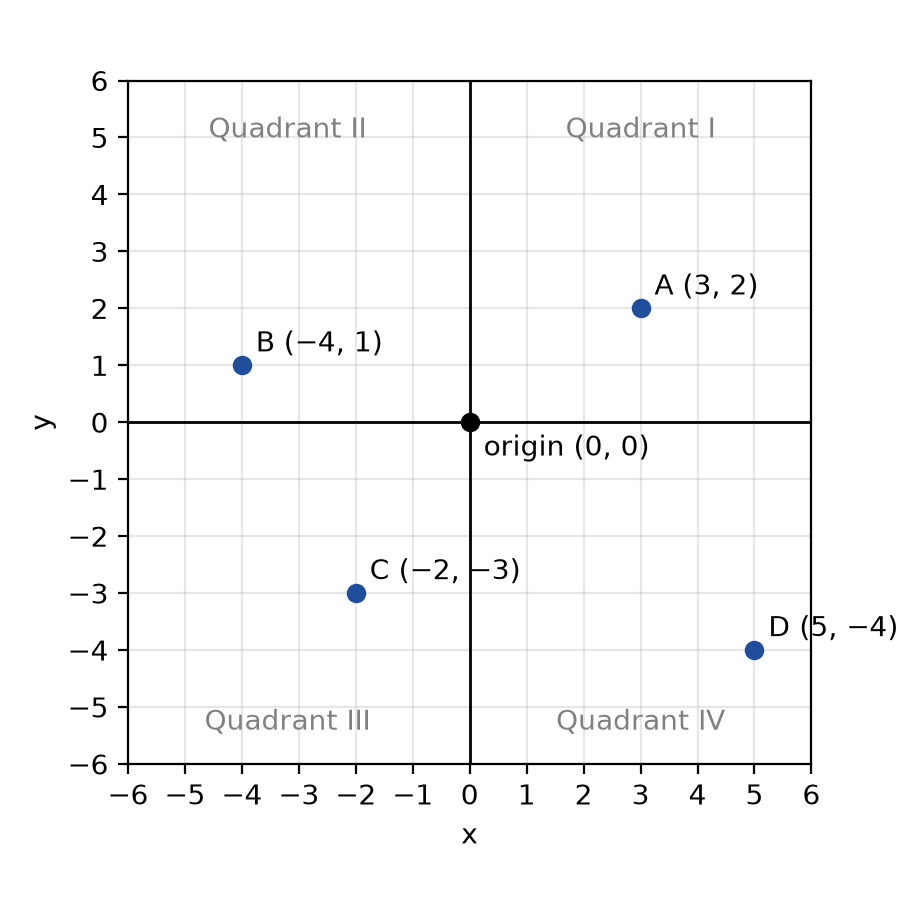
Worked Example 10.1 · Plotting and naming points
Plot the points P(−3, 4) and Q(4, −3), and name the quadrant of each.
Step 1: For P, start at the origin. Move 3 units left, because x = −3. Then move 4 units up, because y = 4. Mark P.
Step 2: For Q, move 4 units right, then 3 units down. Mark Q.
Step 3: P has negative x and positive y, so it is in Quadrant II. Q has positive x and negative y, so it is in Quadrant IV.
Check: P and Q use the same two numbers in opposite order, and they land in different quadrants. This shows that order matters. ✓
In words: P is 3 left and 4 up; Q is 4 right and 3 down.
Where negatives show up in real graphs. If the x-axis shows days relative to a deadline, −2 means two days before it. If the y-axis shows a bank balance, −40 means an overdraft of $40. If it shows a temperature, −5 means 5 degrees below zero. Many real situations live only in Quadrant I, because time, distance, and amounts of water are never negative. That will matter when we decide what part of a graph makes sense.
Check yourself 10.1 (a) Which quadrant is (−7, −1) in? (b) Where is (0, −5)? (c) Starting at (2, 3), you move 5 left and 4 down. Where do you end up? Answer: (a) Quadrant III (b) on the y-axis, 5 below the origin (c) (−3, −1).
Good stopping point.
10.2 From a table to a graph
Each column of a table of values is one ordered pair. In the rain-barrel table, the input is time t and the output is volume V. We put the input on the horizontal axis and the output on the vertical axis, so each column (t, V) becomes a point.
Worked Example 10.2 · Graphing the rain barrel
The barrel starts with 40 gallons and loses 5 gallons per hour, so V = 40 − 5t. Graph it from t = 0 to the moment it is empty.
Step 1 · Find when it is empty. Set V = 0: 40 − 5t = 0, so 5t = 40 and t = 8. The barrel empties after 8 hours.
Step 2 · Make a table.
| t (hours) | 0 | 1 | 2 | 3 | 4 | 5 | 6 | 7 | 8 |
|---|---|---|---|---|---|---|---|---|---|
| V (gallons) | 40 | 35 | 30 | 25 | 20 | 15 | 10 | 5 | 0 |
Step 3 · Choose the axes. Horizontal: time from 0 to 9 hours, 1 hour per grid line. Vertical: gallons from 0 to 45, 5 gallons per grid line. Label both axes, with units.
Step 4 · Plot the points (0, 40), (1, 35), …, (8, 0).
Step 5 · Decide whether to join them. Water drains continuously, so there is a volume at every moment, including t = 2.5. The points lie in a straight line, so we join them with a straight line from (0, 40) to (8, 0). We stop at t = 8, because the barrel can’t hold negative water.
Check: At t = 2.5, the line should give V = 40 − 5 × 2.5 = 27.5 gallons, halfway between 30 and 25. ✓
In words: the barrel loses water at a steady rate, so its graph is a straight line falling from 40 gallons to empty at 8 hours.
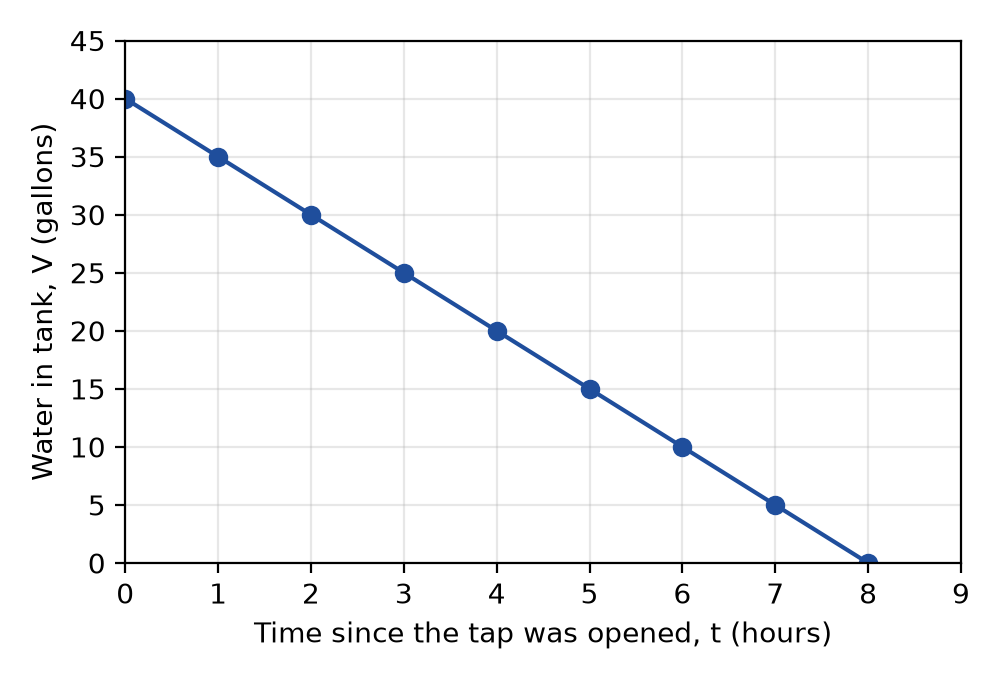
Join the dots, or not? The question is whether the in-between values make sense.
- Continuous quantities (time, distance, volume, temperature) have values between the table entries. Join the points.
- Discrete quantities (people, tickets, cars) come in whole numbers. There is no such thing as 2.5 tickets. Plot dots only, or draw a light dashed line just to show the pattern and say that only the whole-number points count.
For example, if movie tickets cost $14 each, the cost of n tickets is 14n. The points (0, 0), (1, 14), (2, 28), (3, 42) line up, but the point (2.5, 35) means nothing, so the honest graph is a row of dots.
A link to U01. In U01 Chapter 6 you made ratio tables, where the output is always the same multiple of the input. The ticket table is one of those: every cost is 14 times the number of tickets. On a graph, a ratio table always gives points on a straight line through the origin. The rain barrel doesn’t go through the origin, so it isn’t proportional. It starts at 40, not at 0. Chapter 11 measures both kinds of line.
Check yourself 10.2 A phone plan charges $30 plus $10 per gigabyte. Make a table for 0 to 4 gigabytes, list the points, and say whether to join them if data is billed (a) by the exact amount used, (b) only in whole gigabytes. Answer: (0, 30), (1, 40), (2, 50), (3, 60), (4, 70). (a) Join them, since 2.5 GB costs $55. (b) Dots only.
Good stopping point.
10.3 Reading a graph in both directions
A graph lets you answer two kinds of question:
- Input to output: “How much does a 4-mile ride cost?” Find 4 on the horizontal axis, go straight up to the line, then go straight across to the vertical axis and read the value.
- Output to input: “How far can I go for $26?” Find 26 on the vertical axis, go straight across to the line, then go straight down and read the horizontal axis.
Going backward on a graph is solving an equation by eye. Chapter 6 solved the same question with algebra, and the two should agree.
Worked Example 10.3 · Reading a taxi-fare graph
Chapter 3 described a taxi fare of $3.50 plus $2.25 per mile, F = 3.50 + 2.25m. Figure 10.3 shows its graph.
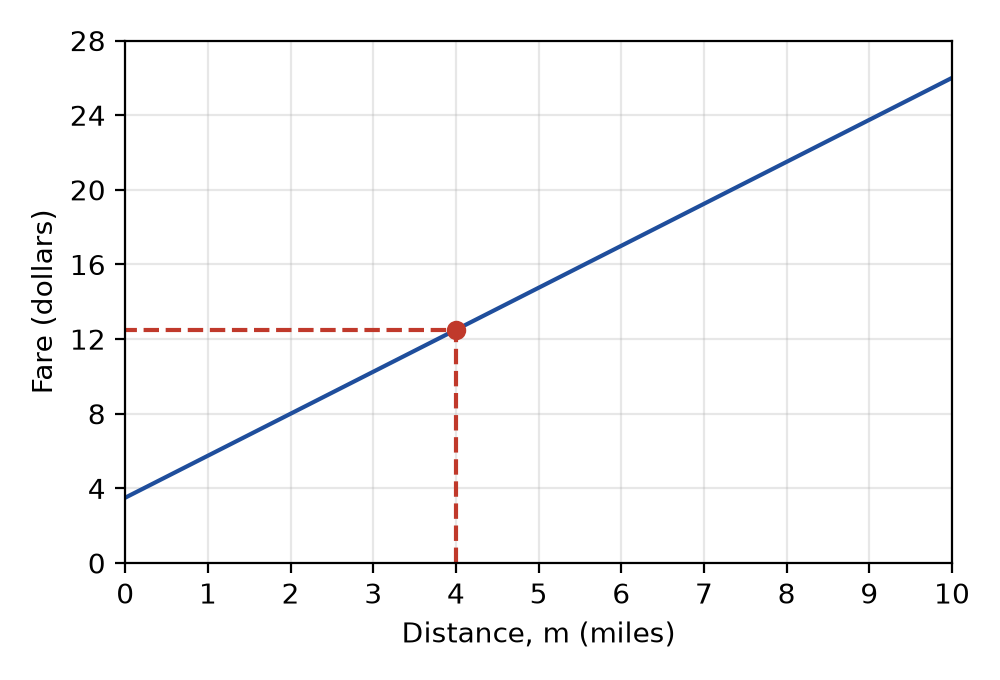
(a) Read the fare for a 4-mile ride.
Step 1: Find 4 on the distance axis.
Step 2: Go up to the line, then across to the fare axis. The dashed path lands at about $12.50.
Check: 3.50 + 2.25 × 4 = 3.50 + 9.00 = 12.50. ✓
(b) About how far can you ride for $26?
Step 1: Find 26 on the fare axis and go across to the line.
Step 2: Go down to the distance axis. The line reaches $26 at the right-hand edge, at about 10 miles.
Check by algebra: 3.50 + 2.25m = 26, so 2.25m = 22.50 and m = 10. ✓
In words: a 4-mile ride costs about $12.50, and $26 pays for about 10 miles.
How precise is a graph? A graph is only as precise as your eye and the grid. On this graph, with fare grid lines every $4, you could read $12.50 as “a bit over 12.” That is fine for a quick answer. When you need the exact cent, use the formula. A good habit is to read from the graph, then check with the formula. The graph protects you from wild algebra mistakes, and the formula gives you precision.
Reading between and beyond. Reading a value between two plotted points is called interpolation. Reading a value beyond the last point is called extrapolation. Interpolation is usually safe when the pattern is steady. Extrapolation is riskier, because the pattern may change outside the range you observed. Chapter 13 returns to this, because it is one of the most important ideas in modeling.
Check yourself 10.3 Use Figure 10.2. (a) About how much water is left after 3 hours? (b) About when does 10 gallons remain? Check both with V = 40 − 5t. Answer: (a) 25 gallons: 40 − 15 = 25. ✓ (b) After 6 hours: 40 − 5t = 10 gives t = 6. ✓
Good stopping point.
10.4 Axes, scales, and honest graphs
A graph communicates only if the reader can tell what it shows. Every graph you draw should have:
- A title, or a caption, that says what is being compared.
- Axis labels with units: “Distance, m (miles),” not just “m.”
- A scale with evenly spaced grid lines. Each grid line must stand for the same amount along an axis, such as $4 per line. The two axes can use different scales.
- A sensible range that includes all the data and, usually, zero.
Worked Example 10.4 · Choosing a scale
You want to graph a savings plan: $150 to start, plus $65 a week, for 10 weeks. Choose the scales.
Step 1 · Find the largest values. Weeks go from 0 to 10. Savings go from $150 to 150 + 65 × 10 = 800 dollars.
Step 2 · Count the grid. Suppose your paper has about 10 grid lines up and 10 across.
Step 3 · Choose friendly steps. Across: 1 week per line covers 0 to 10. Up: $800 ÷ 10 lines = $80 per line, which is awkward, so round up to a friendly $100 per line. That covers $0 to $1,000.
Check: the largest value, $800, fits under the top line of $1,000, and the axis starts at $0. ✓
In words: use 1 week and $100 per grid line, with both axes starting at zero.
The truncated axis. U01 Chapter 11 warned about charts whose vertical axis doesn’t start at zero. Figure 10.4 shows two bar charts of the same two monthly costs, $50 and $52.
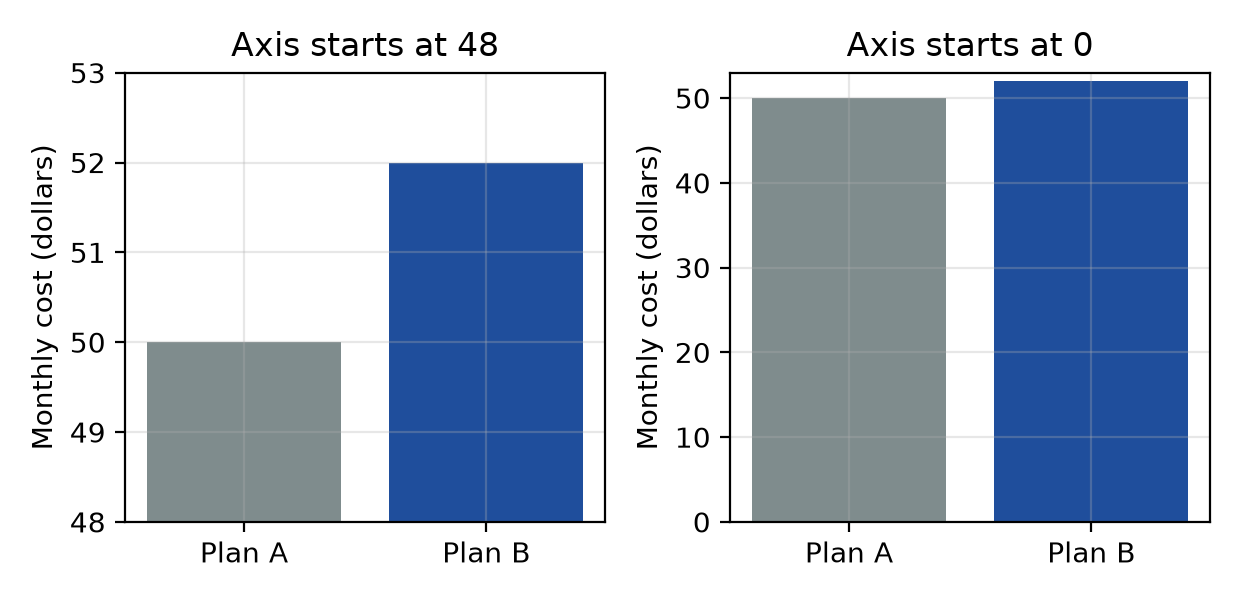
On the left, Plan B’s bar looks twice as tall as Plan A’s, because the bars start at 48: their visible heights are 2 and 4. On the right, the bars are almost equal, which is the truth. Plan B costs $2 more, which is 4% more (U01 Chapter 8).
A truncated axis isn’t always dishonest. For a line graph of a weekly body temperature, starting at 0 °F would squash every reading into a flat line. The rule is to make it obvious. Label the starting value clearly, mark a break in the axis, and never use bar heights to compare amounts when the bars don’t start at zero.
Same data, different stretch. Even with zero included, stretching an axis changes the impression. A line drawn on a tall, narrow grid looks steep, and the same line on a wide, short grid looks gentle. Before you react to how steep a graph looks, read the numbers on the axes. Chapter 11 turns steepness into a number, the slope, so you don’t have to rely on looks.
Check yourself 10.4 A chart shows two rents, $1,450 and $1,500, as bars on an axis starting at $1,400. (a) How many times as tall does the second bar look? (b) By what percent is the second rent actually higher, to one decimal place? Answer: (a) Visible heights 50 and 100, so twice as tall. (b) 50 ÷ 1,450 ≈ 3.4%.
Good stopping point.
10.5 Linear and nonlinear patterns
The rain barrel, the taxi, and the phone plan all gave straight lines. Not every relationship does. You can tell from a table, before you draw anything.
The difference test. When the inputs go up in equal steps, look at how the outputs change.
- If the outputs change by the same amount each step, the pattern is linear: its graph is a straight line.
- If the changes themselves change, the pattern is nonlinear: its graph curves.
Worked Example 10.5 · Linear or not?
Test each table.
Table A · Rain barrel.
| t | 0 | 1 | 2 | 3 | 4 |
|---|---|---|---|---|---|
| V | 40 | 35 | 30 | 25 | 20 |
Step 1: Differences: 35 − 40 = −5, then −5, −5, −5.
Step 2: All equal, so the pattern is linear.
Table B · Area of a square tile with side s inches.
| s (in) | 1 | 2 | 3 | 4 | 5 |
|---|---|---|---|---|---|
| A = s² (sq in) | 1 | 4 | 9 | 16 | 25 |
Step 1: Differences: 3, 5, 7, 9.
Step 2: They grow, so the pattern is nonlinear. The graph curves upward more and more steeply.
Table C · A savings account that grows by 10% a year (U01 Chapter 10), starting at $1,000.
| Year | 0 | 1 | 2 | 3 |
|---|---|---|---|---|
| Balance ($) | 1,000 | 1,100 | 1,210 | 1,331 |
Step 1: Differences: 100, 110, 121.
Step 2: They grow, so it is nonlinear, even though the percent change is the same each year.
Check: a steady amount per step gives a line, while a steady percent per step gives a curve. ✓
In words: only Table A is linear.
Uneven steps. The difference test needs equal steps in the input. If a table jumps from x = 1 to x = 3 to x = 4, compare the change in output per unit of input instead: divide each change in output by the matching change in input. If that ratio is always the same, the pattern is linear. That ratio has a name, the slope, and it is the subject of Chapter 11.
Why linear patterns matter. Linear patterns are the simplest to describe, predict, and solve, and many everyday relationships are close to linear over a sensible range, such as hourly pay, fares, fees, and steady draining. Much of the rest of this book is about linear relationships, but always with the question “Is linear a reasonable description here?”
Check yourself 10.5 Is each table linear? (a) x: 0, 1, 2, 3; y: 7, 10, 13, 16. (b) x: 0, 1, 2, 3; y: 2, 4, 8, 16. (c) x: 0, 2, 4, 6; y: 5, 9, 13, 17. Answer: (a) Yes, +3 each step. (b) No: +2, +4, +8. (c) Yes, +4 per step of 2, which is +2 per unit.
Good stopping point.
Practical activity · Graph something in your own life
Time: 25 minutes. Materials: graph paper or a hand-drawn grid, a ruler, and a pencil.
- Pick a steady process you know the numbers for: a phone plan, an hourly wage, a monthly subscription that adds up, a car’s fuel tank emptying on a trip, or a savings goal.
- Define the input and output with units, as in Chapter 3. For example, “h = hours worked; P = pay in dollars.”
- Make a table of at least five values.
- Use the difference test. Is the pattern linear?
- Choose scales as in Worked Example 10.4, label both axes with units, and plot the points.
- Decide whether to join the points, and write one sentence explaining why.
- Read one value between your points from the graph, then check it with arithmetic.
- Write a caption: what the graph shows, and one thing a reader can learn from it at a glance.
Common mistakes
- Swapping the coordinates. (3, 5) means 3 across, then 5 up. “Along the hall, then up the stairs” is a common memory aid.
- Uneven scales. Spacing 0, 5, 10, 20, 50 evenly on an axis bends a straight line. Each grid line must stand for the same amount.
- Missing units. An axis labeled only “t” leaves the reader guessing whether it is hours, minutes, or days.
- Joining discrete points. A solid line through ticket counts suggests that 2.5 tickets exist. Use dots.
- Reading the wrong axis. When going from output to input, start on the vertical axis.
- Trusting the look. A steep-looking line or a towering bar may be a trick of the scale. Read the numbers on the axes before judging.
Going further (optional) · Graphs that aren’t from formulas
Not every graph comes from an equation. Data you collect, such as a child’s height each birthday or a monthly electricity bill, gives a scatter of points that don’t sit exactly on any line. You can still ask whether the points roughly follow a straight line, whether the trend goes up or down, and whether any point stands far from the rest. A point far from the pattern is called an outlier. It might be a recording error, or a genuinely unusual month, such as a heat wave. Chapter 13 draws a line through data like this and asks how far to trust it, and U04 Statistics: Samples, Center, and Spread develops the full method, called linear regression.
Summary
- The coordinate plane has an x-axis and a y-axis crossing at the origin, (0, 0). Each point is an ordered pair (x, y): across first, then up or down.
- The four quadrants are numbered counterclockwise from the top right. Their signs are (+, +), (−, +), (−, −), (+, −).
- To graph a table, put the input on the horizontal axis and the output on the vertical axis. Join the points only if in-between values make sense.
- Read a graph from input to output, or from output to input. Check readings with the formula.
- Label axes with units, use even scales, and treat truncated axes with suspicion.
- Equal changes in output for equal steps of input mean a linear pattern and a straight-line graph.
Key terms: coordinate plane · x-axis · y-axis · origin · ordered pair · x-coordinate · y-coordinate · quadrant · continuous · discrete · interpolation · extrapolation · truncated axis · nonlinear
Review questions
Questions 1 to 6 practice single skills. Questions 7 to 9 combine them.
- Name the quadrant or axis for each point: (a) (4, −6) (b) (−1, 8) (c) (0, 0) (d) (−5, 0).
- Starting at (−2, 5), you move 6 right and 9 down. Where do you end up?
- A gym charges a $25 joining fee plus $30 per month. Make a table for 0 to 4 months and say whether the pattern is linear.
- Is this table linear? x: 1, 2, 3, 4; y: 3, 6, 12, 24. Explain.
- A delivery fee is $5 for each order. Should the graph of total fees against number of orders be a line or a row of dots? Why?
- A student plots (2, 7) by going up 2 and right 7. What point did she actually plot?
- A candle is 12 inches tall and burns down 1.5 inches per hour. (a) Write a formula for its height h after t hours. (b) When does it burn out? (c) Read or calculate the height after 3.5 hours. (d) What part of the line makes sense to draw?
- A news graphic compares two cities’ average commute times, 26 minutes and 29 minutes, using bars on an axis that starts at 25 minutes. Explain what a reader might wrongly conclude, and give the honest comparison as a difference and a percent, to one decimal place.
- You want to graph a car’s fuel tank: 14 gallons at the start, using 0.04 gallons per mile, until the tank is empty. (a) How far can the car go? (b) Choose scales for a 10-by-10 grid. (c) What is the fuel level after 200 miles?
Explained answers
1. (a) Quadrant IV (b) Quadrant II (c) the origin (d) on the x-axis.
2. −2 + 6 = 4 and 5 − 9 = −4, so (4, −4).
3. Months 0 to 4: $25, $55, $85, $115, $145. The differences are all +30, so linear.
4. No. The differences are 3, 6, and 12, and they aren’t equal. Each output doubles, which is a nonlinear pattern.
5. Dots. Orders come in whole numbers, so only (0, 0), (1, 5), (2, 10), and so on mean anything.
6. She plotted (7, 2): 7 across and 2 up. The point (2, 7) is 2 across and 7 up.
7. (a) h = 12 − 1.5t. (b) 12 − 1.5t = 0 gives t = 8 hours. (c) 12 − 1.5 × 3.5 = 12 − 5.25 = 6.75 inches. (d) From t = 0 to t = 8 only, because the height can’t be negative.
8. The visible bar heights are 1 and 4, so the second bar looks 4 times as tall, as though one commute were four times as long. In fact, the second city’s commute is 3 minutes longer, which is 3 ÷ 26 ≈ 11.5% longer.
9. (a) 14 − 0.04d = 0 gives d = 14 ÷ 0.04 = 350 miles. (b) Across: 350 ÷ 10 = 35 miles per line, so round up to 40 miles per line, covering 0 to 400. Up: 14 ÷ 10 = 1.4 gallons per line, so round up to 2 gallons per line, covering 0 to 20. (c) 14 − 0.04 × 200 = 14 − 8 = 6 gallons.
Connections
- Chapter 2 (the number line) becomes the two axes. Chapter 4 (tables of values) supplies the points.
- U01 Chapter 6 (ratio tables) gives straight lines through the origin, and U01 Chapter 11 (misleading numbers) warned about truncated axes.
- U01 Chapter 10 (successive percentage changes) produced the nonlinear savings table.
- Chapter 11 measures how steep a line is, and Chapter 13 asks when extrapolation is safe.
- Other MORI books: U03 Geometry: Measure, Diagonals, and Scale uses the coordinate plane for shapes, U04 Statistics: Samples, Center, and Spread builds scatter plots and regression lines, and U12 Data Analysis: Tables, Missing Values, and Honest Charts turns graphs into reports.
Sources consulted for scope and accuracy: OpenStax, Elementary Algebra 2e (Section 4.1, “Use the Rectangular Coordinate System”), https://openstax.org/details/books/elementary-algebra-2e, CC BY 4.0; Common Core State Standards, 5.G.A.1–2 and 6.NS.C.6–8, https://www.thecorestandards.org/Math/Content/6/NS/. All examples, exercises, and figures are original to MORI University. Prices, fares, volumes, and commute times are illustrative.
Chapter 11 · Slope and Intercept, with Units
U02 Algebra: Expressions, Equations, and Models · MORI University · Foundation level
Time needed: about 110 minutes in total, in six short sections. Each section ends at a good place to stop. You need: a pencil, a calculator, a ruler, and graph paper.
Learning goals
By the end of this chapter, you will be able to:
- Calculate the rate of change between two points, and the slope of a line, with units.
- Explain slope as a unit rate, building on U01 Chapter 5, and say what it means in a sentence.
- Find and interpret the intercept of a line as a starting value, and say when it doesn’t make sense.
- Read, write, and graph a line in slope-intercept form, y = mx + b.
- Recognize positive, negative, and zero slopes, and write the equation of a line through two given points.
Start here
Two taxi companies post their fares. One charges $3.50 plus $2.25 per mile. The other only shows a graph. Which is cheaper for your trip?
To compare them, you need two numbers for each company: what you pay before you move at all, and what each extra mile adds. On a graph, these two numbers are the line’s intercept and its slope. Every straight-line graph is described completely by these two numbers, and each one has units and a meaning in words.
Chapter 10 showed that a straight line means equal changes for equal steps. This chapter measures those changes. The skill you’ll practice most is not the calculation, which is a subtraction and a division, but the sentence afterward: “Each extra mile adds $2.25 to the fare.”
11.1 Rate of change between two points
Figure 11.1 shows the taxi fare F = 3.50 + 2.25m from Chapter 10, with two points marked: a 2-mile ride costs $8.00, and a 6-mile ride costs $17.00.
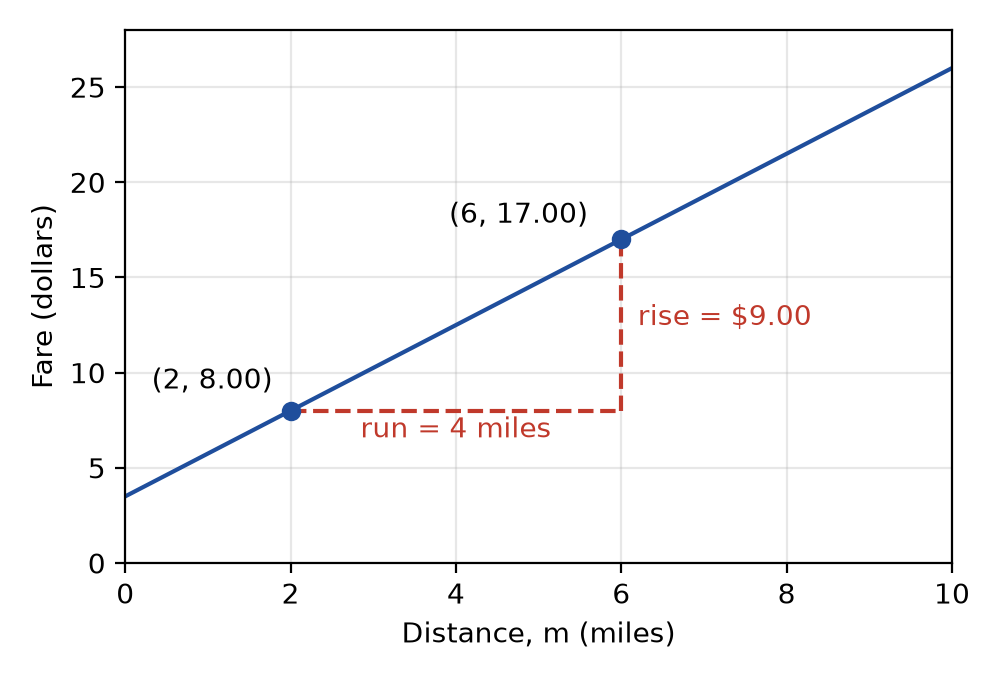
Going from the first point to the second:
- the distance increases by 6 − 2 = 4 miles. On a graph, this horizontal change is called the run;
- the fare increases by 17.00 − 8.00 = 9.00 dollars. This vertical change is called the rise.
The rate of change is the change in output divided by the change in input:
Worked Example 11.1 · The rain barrel’s rate
From Chapter 10, the rain barrel holds 35 gallons after 1 hour and 15 gallons after 5 hours. Find the rate of change.
Step 1 · Change in input: 5 − 1 = 4 hours.
Step 2 · Change in output: 15 − 35 = −20 gallons. It’s negative, because the water went down.
Step 3 · Divide: (−20 gallons)/(4 hours) = −5 gallons per hour.
Check: the barrel was described as losing 5 gallons per hour. ✓
In words: the barrel’s volume changes by −5 gallons each hour; that is, it loses 5 gallons an hour.
Always subtract in the same order. Take “second minus first” for both changes, or “first minus second” for both. Mixing the order flips the sign and gives a wrong answer. Done consistently, either order gives the same result: (35 − 15)/(1 − 5) = 20/−4 = −5. ✓
Check yourself 11.1 A hiker is at an elevation of 1,200 feet after 1 hour and 3,000 feet after 4 hours. Find the rate of change, with units. Answer: (3,000 − 1,200)/(4 − 1) = 1,800/3 = 600 feet per hour.
Good stopping point.
11.2 Slope as a unit rate
For a straight line, the rate of change is the same between any two points. This constant rate is the line’s slope, written m. Given two points (x₁, y₁) and (x₂, y₂), with x₁ ≠ x₂:
The small numbers below the letters are subscripts. They are labels, not exponents: x₁ means “the x-coordinate of the first point.”
Slope is a unit rate. In U01 Chapter 5, a unit rate was “how much per one,” such as dollars per pound or miles per gallon. Slope is exactly that: how much the output changes per one unit of input. So its units are output units per input unit.
| Situation | Output | Input | Slope units |
|---|---|---|---|
| Taxi | dollars | miles | dollars per mile |
| Rain barrel | gallons | hours | gallons per hour |
| Hike | feet | hours | feet per hour |
| Wage | dollars | hours | dollars per hour |
| Car fuel | gallons | miles | gallons per mile |
Worked Example 11.2 · Any two points give the same slope
Check that the taxi line has the same slope using (0, 3.50) and (10, 26.00).
Step 1: m = (26.00 − 3.50)/(10 − 0) = 22.50/10.
Step 2: m = 2.25 dollars per mile.
Check: the same as the slope from (2, 8.00) and (6, 17.00). ✓
In words: however far you ride, each extra mile adds $2.25.
Slope as steepness, honestly. A larger slope means a steeper line when both graphs use the same scales. As Chapter 10 warned, stretching an axis changes how steep a line looks, but not its slope. The number is reliable even when the picture isn’t.
Interpreting slope: the sentence pattern. A good interpretation names the input step, the output change, and both units:
“Each additional [one input unit] [increases/decreases] [the output] by [slope] [output units].”
For example: “Each additional hour of draining decreases the water in the barrel by 5 gallons.” Avoid “the slope is 2.25” on its own. That is a calculation, not an interpretation.
Check yourself 11.2 A plumber’s bills are $161 for 2 hours and $257 for 4 hours. (a) Find the slope with units. (b) Interpret it in a sentence. Answer: (a) (257 − 161)/(4 − 2) = 96/2 = 48 dollars per hour. (b) Each additional hour of work adds $48 to the bill.
Good stopping point.
11.3 The intercept as a starting value
The vertical intercept, often just called the intercept and written b, is the output when the input is zero. On the graph, it’s where the line crosses the vertical axis, at the point (0, b).
In context, the intercept is usually a starting value: the amount before anything happens.
| Situation | Intercept | Meaning |
|---|---|---|
| Taxi, F = 3.50 + 2.25m | 3.50 dollars | the charge for getting in, before any miles |
| Rain barrel, V = 40 − 5t | 40 gallons | the water in the barrel when the tap opens |
| Plumber, C = 65 + 48h | 65 dollars | the call-out fee, before any hours of work |
Finding the intercept from a point and the slope. The plumber in Check yourself 11.2 charged $161 for 2 hours, at $48 per hour. Two hours of work cost 2 × 48 = 96 dollars, so the rest is the starting fee: 161 − 96 = 65 dollars. That matches the plumber’s formula from Chapter 3.
The point where a line crosses the horizontal axis is also useful. It’s the horizontal intercept, the input that makes the output zero. For the rain barrel, setting V = 0 gave t = 8 hours: the moment it’s empty. Chapter 6’s equation-solving finds horizontal intercepts.
Worked Example 11.3 · When the intercept doesn’t make sense
A rough rule for a teenage growth spurt (illustrative) says height in inches is H = 2.5a + 25, where a is age in years, for ages 11 to 15. Interpret the slope and intercept.
Step 1 · Slope: 2.5 inches per year. Over these ages, each additional year adds about 2.5 inches of height.
Step 2 · Intercept: H = 25 inches at age 0.
Step 3 · Is that sensible? A newborn is around 20 inches long, and children don’t grow at a steady rate from birth. The rule was only meant for ages 11 to 15. Age 0 is far outside that range.
Check: at age 13, H = 2.5 × 13 + 25 = 57.5 inches, about 4 ft 9.5 in, a plausible height for a 13-year-old. ✓
In words: the slope has a useful meaning within the ages the rule covers, but the intercept is just a number that positions the line. It isn’t a newborn’s length.
The lesson: always ask whether input zero is inside the range where the formula applies. If not, the intercept is a mathematical anchor, not a fact about the world. Chapter 13 calls this range the valid range of a model.
Check yourself 11.3 A streaming bill is $24 for 2 months and $48 for 4 months. (a) Find the slope and intercept. (b) Interpret the intercept. Answer: (a) Slope 24 ÷ 2 = 12 dollars per month, and intercept 24 − 2 × 12 = 0. (b) There’s no joining fee: zero months cost $0. This is a proportional relationship (U01 Chapter 6).
Good stopping point.
11.4 Slope-intercept form: y = mx + b
A line with slope m and intercept b has the equation
This is slope-intercept form. You have used it all along:
- taxi: F = 2.25m + 3.50, so the slope is 2.25 and the intercept is 3.50 (here the letter m is miles, not the slope, which shows why we define variables carefully);
- barrel: V = −5t + 40, so the slope is −5 and the intercept is 40.
Order doesn’t matter. y = b + mx is the same line, by the commutative property from Chapter 5. The coefficient of the input is the slope, and the constant term is the intercept.
Worked Example 11.4 · Graphing from m and b
Graph the savings plan S = 65w + 150: $150 to start, plus $65 a week.
Step 1 · Plot the intercept: (0, 150).
Step 2 · Use the slope as rise over run: 65 up for every 1 across. To get a clearer point, take 4 weeks at a time: 4 across and 4 × 65 = 260 up. That gives (4, 410).
Step 3 · Draw the line through (0, 150) and (4, 410), from w = 0 onward.
Check: 65 × 4 + 150 = 410. ✓
In words: savings start at $150 and grow by $65 each week.
Worked Example 11.5 · Rewriting into slope-intercept form
A fundraiser’s income and costs satisfy 2y − 6x = 10. Find the slope and intercept.
Step 1 · Get y alone (Chapter 8). Add 6x to both sides: 2y = 6x + 10.
Step 2 · Divide both sides by 2: y = 3x + 5.
Step 3 · Read off: slope 3, intercept 5.
Check: x = 1 gives y = 8, and 2 × 8 − 6 × 1 = 10. ✓
In words: the equation describes a line that crosses the vertical axis at 5 and rises 3 for every 1 across.
Comparing two lines. Back to the taxi question. Company B’s graph passes through (0, 5.00) and (4, 11.00), so its slope is (11 − 5) ÷ 4 = 1.50 dollars per mile and its intercept is $5.00. Company A starts cheaper ($3.50 vs $5.00) but adds more per mile ($2.25 vs $1.50). Which is cheaper depends on distance. Chapter 12 finds the distance where they cost the same.
Check yourself 11.4 Find the slope and intercept: (a) y = −4x + 9 (b) C = 12 + 0.5k (c) 3y = 12x − 6. Answer: (a) slope −4, intercept 9 (b) slope 0.5, intercept 12 (c) y = 4x − 2: slope 4, intercept −2.
Good stopping point.
11.5 Negative, zero, and undefined slopes
The sign of the slope tells you the direction:
- Positive slope: the line rises from left to right, so the output increases as the input increases. Examples: a fare, a wage, savings.
- Negative slope: the line falls from left to right, so the output decreases as the input increases. Examples: a draining barrel, a phone battery, a loan being paid off.
- Zero slope: the line is flat, so the output doesn’t change. Example: a streaming subscription at $12 a month, however many hours you watch. Cost against hours watched is y = 12.
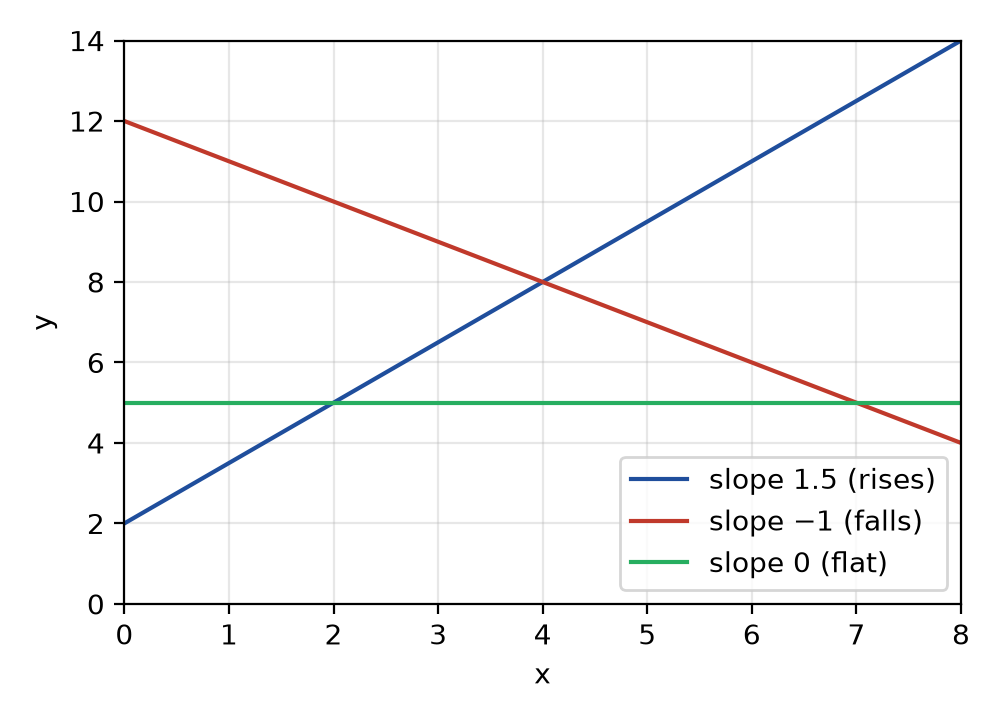
Vertical lines. A vertical line, such as x = 3, has every point with the same input. The run between any two points is 0, and division by zero is undefined (Chapter 1). So a vertical line has an undefined slope. In real situations, a vertical line would mean many outputs for one input, such as many prices at the same instant. It rarely appears in models.
Worked Example 11.6 · A loan balance
You owe $1,800 on a laptop and pay $150 a month, with no interest (illustrative). Write the balance as a line and interpret.
Step 1 · Intercept: at month 0, you owe $1,800.
Step 2 · Slope: the balance changes by −150 dollars per month.
Step 3 · Equation: B = 1,800 − 150n, where n is the number of months.
Step 4 · Horizontal intercept: 1,800 − 150n = 0, so n = 12.
Check: after 12 payments, 150 × 12 = 1,800 has been paid. ✓
In words: the balance falls by $150 each month and reaches zero after 12 months.
Negative slope isn’t “bad.” A negative slope just means the output goes down. For a debt or a waiting list, that’s good news. Interpret the sign in context.
Check yourself 11.5 Give the sign of the slope: (a) the distance left on a trip as you drive (b) the total cost as you buy more pizzas (c) the number of days in a week as the year goes on. Answer: (a) negative (b) positive (c) zero: always 7.
Good stopping point.
11.6 Writing a line from two points
Often you don’t get the formula, only two observations. For a straight-line relationship, two points are enough to find the whole line.
The method:
- Find the slope from the two points.
- Use one point to find the intercept: b = y − mx.
- Write y = mx + b, with defined variables and units.
- Check with the other point.
Worked Example 11.7 · A water bill
A household’s water bill (illustrative) was $38.50 in a month when it used 3 thousand gallons, and $62.50 in a month when it used 7 thousand gallons. Assume the bill is a fixed charge plus a price per thousand gallons. Find the formula.
Step 1 · Define the variables. Let g be water used, in thousands of gallons, and C the bill in dollars.
Step 2 · Slope: m = (62.50 − 38.50)/(7 − 3) = 24.00/4 = 6.00 dollars per thousand gallons.
Step 3 · Intercept: b = 38.50 − 6.00 × 3 = 38.50 − 18.00 = 20.50 dollars.
Step 4 · Equation: C = 20.50 + 6.00g.
Check with the other point: 20.50 + 6.00 × 7 = 20.50 + 42.00 = 62.50. ✓
In words: the water company charges a fixed $20.50 a month, plus $6.00 for each thousand gallons used.
Use it: a month with 5 thousand gallons would cost 20.50 + 30.00 = 50.50 dollars, if the assumption of a fixed charge plus a steady price holds. Many real utilities charge different prices for different amounts of use (called tiers). Then a single line fits only within one tier. Asking “does the assumption hold?” is the start of modeling, which is Chapter 13’s subject.
A shortcut form (optional). Some books write a line through (x₁, y₁) with slope m as y − y₁ = m(x − x₁). Expanding it (Chapter 5) gives the same slope-intercept form, so use whichever you find clearer.
Check yourself 11.6 A printing shop (illustrative) charges $47 for 100 flyers and $77 for 300 flyers. Find the formula for the cost C of n flyers, and interpret both numbers. Answer: m = 30 ÷ 200 = 0.15 dollars per flyer; b = 47 − 15 = 32. So C = 32 + 0.15n: a $32 setup charge, plus 15 cents a flyer. Check: 32 + 45 = 77. ✓
Good stopping point.
Practical activity · Find the line hidden in a bill
Time: 25 minutes. Materials: two bills or receipts for the same service with different amounts used (or the illustrative ones below), a calculator, and graph paper.
- Find two bills where only the amount used differs, such as two phone, parking, water, or ride receipts. If you have none, use: 45 minutes of parking for $7.25, and 120 minutes for $14.00.
- Define the input and output with units.
- Calculate the slope, and write it as a unit rate in a sentence.
- Calculate the intercept, and say what it would mean. Is it a fixed fee, or is it meaningless?
- Write the equation in slope-intercept form.
- If you have a third bill, test the formula. Is it exact, close, or far off? What might explain a difference: taxes, minimum charges, or tiers?
- Graph the line, marking the intercept and a slope triangle.
(For the illustrative parking: slope 6.75 ÷ 75 = 0.09 dollars per minute, intercept 7.25 − 4.05 = 3.20 dollars.)
Common mistakes
- Run over rise. Slope is output change over input change. Dividing the other way gives miles per dollar, not dollars per mile.
- Mixed subtraction order. Subtract in the same order on top and bottom.
- Slope without units. “The slope is 6” says nothing. Six dollars per thousand gallons says everything.
- Reading b from the wrong place. In y = 3x + 5, the intercept is 5, not 3. In y = 5 − 3x, the slope is −3, not 3.
- Trusting every intercept. If zero input is outside the range where the formula applies, don’t interpret the intercept as a fact.
- Skipping the second-point check. Always test the finished equation with the point you didn’t use for the intercept.
Going further (optional) · Slope in the built world
Engineers use slope every day, often as a percent. A road grade of 6% means the road rises 6 feet for every 100 feet of horizontal distance: a slope of 0.06, with no units, because both distances use feet. Accessibility rules in the United States set a maximum slope for wheelchair ramps of 1:12, which is 1 inch of rise for every 12 inches of run, or about 8.3% (US Access Board, ADA Standards for Accessible Design, 2010, Section 405.2). A roof’s pitch, such as “6 in 12,” is the same idea. Each of these is rise over run, the same quantity you’ve calculated in this chapter.
Summary
- The rate of change between two points is the change in output divided by the change in input: rise over run.
- For a straight line, this rate is the same everywhere. It’s the slope, m = (y₂ − y₁)/(x₂ − x₁), measured in output units per input unit.
- The intercept b is the output when the input is 0, usually a starting value. Check whether zero input makes sense before interpreting it.
- Slope-intercept form, y = mx + b, shows both numbers at once.
- Positive slopes rise, negative slopes fall, zero slopes are flat, and vertical lines have undefined slope.
- Two points determine a line: find the slope, then the intercept, then check with the other point.
Key terms: rise · run · rate of change · slope · subscript · vertical intercept · intercept · starting value · horizontal intercept · slope-intercept form · undefined slope · grade
Review questions
Questions 1 to 6 practice single skills. Questions 7 to 9 combine them.
- Find the slope through (1, 4) and (5, 16).
- Find the slope through (−2, 7) and (3, −8).
- Give the slope and intercept of y = 7 − 2x.
- Rewrite 4y + 8x = 20 in slope-intercept form.
- A car has 52 liters of fuel after 100 km and 40 liters after 250 km. Find the slope with units and interpret it.
- A student computes the slope through (2, 10) and (6, 30) as (6 − 2)/(30 − 10) = 0.2. What went wrong, and what is the correct slope?
- A moving van rental (illustrative) costs $79.90 for 40 miles and $103.90 for 100 miles. (a) Find the formula. (b) Interpret the slope and intercept. (c) What would 160 miles cost?
- A candle is 18 cm tall after 2 hours of burning and 12 cm after 5 hours. (a) Find the equation of height against time. (b) How tall was it at the start? (c) When does it burn out?
- Gym A charges $40 to join plus $25 a month. Gym B has no joining fee and charges $30 a month. (a) Write both in slope-intercept form. (b) Which line is steeper, and what does that mean? (c) Which is cheaper for 4 months, and which for 12 months?
Explained answers
1. (16 − 4)/(5 − 1) = 12/4 = 3.
2. (−8 − 7)/(3 − (−2)) = −15/5 = −3.
3. y = −2x + 7: slope −2, intercept 7.
4. 4y = −8x + 20, so y = −2x + 5.
5. (40 − 52)/(250 − 100) = −12/150 = −0.08 liters per km. Each additional kilometer uses 0.08 liters of fuel, which is 8 liters per 100 km.
6. The student divided the input change by the output change. Correct: (30 − 10)/(6 − 2) = 20/4 = 5.
7. (a) m = (103.90 − 79.90)/(100 − 40) = 24/60 = 0.40 dollars per mile; b = 79.90 − 0.40 × 40 = 63.90. So C = 63.90 + 0.40d. Check: 63.90 + 40 = 103.90. ✓ (b) Each mile adds 40 cents; the fixed rental charge is $63.90. (c) 63.90 + 0.40 × 160 = 63.90 + 64 = 127.90 dollars.
8. (a) m = (12 − 18)/(5 − 2) = −2 cm per hour; b = 18 − (−2)(2) = 22. So h = 22 − 2t. Check: 22 − 10 = 12. ✓ (b) 22 cm. (c) 22 − 2t = 0 gives t = 11 hours.
9. (a) A: C = 25m + 40. B: C = 30m + 0. (b) B is steeper: each month adds $30 at B but $25 at A. (c) 4 months: A costs 40 + 100 = 140 and B costs 120, so B is cheaper. 12 months: A costs 40 + 300 = 340 and B costs 360, so A is cheaper. Chapter 12 shows they cost the same at 8 months.
Connections
- U01 Chapter 5 (unit rates) is the meaning of slope, and U01 Chapter 6 (ratio tables) gives lines with intercept 0.
- Chapter 3 introduced the taxi, plumber, and phone formulas whose slopes and intercepts appear here. Chapter 8 (rearranging) produces slope-intercept form.
- Chapter 12 compares two lines to find where they meet, and Chapter 13 asks when an intercept or a slope can be trusted.
- Other MORI books: U07 Mechanics: Motion, Force, and Work reads velocity as the slope of a distance–time graph, U23 Draft a Business Idea with Visible Assumptions uses fixed and variable costs, and U29 Economics: Choices, Markets and Price Changes interprets slopes as marginal costs.
Sources consulted for scope and accuracy: OpenStax, Elementary Algebra 2e (Sections 4.4–4.6, “Understand Slope of a Line,” “Use the Slope-Intercept Form of an Equation of a Line,” “Find the Equation of a Line”), https://openstax.org/details/books/elementary-algebra-2e, CC BY 4.0; Common Core State Standards, 8.EE.B.5–6 and 8.F.B.4, https://www.thecorestandards.org/Math/Content/8/F/; US Access Board, 2010 ADA Standards for Accessible Design, Section 405.2 (ramp slope), https://www.access-board.gov/ada/. All examples, exercises, and figures are original to MORI University. Prices, fares, bills, and growth rates are illustrative.
Chapter 12 · Simple Systems: Two Lines, Two Unknowns
U02 Algebra: Expressions, Equations, and Models · MORI University · Foundation level
Time needed: about 110 minutes in total, in six short sections. Each section ends at a good place to stop. You need: a pencil, a calculator, a ruler, and graph paper.
Learning goals
By the end of this chapter, you will be able to:
- Explain what a system of equations is, and check whether an ordered pair is its solution.
- Solve a system by graphing and by tables, and read the point of intersection in context.
- Solve a system algebraically by substitution and by elimination.
- Find and interpret a break-even point, and say which option is better on each side of it.
- Recognize systems with no solution (parallel lines) and with infinitely many solutions (identical lines).
Start here
A family of 12 goes to a museum. Adult tickets cost $14, and child tickets cost $9 (illustrative). The receipt says $133, but it doesn’t say how many of each ticket were bought. Can you work it out?
One fact alone isn’t enough. “12 people” fits 12 adults, or 12 children, or anything in between. “$133” fits many combinations too. But only one combination fits both facts at once. Finding it means solving two equations together, which is called a system.
You’ve already met systems without the name. Chapter 7 asked when two phone plans cost the same, and Chapter 11 asked which gym is cheaper. Each time, two lines were being compared. This chapter gives you three dependable methods, and the habit that matters most: saying what the answer means for the decision.
12.1 Two conditions at once
A system of equations is a set of equations that must all be true at the same time. In this book, systems have two linear equations and two unknowns.
For the museum, let a be the number of adult tickets and k the number of child tickets.
14a + 9k = 133 (dollars)
A solution of the system is a pair of values that makes every equation true.
Worked Example 12.1 · Testing possible solutions
Which of these pairs (a, k) solves the museum system: (6, 6), (4, 11), (5, 7)?
Step 1 · Test (6, 6). People: 6 + 6 = 12. ✓ Dollars: 84 + 54 = 138, not 133. ✗
Step 2 · Test (4, 11). People: 4 + 11 = 15, not 12. ✗ (Dollars: 56 + 99 = 155. ✗)
Step 3 · Test (5, 7). People: 5 + 7 = 12. ✓ Dollars: 70 + 63 = 133. ✓
Check: only (5, 7) passes both tests. ✓
In words: the family bought 5 adult tickets and 7 child tickets.
Testing is the substitution check from Chapter 6, applied to two equations. It’s how you’ll check every system in this chapter. But guessing pairs is slow. The next sections find the solution directly.
Check yourself 12.1 Is (x, y) = (3, −1) a solution of x + y = 2 and 2x − y = 5? Answer: 3 + (−1) = 2 ✓ and 6 − (−1) = 7, not 5. ✗ So it isn’t a solution.
Good stopping point.
12.2 Solving with graphs and tables
Each linear equation is a line (Chapter 10). A point on a line satisfies that equation. So a point on both lines satisfies both equations. The solution of a system is the point of intersection, where the lines cross.
Worked Example 12.2 · Two gyms
Gym A charges $40 to join, plus $25 a month. Gym B has no joining fee and charges $30 a month (illustrative). When do they cost the same?
Step 1 · Write the lines. Let m be months and C total cost in dollars. A: C = 40 + 25m. B: C = 30m.
Step 2 · Make a table.
| Months, m | 0 | 2 | 4 | 6 | 8 | 10 | 12 |
|---|---|---|---|---|---|---|---|
| Gym A ($) | 40 | 90 | 140 | 190 | 240 | 290 | 340 |
| Gym B ($) | 0 | 60 | 120 | 180 | 240 | 300 | 360 |
Step 3 · Find where they match. At m = 8, both cost $240.
Step 4 · Graph to see the whole story (Figure 12.1).
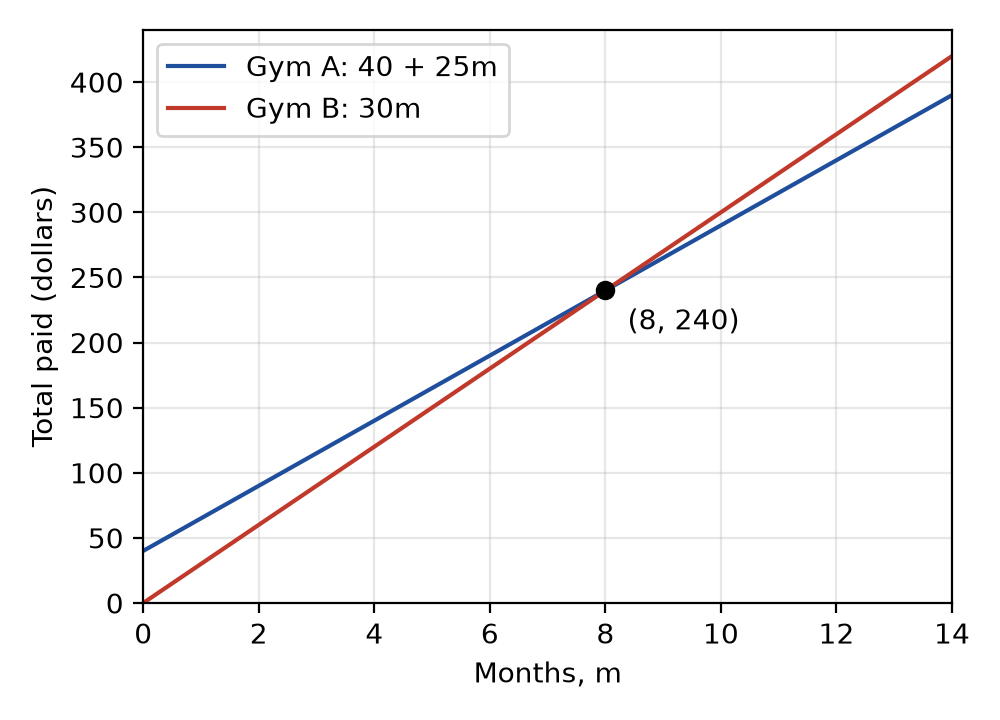
Check: 40 + 25 × 8 = 240 and 30 × 8 = 240. ✓
In words: both gyms cost $240 for 8 months. Before 8 months, Gym B’s line is lower, so B is cheaper. After 8 months, Gym A is cheaper, because its lower monthly fee eventually makes up for the joining fee.
Strengths and limits. Tables and graphs show which option wins on each side, which is often what you really want. But they are only as precise as your table steps or your eye. If the lines crossed at m = 7.4, a table in steps of 2 would show only that the crossing is between 6 and 8. For exact answers, use algebra and then check against the picture.
Check yourself 12.2 Plan P costs 10 + 4x and plan Q costs 2 + 6x. Use a table for x = 0 to 5 to find where they’re equal. Answer: P: 10, 14, 18, 22, 26, 30. Q: 2, 8, 14, 20, 26, 32. They’re equal at x = 4, where both are 26.
Good stopping point.
12.3 The substitution method
Substitution turns two equations with two unknowns into one equation with one unknown, which Chapters 6 and 7 taught you to solve.
The method:
- Get one variable alone in one equation (Chapter 8).
- Substitute that expression into the other equation.
- Solve for the remaining variable.
- Substitute back to find the first variable.
- Check both original equations, and answer in words.
Worked Example 12.3 · The museum tickets, by substitution
14a + 9k = 133
Step 1 · Isolate a variable. From the first equation, k = 12 − a.
Step 2 · Substitute. 14a + 9(12 − a) = 133.
Step 3 · Solve. Expand: 14a + 108 − 9a = 133. Combine: 5a + 108 = 133. Subtract 108: 5a = 25. So a = 5.
Step 4 · Back-substitute. k = 12 − 5 = 7.
Check: 5 + 7 = 12 ✓ and 14 × 5 + 9 × 7 = 70 + 63 = 133. ✓
In words: 5 adults and 7 children.
When both equations give the same output. If both equations are already solved for the same variable, as with two cost formulas, substitution means “set them equal.” That’s exactly what Chapter 7 did with two plans.
Worked Example 12.4 · Two taxi companies
From Chapter 11: Company A charges 3.50 + 2.25d and Company B charges 5.00 + 1.50d for d miles. When are they equal?
Step 1 · Set the costs equal. 3.50 + 2.25d = 5.00 + 1.50d.
Step 2 · Solve. Subtract 1.50d: 3.50 + 0.75d = 5.00. Subtract 3.50: 0.75d = 1.50. So d = 2.
Step 3 · Find the fare. 3.50 + 2.25 × 2 = 8.00.
Check: B gives 5.00 + 1.50 × 2 = 8.00. ✓
In words: both companies charge $8.00 for a 2-mile ride. A is cheaper for shorter rides, and B is cheaper for longer ones. For a 6-mile trip, A charges $17.00 and B charges $14.00.
Check yourself 12.3 Solve by substitution: y = 2x + 1 and 3x + y = 16. Answer: 3x + 2x + 1 = 16, so 5x = 15 and x = 3; then y = 7. Check: 7 = 6 + 1 ✓ and 9 + 7 = 16. ✓
Good stopping point.
12.4 The elimination method
Elimination adds or subtracts the two equations so that one variable disappears. It works because adding equal amounts to both sides of an equation keeps it balanced (Chapter 6). The left side of the second equation equals its right side, so adding one to each side of the first equation is fair.
The method:
- Line up the equations with like terms in columns.
- If needed, multiply one or both equations so that one variable has matching (or opposite) coefficients.
- Subtract (or add) the equations to eliminate that variable.
- Solve, back-substitute, check both equations, and answer in words.
Worked Example 12.5 · Elimination when coefficients are opposites
Solve 2x + 3y = 13 and 5x − 3y = 1.
Step 1 · Notice that the y coefficients are +3 and −3, which are opposites.
Step 2 · Add the equations. (2x + 5x) + (3y − 3y) = 13 + 1, so 7x = 14 and x = 2.
Step 3 · Back-substitute. 2(2) + 3y = 13, so 3y = 9 and y = 3.
Check: 4 + 9 = 13 ✓ and 10 − 9 = 1. ✓
In words: the solution is x = 2, y = 3.
Worked Example 12.6 · Mixing two coffees
A café blends a coffee that costs it $12 a pound with one that costs $16 a pound (illustrative). It wants 20 pounds of blend costing $13.80 a pound, $276 in all. How many pounds of each?
Step 1 · Define. Let x be pounds of the $12 coffee and y pounds of the $16 coffee.
Step 2 · Write the system.
12x + 16y = 276 (dollars)
Step 3 · Match a coefficient. Multiply the first equation by 12: 12x + 12y = 240.
Step 4 · Subtract it from the second equation: (12x − 12x) + (16y − 12y) = 276 − 240, so 4y = 36 and y = 9.
Step 5 · Back-substitute. x = 20 − 9 = 11.
Check: 11 + 9 = 20 ✓ and 12 × 11 + 16 × 9 = 132 + 144 = 276. ✓
In words: blend 11 pounds of the $12 coffee with 9 pounds of the $16 coffee.
A reasonableness check. The blend price, $13.80, is closer to $12 than to $16, so there should be more of the cheaper coffee. There is: 11 pounds against 9. ✓ This kind of check catches many slips before the arithmetic check does.
Which method? Use substitution when a variable is already alone, or easy to isolate, as with cost formulas. Use elimination when the equations are written as “ax + by = c” and a coefficient is easy to match. Both give the same answer, and the check is the same.
Check yourself 12.4 Solve by elimination: x + y = 10 and 3x + 5y = 38. Answer: Multiply the first by 3: 3x + 3y = 30. Subtract: 2y = 8, so y = 4 and x = 6. Check: 18 + 20 = 38. ✓
Good stopping point.
12.5 Break-even points and interpretation
In business and personal decisions, the intersection of two lines is often called the break-even point: the input at which two options cost the same, or at which income just covers costs.
Worked Example 12.7 · A bake-sale stall
A stall at a weekend market (illustrative) costs $120 to rent. Each loaf of bread costs $1.50 in ingredients and sells for $4.00. How many loaves must be sold to break even?
Step 1 · Define. Let n be the number of loaves sold.
Step 2 · Two lines. Cost: C = 120 + 1.50n. Revenue (money taken in): R = 4.00n.
Step 3 · Set them equal. 4.00n = 120 + 1.50n. Subtract 1.50n: 2.50n = 120. So n = 48.
Check: R = 4 × 48 = 192 and C = 120 + 72 = 192. ✓
Step 4 · Interpret each side (Chapter 9). Profit is R − C = 2.50n − 120. It’s positive when 2.50n > 120, that is, when n > 48.
In words: selling 48 loaves covers the costs exactly. Each loaf beyond 48 earns $2.50 profit. Selling fewer than 48 means a loss. Each loaf contributes $2.50 toward the $120 rent, and 120 ÷ 2.50 = 48, which is another way to see the answer.
Interpreting, not just calculating. “n = 48” isn’t an answer to the stallholder’s question. A useful answer says:
- The break-even value, with units: 48 loaves.
- Which option wins on each side: below 48 is a loss, and above 48 is a profit.
- Whether the break-even is realistic: can one stall sell 48 loaves in a weekend? If it usually sells 30, the stall is a loss at these prices, and the owner should change the price or the costs.
Worked Example 12.8 · Bus pass or car?
Chapter 3 compared a $55 monthly bus pass with driving at $40 a month in fixed costs plus $0.30 a mile (illustrative). At what monthly mileage do they cost the same?
Step 1: 40 + 0.30d = 55.
Step 2: 0.30d = 15, so d = 50 miles.
Check: 40 + 0.30 × 50 = 40 + 15 = 55. ✓
In words: at 50 miles a month, the two cost the same. A commuter who drives 20 miles a day for 20 working days, 400 miles a month, would pay 40 + 120 = 160 dollars to drive, so the $55 bus pass saves $105 a month, if the bus route works for them. Money is one part of the decision. Time, reliability, and convenience are others, and algebra can’t weigh those for you.
Check yourself 12.5 A printer costs $80 and uses $0.05 of ink per page. A print shop charges $0.25 per page. After how many pages does owning the printer break even? Which is cheaper for 300 pages? Answer: 80 + 0.05p = 0.25p gives 0.20p = 80 and p = 400 pages. For 300 pages, the shop costs $75 and owning costs $95, so the shop is cheaper.
Good stopping point.
12.6 Parallel lines and identical lines
Two lines don’t always cross at exactly one point.
Parallel lines: no solution. Two streaming services both charge $8 a month (illustrative). One has a $20 sign-up fee, and the other a $35 fee:
Setting them equal gives 20 + 8x = 35 + 8x. Subtracting 8x leaves 20 = 35, which is false. As in Chapter 7, a false statement means no solution. On a graph (Figure 12.2), the lines have the same slope and different intercepts. They’re parallel lines and never meet.
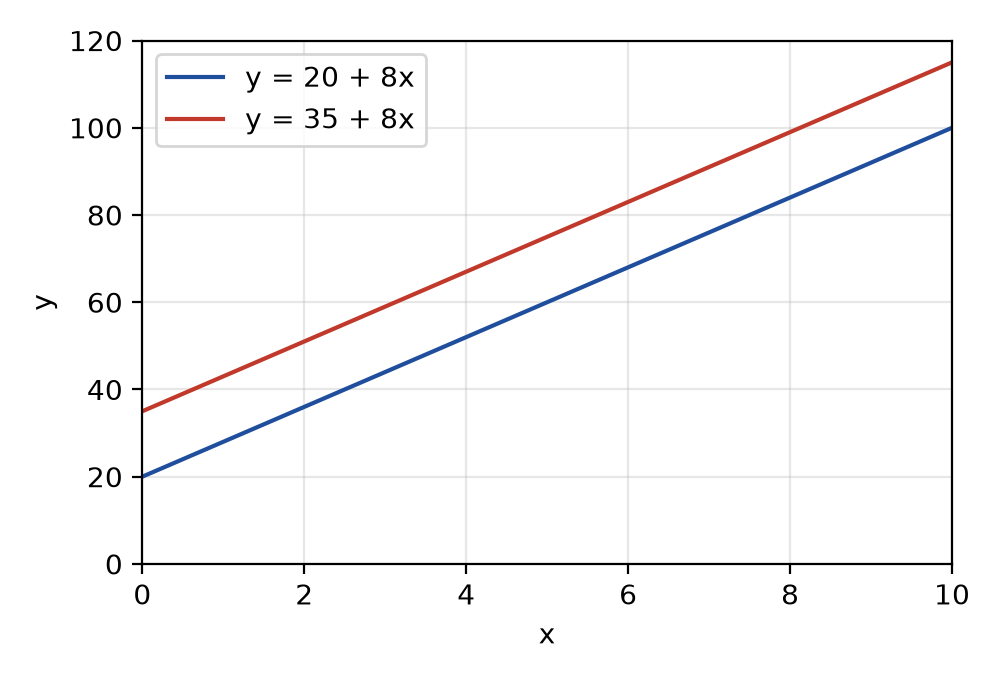
In words: the second service always costs $15 more, whatever the number of months. There is no break-even point.
Identical lines: infinitely many solutions. Consider x + y = 12 and 2x + 2y = 24. The second equation is the first one multiplied by 2, so every pair that fits one fits the other. Elimination gives 0 = 0, which is always true (Chapter 7’s identity). The lines are identical lines, the same line written two ways, and the system has infinitely many solutions.
In words: the second equation adds no new information. To pin down the answer, you need a genuinely different second fact, such as the museum’s total cost.
A quick test before solving. Put both equations in slope-intercept form (Chapter 11).
| Slopes | Intercepts | Lines | Number of solutions |
|---|---|---|---|
| different | anything | cross once | exactly one |
| same | different | parallel | none |
| same | same | identical | infinitely many |
Check yourself 12.6 Without solving, say how many solutions each system has. (a) y = 3x + 2 and y = 3x − 5 (b) y = 2x + 1 and y = −x + 4 (c) y = 4 − x and 2y + 2x = 8. Answer: (a) none: parallel (b) one: different slopes (c) infinitely many: the second is y = 4 − x.
Good stopping point.
Practical activity · Settle a real choice
Time: 30 minutes. Materials: prices for two options you’re actually choosing between (or the illustrative ones below), a calculator, and graph paper.
- Pick a decision with a fixed cost and a per-use cost, such as two phone plans, a membership against paying per visit, buying against renting a tool, or two delivery services. Illustrative: a museum membership for $90 a year with $3 visits, against $15 per visit without it.
- Define the input (for example, visits per year) and write both cost lines.
- Make a short table and sketch both lines.
- Solve the system algebraically, and check against your graph.
- Write a three-part interpretation: the break-even value with units, which option wins on each side, and which side you are likely to be on.
- Name one thing the equations leave out, such as cancellation fees, your time, or how sure you are about your usage.
(Illustrative answer: 90 + 3v = 15v gives v = 7.5, so the membership pays off from 8 visits a year.)
Common mistakes
- Stopping at one variable. Finding a = 5 isn’t the end. Find k too, and check both equations.
- Checking only one equation. A pair can satisfy one equation and fail the other, as (6, 6) did in Worked Example 12.1.
- Sign slips in elimination. When subtracting a whole equation, subtract every term, including the right side.
- Mismatched units. Pounds in one equation and dollars in the other is fine, but each equation must be consistent within itself.
- Reporting the intersection without the decision. Always say which option is better on each side of the break-even.
- Rounding a discrete answer the wrong way. A break-even of 7.5 visits means the membership saves money from 8 visits, not 7 (Chapter 9).
Going further (optional) · More unknowns
Systems can have three or more unknowns, such as tickets for adults, children, and seniors. Each extra unknown needs another independent fact. The same ideas work: eliminate one variable at a time until one equation in one unknown remains. With many unknowns, people use spreadsheets or software that organizes the coefficients into a grid called a matrix. Elimination is still the method underneath. U12 Data Analysis: Tables, Missing Values, and Honest Charts and later mathematics courses develop these tools.
Summary
- A system of equations is a set of equations that must all hold at once. Its solution satisfies every equation.
- Graphically, the solution of a two-line system is the point of intersection.
- Substitution: isolate one variable, substitute, solve, and back-substitute.
- Elimination: match a coefficient, add or subtract equations to remove a variable, then solve.
- A break-even point is where two options are equal. Interpret both sides of it, and whether it’s realistic.
- Same slope with different intercepts gives parallel lines and no solution. The same line twice gives infinitely many solutions.
- Always check both original equations, and answer in words.
Key terms: system of equations · solution of the system · point of intersection · substitution · elimination · break-even point · revenue · parallel lines · identical lines
Review questions
Questions 1 to 6 practice single skills. Questions 7 to 9 combine them.
- Is (4, 1) a solution of x − y = 3 and x + 2y = 6?
- Solve by substitution: y = x + 4 and 2x + y = 19.
- Solve by elimination: 3x + 2y = 16 and x − 2y = 0.
- How many solutions does y = 5x − 1, y = 5x + 2 have? Explain.
- Solve: 2x + 3y = 12 and 4x + 6y = 24.
- A student solving x + y = 9, x − y = 3 adds the equations to get 2x = 12, so x = 6, and reports “x = 6.” What’s missing?
- A theater sold 250 tickets for $3,060 (illustrative). Adult tickets were $14 and student tickets $10. (a) Write a system. (b) Solve it. (c) Check, and answer in words.
- Moving company A charges $150 plus $90 an hour, and company B charges $240 plus $75 an hour (illustrative). (a) Find the break-even time. (b) Which is cheaper for a 4-hour move? (c) For a 10-hour move?
- A school wants 30 liters of a cleaning solution that is 12% vinegar, by mixing a 5% solution with a 20% solution. (a) Write a system, using liters of each solution. (b) Solve it. (c) Check that the vinegar adds up, and say why the answer is reasonable.
Explained answers
1. 4 − 1 = 3 ✓ and 4 + 2 = 6. ✓ Yes.
2. 2x + x + 4 = 19, so 3x = 15 and x = 5; y = 9. Check: 10 + 9 = 19. ✓
3. Add: 4x = 16, so x = 4; then 4 − 2y = 0 gives y = 2. Check: 12 + 4 = 16. ✓
4. None. The slopes are equal (5) and the intercepts differ, so the lines are parallel.
5. The second equation is the first multiplied by 2, so there are infinitely many solutions: every point on 2x + 3y = 12.
6. The value of y and the check. From x + y = 9, y = 3. Check: 6 − 3 = 3. ✓ The solution is (6, 3).
7. (a) Let a be adult tickets and s student tickets: a + s = 250 and 14a + 10s = 3,060. (b) Multiply the first by 10: 10a + 10s = 2,500. Subtract: 4a = 560, so a = 140 and s = 110. (c) Check: 140 + 110 = 250 ✓ and 1,960 + 1,100 = 3,060. ✓ In words: the theater sold 140 adult and 110 student tickets. (If the total had been $3,050, you’d get a = 137.5. A count that isn’t a whole number signals an error in the data, as in Chapter 7.)
8. (a) 150 + 90h = 240 + 75h, so 15h = 90 and h = 6 hours. (b) 4 hours: A costs $510 and B costs $540, so A is cheaper. (c) 10 hours: A costs $1,050 and B costs $990, so B is cheaper.
9. (a) Let x be liters of the 5% solution and y liters of the 20% solution. Then x + y = 30 and 0.05x + 0.20y = 0.12 × 30 = 3.6. (b) Multiply the first by 0.05: 0.05x + 0.05y = 1.5. Subtract: 0.15y = 2.1, so y = 14 and x = 16. (c) Vinegar: 0.05 × 16 + 0.20 × 14 = 0.8 + 2.8 = 3.6 liters. ✓ It’s reasonable: 12% is a little closer to 5% than to 20%, so a little more of the 5% solution is used.
Connections
- Chapters 6 and 7 (solving equations) do the work inside each method, and Chapter 7 introduced no-solution and identity cases.
- Chapter 9 (inequalities) says which option wins on each side, and Chapter 11 (slope and intercept) predicts the number of solutions.
- U01 Chapter 12 (project: a checked comparison) compared options by calculation; this chapter finds the exact crossover. U01 Chapter 8 (percent) underlies mixtures.
- Chapter 13 uses systems to fit a line through two observations.
- Other MORI books: U23 Draft a Business Idea with Visible Assumptions develops break-even analysis, U29 Economics: Choices, Markets and Price Changes meets supply and demand as two intersecting lines, and U08 Energy Systems: Power, Efficiency, and Budgets compares buying against generating power.
Sources consulted for scope and accuracy: OpenStax, Elementary Algebra 2e (Chapter 5, “Systems of Linear Equations,” Sections 5.1–5.5), https://openstax.org/details/books/elementary-algebra-2e, CC BY 4.0; Common Core State Standards, 8.EE.C.8, https://www.thecorestandards.org/Math/Content/8/EE/. All examples, exercises, and figures are original to MORI University. Prices, fees, and quantities are illustrative.
Chapter 13 · Linear Models: Assumptions, Ranges, and Interpretation
U02 Algebra: Expressions, Equations, and Models · MORI University · Foundation level
Time needed: about 110 minutes in total, in six short sections. Each section ends at a good place to stop. You need: a pencil, a calculator, a ruler, and graph paper.
Learning goals
By the end of this chapter, you will be able to:
- Explain what a mathematical model is, and what it leaves out.
- State the assumptions behind a linear model in plain words.
- Build a linear model from two observations, and test it against others using residuals.
- State a model’s valid range, and explain why extrapolation beyond it is risky.
- Write an interpretation of a model’s slope, intercept, and predictions that a nonspecialist could act on.
Start here
At 8:00 a.m. your phone shows 100% battery. At 11:00 a.m. it shows 76%. You have a long evening ahead. Will it last until 9:00 p.m.?
The battery dropped 24 percentage points in 3 hours, which is 8 points an hour. At that rate, it reaches 0% after 100 ÷ 8 = 12.5 hours, at 8:30 p.m. So: no, not quite.
That’s a model: a simplified mathematical description of something real, used to predict or decide. It rests on an assumption: that you’ll use the phone in the afternoon the way you did in the morning. If you spend the afternoon streaming video, the battery will run down faster. If the phone sits in your bag, it will last much longer. The arithmetic was easy. The real questions are whether the assumption holds and how far to trust the answer.
Chapters 10 to 12 gave you lines, slopes, and intercepts. This chapter is about using them responsibly.
13.1 What a model is, and what it isn’t
A mathematical model describes a real situation with variables and equations. A linear model has the form
that is, y = b + mx with units, from Chapter 11.
Every model has five parts. Naming them is the difference between a calculation and a model:
- Quantities and variables, defined with units (Chapter 3).
- Assumptions: what we take to be true, such as “the rate stays constant.”
- The equation.
- The valid range: the inputs for which we trust it.
- Evidence: the data or facts the model was built from, and how well it fits them.
A model isn’t the truth. A map leaves out most of the world on purpose, so that you can find your way. A model leaves out most of the details on purpose, so that you can think clearly. A common saying among statisticians is that all models are wrong, but some are useful. A linear model is useful when the leftover details are small compared with what you need to decide.
Worked Example 13.1 · Naming the parts
The battery model above: name its five parts.
Step 1 · Variables: t is hours since 8:00 a.m., and B is battery level in percent.
Step 2 · Assumption: the phone is used the same way all day, so the battery falls at a constant rate.
Step 3 · Equation: slope (76 − 100) ÷ 3 = −8 percentage points per hour, and intercept 100. So B = 100 − 8t.
Step 4 · Valid range: 0 ≤ t ≤ 12.5, since a battery can’t go below 0%, and only while the usage pattern stays the same.
Step 5 · Evidence: only two readings, which is thin. One more reading would tell us a lot.
Check: B(3) = 100 − 24 = 76. ✓
In words: if I keep using the phone as I did this morning, it will be empty around 8:30 p.m., so I should charge it during the afternoon.
Check yourself 13.1 A model says a lawn-mowing business earns E = 35n dollars for n lawns. Name one assumption and one thing the model leaves out. Answer: For example, it assumes every lawn pays the same $35. It leaves out costs such as fuel and travel time, and larger lawns that pay more.
Good stopping point.
13.2 Stating assumptions
An assumption is a condition the model takes for granted. Linear models usually assume:
- A constant rate: each unit of input changes the output by the same amount.
- A fixed starting value, which doesn’t change over time.
- Nothing else changes: prices, conditions, and behavior stay the same.
Stating them in words lets other people, and your future self, check them.
Worked Example 13.2 · A road trip’s fuel
A car’s tank holds 14 gallons. On the highway, it gets about 30 miles per gallon (illustrative). Build a model of fuel left, and state its assumptions.
Step 1 · Variables. d is miles driven since filling up, and G is gallons left.
Step 2 · Rate. 30 miles per gallon means 1 ÷ 30 gallon per mile used (U01 Chapter 5: a unit rate can be flipped). As a slope, it’s −1/30 gallon per mile.
Step 3 · Equation. G = 14 − d/30.
Step 4 · Assumptions, in words.
- The car uses fuel at the same rate for the whole trip, which is reasonable for steady highway driving.
- The trip starts with a full 14-gallon tank.
- Speed, load, hills, and air conditioning don’t change much. City traffic or a mountain pass would break this.
Step 5 · Use it. A full tank runs out at 14 = d ÷ 30, so d = 420 miles. With a safety margin of 2 gallons, plan to stop by G = 2: 14 − d/30 = 2 gives d = 360 miles.
Check: 14 − 360 ÷ 30 = 14 − 12 = 2 gallons. ✓
In words: if highway conditions hold, plan to refuel within 360 miles. The assumption list says exactly when to stop trusting that number.
Which assumptions matter most? Ask: “If this assumption were wrong, would my decision change?” For the road trip, a 10% worse fuel economy (27 miles per gallon) gives a 2-gallon point of 12 × 27 = 324 miles, which is 36 miles sooner. That’s worth knowing before you pass the last gas station for a while.
Check yourself 13.2 A model says a savings account balance will be S = 500 + 120m after m months. List two assumptions. Answer: For example: $120 is deposited every month, with no withdrawals; and any interest is small enough to ignore.
Good stopping point.
13.3 Building a model from two observations
Often you have data, not a formula. If the pattern looks roughly linear, you can build a model from two observations, using the method of Chapter 11.6.
A student grows a bean plant and measures its height each week (illustrative data):
| Weeks since planting, w | 1 | 2 | 3 | 4 | 5 | 6 |
|---|---|---|---|---|---|---|
| Height, h (cm) | 6.0 | 8.4 | 11.2 | 13.6 | 16.0 | 18.8 |
The differences are 2.4, 2.8, 2.4, 2.4, and 2.8. They aren’t equal, so the data isn’t exactly linear (Chapter 10). But they’re close, so a linear model is a reasonable start.
Worked Example 13.3 · A line through two observations
Build a linear model from weeks 1 and 5.
Step 1 · Choose two points. Points far apart give a steadier slope, because small measuring errors matter less over a long run. We use (1, 6.0) and (5, 16.0).
Step 2 · Slope: m = (16.0 − 6.0)/(5 − 1) = 10.0/4 = 2.5 cm per week.
Step 3 · Intercept: b = 6.0 − 2.5 × 1 = 3.5 cm.
Step 4 · Model: h = 3.5 + 2.5w.
Check: 3.5 + 2.5 × 5 = 16.0. ✓
In words: the plant grows about 2.5 cm a week.
Different pairs give different lines. With weeks 2 and 6, the slope is (18.8 − 8.4) ÷ 4 = 2.6 cm per week, and the intercept 8.4 − 5.2 = 3.2 cm. Neither line is “the right one.” Both summarize the same data slightly differently. That’s normal when data isn’t exactly linear. U04 Statistics: Samples, Center, and Spread teaches a method, the least-squares line, that uses every point at once rather than picking two.
Check yourself 13.3 Build a model from weeks 1 and 4 instead. Round the slope to two decimal places. Answer: m = (13.6 − 6.0) ÷ 3 = 7.6 ÷ 3 ≈ 2.53 cm per week; b ≈ 6.0 − 2.53 = 3.47 cm. So h ≈ 3.47 + 2.53w.
Good stopping point.
13.4 Checking a model against other observations
A model built from two points always fits those two points. That’s no evidence at all. The real test is how well it fits the observations you didn’t use.
The residual of an observation is
A positive residual means the real value was above the model’s prediction. A negative residual means it was below.
Worked Example 13.4 · Residuals for the bean plant
Use h = 3.5 + 2.5w to find the residuals for weeks 2, 3, 4, and 6.
Step 1 · Predict, then subtract.
| w | Observed h | Predicted 3.5 + 2.5w | Residual |
|---|---|---|---|
| 2 | 8.4 | 8.5 | −0.1 |
| 3 | 11.2 | 11.0 | +0.2 |
| 4 | 13.6 | 13.5 | +0.1 |
| 6 | 18.8 | 18.5 | +0.3 |
Step 2 · Judge the size. All residuals are within 0.3 cm. That’s about the precision of a ruler held against a bendy stem.
Step 3 · Look for a pattern. The residuals are small and of mixed sign, with no steady drift in one direction.
Check: week 6: 3.5 + 15 = 18.5, and 18.8 − 18.5 = 0.3. ✓
In words: the model predicts this plant’s height to within about 0.3 cm for weeks 1 to 6. That is good enough for, say, deciding when it will need a taller stake.
Warning signs in residuals:
- Large residuals compared with what you need: the model isn’t precise enough for your purpose.
- A pattern, such as residuals growing steadily or going negative, then positive, then negative. This means the true relationship probably isn’t a straight line. A curve may fit better.
- One huge residual: an outlier (Chapter 10). Check whether it was a recording error before you change the model.
Check yourself 13.4 A model predicts a bill of $84.00, and the bill was $79.50. Find the residual and say what it means. Answer: 79.50 − 84.00 = −4.50 dollars: the real bill was $4.50 below the prediction.
Good stopping point.
13.5 Valid ranges and the danger of extrapolation
The valid range of a model is the set of inputs for which there’s good reason to trust it, usually the range of the data it came from, perhaps a little beyond. It’s written as an inequality (Chapter 9), such as 1 ≤ w ≤ 6.
Figure 13.1 shows the bean-plant data, the model inside its valid range, and what happens if you extend the line.
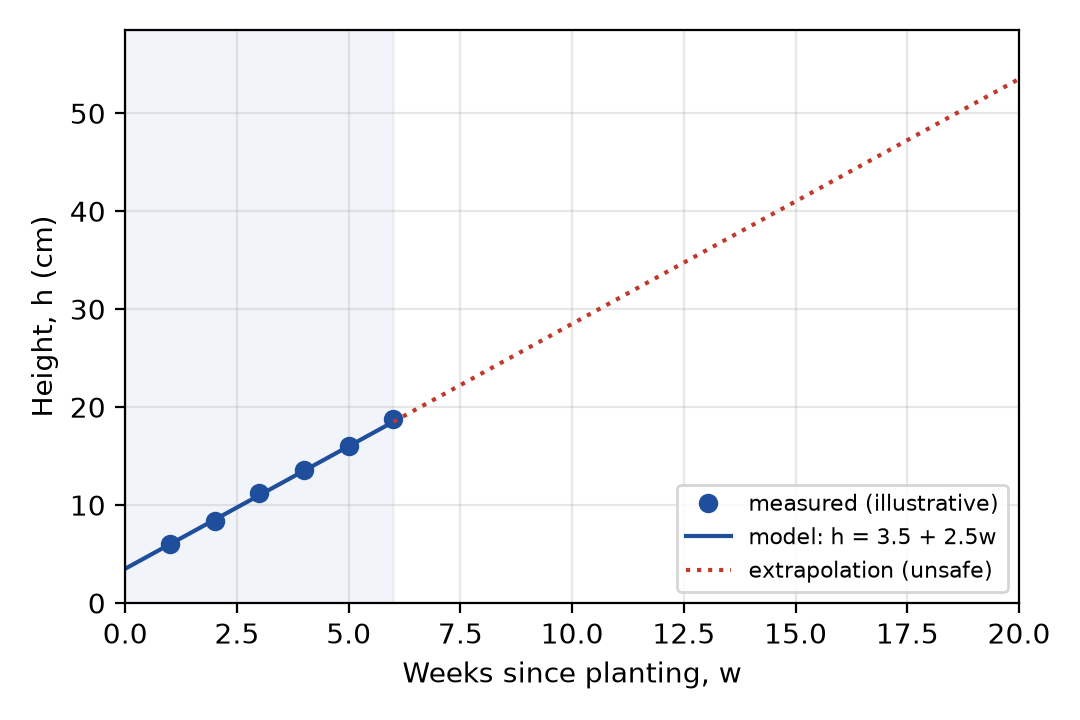
Worked Example 13.5 · Two predictions outside the data
(a) Predict the height at week 20.
Step 1: h = 3.5 + 2.5 × 20 = 53.5 cm.
Step 2 · Question it. Week 20 is more than three times as far from planting as the last observation. Suppose the seed packet says this bush bean grows to about 45 cm at maturity (illustrative). The model’s 53.5 cm is taller than the plant will ever get. Real plants grow quickly, then slow down, then stop.
In words: the model can’t answer this question. It was built on weeks 1 to 6, and growth won’t stay linear.
(b) Interpret the intercept, week 0.
Step 1: h = 3.5 cm at w = 0.
Step 2 · Question it. At planting, the bean is a seed under the soil, with a visible height of 0 cm. The model says 3.5 cm, because the early growth (sprouting) isn’t steady either.
In words: the intercept positions the line; it doesn’t describe the plant at planting (Chapter 11.3).
Check: both questions use inputs outside 1 ≤ w ≤ 6. ✓
Interpolation vs extrapolation. Predicting inside the range of the data, such as week 3.5, is interpolation (Chapter 10), and it’s usually safe when residuals are small. Predicting outside is extrapolation. It may be reasonable a short distance beyond, such as week 7, but it gets less reliable the further you go, because the conditions that kept the pattern linear may change.
Extrapolation in the news. “At this rate, the town will run out of parking by 2040,” or “if this trend continues, everyone will own one by next year.” Such claims extrapolate a line far beyond the data. Ask: over what range was the trend observed, and why should it continue?
Check yourself 13.5 A model of a child’s weekly allowance savings, S = 20 + 5w, was built from weeks 1 to 8. (a) State the valid range. (b) Is a prediction for week 9 interpolation or extrapolation? Is it reasonable? (c) What about week 200? Answer: (a) 1 ≤ w ≤ 8. (b) Extrapolation, a short way out; probably fine if nothing changes. (c) Far outside: almost four years ahead, when allowances, spending, and the child will all have changed.
Good stopping point.
13.6 Interpreting, not just calculating
A model only helps if someone can act on it. A good interpretation turns numbers into sentences with units, limits, and a decision.
An interpretation checklist:
- Slope: “Each additional [input unit] [increases/decreases] [output] by about [m] [units].”
- Intercept: what it means, or why it doesn’t mean anything here.
- Prediction: the value asked for, rounded sensibly, with units.
- Range and trust: the valid range, and how big the residuals were.
- Decision: what to do, and what would change the decision.
Worked Example 13.6 · A delivery driver’s earnings
A delivery driver records her earnings on three evenings (illustrative): 2 hours earned $47, 4 hours earned $83, and 5 hours earned $103. Should she work 7 hours on Friday to earn $135 for a car repair?
Step 1 · Model from the first two evenings: m = (83 − 47) ÷ 2 = 18 dollars per hour, and b = 47 − 36 = 11 dollars. So E = 11 + 18h.
Step 2 · Test with the third evening: predicted 11 + 90 = 101, observed 103, residual +$2.
Step 3 · Predict: E(7) = 11 + 126 = 137 dollars.
Step 4 · Solve for her goal (Chapter 6): 11 + 18h = 135, so 18h = 124 and h ≈ 6.9 hours.
Check: 11 + 18 × 7 = 137 ≥ 135. ✓
Step 5 · Interpret, using the checklist.
- Slope: each extra hour earns her about $18.
- Intercept: $11 isn’t pay for zero hours. It’s probably the tips and bonuses that come with most shifts. It’s only an anchor for the line.
- Prediction: about $137 for 7 hours.
- Range and trust: the data covers 2 to 5 hours, so 7 hours is an extrapolation. The residual was only $2, but with three evenings of data, a $10 swing on a quiet night is quite possible. Friday is often busier, or slower, than other nights.
- Decision: 7 hours should reach $135, but with little margin ($2 above the goal). If she can, she should plan for 7.5 hours, or set aside a little extra from another evening.
In words: “My earnings run about $18 an hour plus about $11 a shift. Seven hours should just cover the $135 repair, but my estimate is based on three evenings and a longer shift than I’ve worked so far, so I’ll plan a bit of extra time.”
Check yourself 13.6 Rewrite this weak interpretation as a strong one: “The slope is 2.5 and the model gives 53.5 at w = 20.” (Bean-plant model.) Answer: For example: “The plant grew about 2.5 cm a week during weeks 1 to 6, and the model fits those weeks to within 0.3 cm. It can’t predict week 20: growth will slow, and the result, 53.5 cm, is taller than the plant gets.”
Good stopping point.
Practical activity · Model something for two weeks
Time: 15 minutes to set up, a minute a day to record, and 30 minutes to analyze. Materials: a notebook or phone notes, a calculator, and graph paper.
- Choose something you can measure daily for two weeks that might grow or shrink steadily: a phone battery at set times, the miles on a car, a savings jar, pages read in a book, or a plant.
- Write your variables with units and your assumption before you start. Why might it be linear?
- Record at least 8 observations.
- Plot them (Chapter 10). Do they look roughly linear?
- Build a model from two well-separated points.
- Find the residuals for the other points. Are they small and patternless?
- State the valid range.
- Make one interpolation and one short extrapolation, and later check the extrapolation against reality.
- Write a five-part interpretation using the checklist in Section 13.6.
Common mistakes
- Treating the model as fact. Report predictions as “about” and “if the assumptions hold.”
- Judging fit with the points you used. The two building points always fit perfectly. Test with the others.
- Extrapolating far beyond the data. The further outside the valid range, the less the line means.
- Interpreting a meaningless intercept. If zero input is outside the valid range, say so.
- Ignoring a pattern in residuals. A steady drift means the shape is wrong, not just the numbers.
- Hiding assumptions. Unstated assumptions can’t be checked by anyone, including you.
Going further (optional) · When linear is the wrong shape
Some patterns are clearly not linear. A savings account with compound interest grows by a steady percent (U01 Chapter 10), so its graph curves upward. A hot drink cools quickly at first, then more slowly. A new product’s sales may rise slowly, then quickly, then level off. For these, a straight line may still be useful over a short range, which is called a local linear approximation, but it fails over longer ones. Recognizing the wrong shape early, from the difference test or from patterned residuals, is one of the most valuable modeling skills. Later courses introduce exponential and other models for these cases.
Summary
- A mathematical model describes a real situation with variables and equations. It’s useful, not true.
- A model has five parts: variables, assumptions, an equation, a valid range, and evidence.
- Linear models assume a constant rate, a fixed starting value, and that other conditions stay the same. State these in words.
- Two observations give a line. Residuals (observed minus predicted) at other observations test it.
- The valid range is where the model can be trusted. Extrapolation beyond it is risky, and more so the further you go.
- Interpret slope, intercept, prediction, trust, and decision in sentences with units.
Key terms: model · mathematical model · assumption · residual · valid range · interpretation · local linear approximation
Review questions
Questions 1 to 6 practice single skills. Questions 7 to 9 combine them.
- List the five parts of a model.
- A model predicts 42 and the observation is 45. Find the residual.
- Build a linear model through (2, 30) and (6, 50), and state the slope and intercept.
- A model was built from data with inputs from 10 to 40. Classify each prediction as interpolation or extrapolation: (a) 25 (b) 55 (c) 0.
- Give two assumptions behind the model “a 5-gallon water jug empties at 0.5 gallon per day.”
- A student says, “My model fits perfectly—it matches both of the points I used.” What’s wrong with this reasoning?
- A runner’s training log (illustrative) records 30 minutes for 5 km in week 1 and 27 minutes for 5 km in week 4. (a) Build a linear model of time against week. (b) Predict week 6 and week 52. (c) Comment on each prediction.
- A small bakery’s weekly flour use (illustrative) was 80 lb in a week with 400 loaves and 130 lb in a week with 650 loaves. (a) Build the model. (b) Interpret the slope and intercept. (c) A third week used 104 lb for 520 loaves. Find the residual and comment.
- A city’s population (illustrative) was 48,000 in 2015 and 54,000 in 2025. A council member says, “At this rate, we’ll reach 100,000 by 2100.” (a) Check the arithmetic. (b) Write two questions you’d ask before accepting the claim.
Explained answers
1. Variables with units, assumptions, the equation, the valid range, and the evidence.
2. 45 − 42 = 3.
3. m = (50 − 30) ÷ (6 − 2) = 5 and b = 30 − 10 = 20. So y = 20 + 5x: slope 5, intercept 20.
4. (a) Interpolation (b) extrapolation (c) extrapolation.
5. For example: the same amount is used every day; nobody refills the jug partway; nothing leaks. (Any two sensible ones.)
6. A line through two points always matches them. That’s how it was built. Fit has to be judged by points that weren’t used to build the model.
7. (a) m = (27 − 30) ÷ (4 − 1) = −1 minute per week; b = 30 − (−1)(1) = 31. So T = 31 − w. (b) Week 6: 25 minutes. Week 52: 31 − 52 = −21 minutes. (c) Week 6 is a short extrapolation and plausible. Week 52 is impossible: a negative time. Improvement slows as fitness rises, so the model holds only over a short range.
8. (a) m = (130 − 80) ÷ (650 − 400) = 50 ÷ 250 = 0.2 lb per loaf; b = 80 − 0.2 × 400 = 0. So L = 0.2n. (b) Each loaf uses about 0.2 lb of flour (about 3.2 oz). The intercept of 0 means no loaves, no flour: a proportional model (U01 Chapter 6). (c) Predicted 0.2 × 520 = 104 lb, observed 104 lb, residual 0. The model fits this week exactly.
9. (a) Slope (54,000 − 48,000) ÷ 10 = 600 people per year. Reaching 100,000 needs 46,000 more, which takes 46,000 ÷ 600 ≈ 76.7 years: about 2102. So “by 2100” is close but slightly early. (b) For example: Is growth really linear, or is it speeding up or slowing down? What data from other years supports the trend? What could change it, such as housing, jobs, or the economy? Is a prediction 75 years past the data meaningful?
Connections
- Chapter 3 (defining variables) and Chapter 9 (inequalities) supply the parts of a model and its valid range.
- Chapter 10 introduced interpolation and extrapolation, and Chapter 11 builds a line from two points.
- U01 Chapter 11 (estimates, checks, and misleading numbers) is the same skepticism applied to models, and U01 Chapter 10 explains why percent growth isn’t linear.
- Chapter 14 puts the whole modeling process to work on a real decision.
- Other MORI books: U04 Statistics: Samples, Center, and Spread fits lines to all the data at once and measures uncertainty, U07 Mechanics: Motion, Force, and Work models motion, U12 Data Analysis: Tables, Missing Values, and Honest Charts checks residuals in practice, and U29 Economics: Choices, Markets and Price Changes uses linear models with stated assumptions.
Sources consulted for scope and accuracy: OpenStax, Elementary Algebra 2e (Chapter 4, “Graphs”), https://openstax.org/details/books/elementary-algebra-2e, CC BY 4.0; Common Core State Standards for Mathematics, Modeling standards for high school, and 8.SP.A.1–3, https://www.thecorestandards.org/Math/Content/8/SP/; GAIMME: Guidelines for Assessment and Instruction in Mathematical Modeling Education, 2nd ed., Sol Garfunkel and Michelle Montgomery, editors (COMAP and SIAM, 2019), https://www.siam.org/publications/reports/guidelines-for-assessment-and-instruction-in-mathematical-modeling-education/. All examples, exercises, data, and figures are original to MORI University. All data in this chapter is illustrative.
Chapter 14 · Project: Build and Check a Linear Model
U02 Algebra: Expressions, Equations, and Models · MORI University · Foundation level
Time needed: about 4 to 6 hours, spread over one or two weeks. Each section ends at a good place to stop. You need: a notebook or spreadsheet, a calculator, graph paper, and real numbers from your own life: bills, receipts, a log you keep, or published prices.
Learning goals
By the end of this project, you will have:
- Framed a real decision as a question that a linear model can help answer.
- Recorded data with sources and dates, and defined variables with units.
- Built a linear model from your data, and tested it with residuals.
- Used the model to predict, to solve for a goal, and to find a break-even point.
- Written a result with its interpretation, assumptions, valid range, and the conditions that would change your conclusion.
Start here
Every chapter of this book has been building toward one skill: turning a real situation into an equation you can trust, and turning the answer back into a sentence you can act on.
This chapter is a project. Section 14.3 contains a fully worked model: a household’s electricity bill, used to decide whether to replace an old refrigerator. Every calculation and every check is shown. Then you’ll do your own. Your finished project is a short written report of two to three pages, assessed with the rubric in Section 14.6.
U01’s project (U01 Chapter 12) compared options with unit rates and percents. This project adds what algebra brings: a formula that predicts, equations that solve for a goal, and a break-even point found exactly.
14.1 Choosing a question a line can answer
A good project question is:
- Real: something you, your household, or your workplace actually faces.
- Roughly linear: an output that grows or shrinks by a fairly steady amount per unit of input, such as a bill against usage, pay against hours, fuel against miles, or savings against weeks.
- Measurable: you can get at least four observations, or published prices that define the line.
- A decision: the model helps you choose, plan, or budget, rather than just describe.
Ideas: Is it worth replacing an appliance? How many hours must I work to reach a goal? Which of two plans, gyms, or services is cheaper for my usage? When will my savings reach a target? What should I charge for a small service so I break even on supplies?
Write your decision as a question: “Given how my bill depends on usage, will a new refrigerator pay for itself within its lifetime?”
Good stopping point.
14.2 The modeling worksheet
Fill in this modeling worksheet before you calculate. It’s the five parts of a model from Chapter 13, plus the question and the checks.
| Item | What to write |
|---|---|
| Question | The decision, in one sentence |
| Variables | Input and output, each with a letter, a meaning, and units |
| Data and sources | Each observation, where it came from, and its date |
| Assumptions | Everything taken as given, as a list |
| Equation | The model, in slope-intercept form |
| Valid range | An inequality for the inputs you trust |
| Checks | Residuals, a second pair of points, units, and the graph |
| Interpretation | Slope, intercept, predictions, trust, and decision |
Assumptions remain the most important row. As in U01, a conclusion is only as good as what it takes for granted. Writing assumptions down shows a reader exactly when the conclusion would change.
Good stopping point.
14.3 A fully worked model: the electricity bill and the old refrigerator
The worksheet
| Item | Entry |
|---|---|
| Question | Should we replace our old refrigerator with a new $900 energy-efficient one, purely on electricity cost? |
| Variables | k = electricity used in a month (kWh); C = that month’s bill (dollars) |
| Data and sources | Six monthly bills, listed below (illustrative figures, in the style of a real US utility bill) |
| Assumptions | (1) The bill is a fixed monthly charge plus a constant price per kWh. (2) Prices stay the same for the life of the new refrigerator. (3) The old refrigerator uses 95 kWh a month and the new one 35 kWh a month, based on their energy labels (illustrative). (4) Nothing else about the household’s use changes. |
The data. The bills, sorted by usage:
| Month | Electricity used, k (kWh) | Bill, C ($) |
|---|---|---|
| March | 380 | 69.00 |
| April | 420 | 74.20 |
| May | 530 | 89.10 |
| June | 610 | 98.90 |
| July | 750 | 117.10 |
| August | 890 | 136.00 |
Step 1 · Plot the data (Chapter 10)
Usage goes on the horizontal axis, because it drives the bill. Figure 14.1 shows the points, which lie very nearly on a straight line.
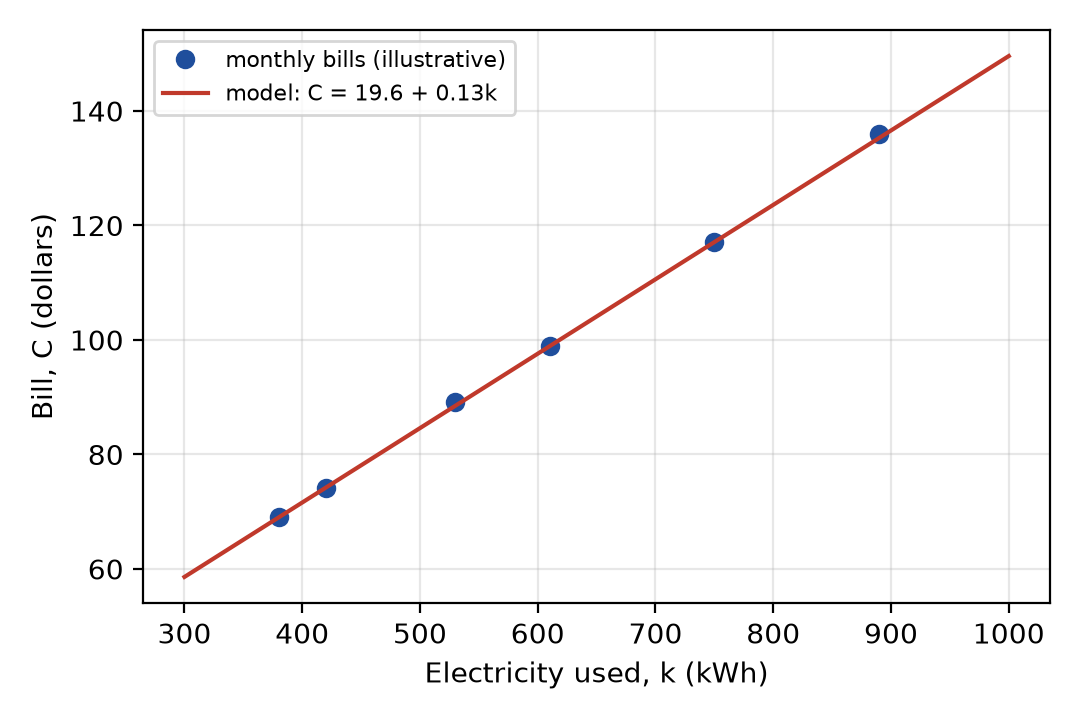
Step 2 · Test for linearity (Chapter 10)
The inputs aren’t equally spaced, so compare the change in bill per kWh between neighboring months:
| From → to | Change in k | Change in C | Per kWh |
|---|---|---|---|
| 380 → 420 | 40 | 5.20 | 0.130 |
| 420 → 530 | 110 | 14.90 | about 0.135 |
| 530 → 610 | 80 | 9.80 | about 0.123 |
| 610 → 750 | 140 | 18.20 | 0.130 |
| 750 → 890 | 140 | 18.90 | 0.135 |
The rates are all close to 13 cents per kWh. A linear model is reasonable.
Step 3 · Build the model from two observations (Chapters 11 and 13)
Use two well-separated months that look typical, March (380, 69.00) and July (750, 117.10).
Check against the bill itself. Real bills usually list both numbers. Ours says “Customer charge $19.60” and “Energy charge 13.0¢ per kWh.” The model has recovered the price structure. ✓
Step 4 · Residuals (Chapter 13)
| Month | k | Observed C | Predicted 19.60 + 0.13k | Residual |
|---|---|---|---|---|
| April | 420 | 74.20 | 74.20 | 0.00 |
| May | 530 | 89.10 | 88.50 | +0.60 |
| June | 610 | 98.90 | 98.90 | 0.00 |
| August | 890 | 136.00 | 135.30 | +0.70 |
Two months match exactly, and two are 60 to 70 cents higher. The bills show a small “fuel cost adjustment” in May and August, which explains them. The residuals are tiny compared with the decision, so we keep the model.
Step 5 · State the valid range (Chapter 13)
The data covers 380 to 890 kWh, so the valid range is 380 ≤ k ≤ 890. Some utilities charge a higher price above a certain usage. We’d need the rate sheet to trust the model far outside this range.
Step 6 · Use the model: what does a refrigerator cost to run?
The model’s slope is the cost of one more kWh, so the intercept doesn’t matter for the difference between two appliances. The fixed charge is paid either way.
- Old refrigerator: 95 × 0.13 = 12.35 dollars a month.
- New refrigerator: 35 × 0.13 = 4.55 dollars a month.
- Saving: 12.35 − 4.55 = 7.80 dollars a month.
Step 7 · The break-even point (Chapter 12)
Let t be months from today. Total spending on the refrigerator over t months:
Buy the new one: N = 900 + 4.55t
Set them equal: 12.35t = 900 + 4.55t, so 7.80t = 900 and t ≈ 115.4 months.
In years: 115.4 ÷ 12 ≈ 9.6 years, about 9 years and 7 months.
Check: 12.35 × 115.4 ≈ 1,425 and 900 + 4.55 × 115.4 ≈ 1,425. ✓
Step 8 · Sensitivity: what if electricity costs more? (Chapter 13)
A sensitivity check changes one assumption to see whether the decision changes. This household’s 13 cents per kWh is low. In July 2026, the US average residential price was 18.31 cents per kWh, and state averages ranged from 12.72 cents (Louisiana) to 48.00 cents (Hawaii) (US Energy Information Administration, Electric Power Monthly, Table 5.6.A, preliminary data released September 24, 2026). At the national average, 18.31 cents:
- Saving: 60 × 0.1831 ≈ 10.99 dollars a month.
- Break-even: 900 ÷ 10.99 ≈ 81.9 months, about 6.8 years.
At 25 cents per kWh (illustrative): saving 60 × 0.25 = 15.00 dollars a month, and break-even after 900 ÷ 15 = 60 months, exactly 5 years.
The decision depends strongly on the price per kWh. That is worth saying in the result.
Good stopping point.
14.4 Checking: substitution, a second pair, units, and the picture
Substitution (Chapter 6). Each model value was recomputed from the equation. For July: 19.60 + 0.13 × 750 = 19.60 + 97.50 = 117.10. ✓
A second pair of points (Chapter 13). April and June give m = (98.90 − 74.20) ÷ (610 − 420) = 24.70 ÷ 190 = 0.13 and b = 74.20 − 54.60 = 19.60. The same line. ✓
Units (Chapter 4). (dollars per kWh) × (kWh per month) = dollars per month. ✓ dollars ÷ (dollars per month) = months. ✓
The picture (Chapter 10). All six points lie on or just above the line in Figure 14.1. ✓
Reasonableness (Chapter 7). A refrigerator lasts many years, so a break-even of 6 to 10 years is plausible, neither instant nor impossible. ✓
In a spreadsheet (optional). Put usage in column A
and the bills in column B, starting in row 2. In C2, type
=19.60+0.13*A2 for the predicted bill, and in D2, type
=B2-C2 for the residual. Fill both down. The spreadsheet
does the substitution check for every month at once, and the formulas
use the order of operations from Chapter 1. A scatter chart of columns A
and B gives you Figure 14.1.
Peer check. Ask someone to redo Steps 3 and 7 from the data table without seeing your answers.
Good stopping point.
14.5 Writing the result: interpretation, trust, and limits
Use the checklist from Chapter 13.6. A strong result reads like this:
Result (model project). Our electricity bill is a fixed $19.60 a month plus 13 cents for each kWh we use. The model matches all six bills to within 70 cents, for usage between 380 and 890 kWh a month.
Prediction and decision. The new refrigerator would use about 60 kWh a month less than the old one, saving about $7.80 a month. At today’s price, the $900 cost is paid back after about 115 months (9.6 years). On electricity alone, that’s a weak case: many refrigerators don’t last much longer than that.
What would change it. If our price rose to the July 2026 US average of 18.31 cents per kWh, the payback would fall to about 6.8 years, and at 25 cents to 5 years. If the old refrigerator is likely to fail soon, the real comparison is between two new models, and the efficient one wins easily. A rebate or a sale price would also shorten the payback: at $600, it would be about 77 months (6.4 years) at our current price.
Assumptions. The energy-label figures (95 and 35 kWh a month) are estimates. Real use depends on the kitchen’s temperature and how often the door opens. We assumed prices stay constant, but they have tended to rise, which would favor buying.
Notice what the result does: every number has units, the prediction is tied to a range, and the conclusion says when it would flip.
Good stopping point.
Project sketches
Choose one of these, or your own question.
Sketch 1 · Hours for a goal. Log your pay for four or more shifts of different lengths, as a delivery driver, server, or tutor. Build E = b + mh, test residuals, and solve for the hours needed to reach a goal. Interpret the intercept (tips? a shift bonus? meaningless?). Then ask how sure you are about a long shift if your data only covers short ones.
Sketch 2 · A savings target. You have $350 saved, and you can save $45 a week. Write S = 350 + 45w, and find when you reach $1,500: 45w = 1,150 gives w ≈ 25.6, so 26 weeks (Chapter 9: round up for “at least”). Then record your actual savings for six weeks and compare. Are the residuals growing? What does that say about the assumption?
Sketch 3 · Pricing a small service. A dog-walking service (illustrative) spends $60 a month on insurance and a phone plan, plus $2 per walk on supplies and transit. At $15 a walk, the break-even is 15n = 60 + 2n, so n ≈ 4.6, meaning 5 walks a month. Build your own version with real costs, then find the price you’d need to earn a target profit at the number of walks you can actually do. Using inequalities (Chapter 9), for what numbers of walks is there a profit?
Sketch 4 · Fuel for a regular trip. Record the odometer and fuel added at four or more fill-ups. Model gallons used against miles, interpret the slope as gallons per mile (and its reciprocal, miles per gallon, from U01 Chapter 5), and predict the fuel cost of a planned trip at a current, dated local price.
14.6 Assessment rubric
| Criterion | Developing (1) | Competent (2) | Strong (3) |
|---|---|---|---|
| Question and variables | Question is vague; variables undefined | Question clear; variables defined | Question, variables with units, and the decision it serves are all stated |
| Data and sources | Numbers have no sources | Most numbers have sources | Every number has a source and a date; illustrative figures are labeled |
| Model building | Equation errors affect the answer | Correct slope and intercept | Correct, with linearity tested and the choice of points explained |
| Checks | None shown | Substitution check only | Residuals, a second pair, units, graph, and reasonableness all shown |
| Assumptions and range | Not stated | Some stated | All stated in words; valid range given as an inequality |
| Interpretation and decision | Numbers only | Slope and prediction interpreted | Slope, intercept, prediction, trust, decision, and what would change it |
Scoring: 6 to 9 is developing, 10 to 14 is competent, and 15 to 18 is strong. Revise and resubmit as often as you like. Projects at MORI University are for learning, not for ranking.
Common mistakes
- Building the model from the two most unusual months. Choose typical, well-separated observations, and say why.
- Judging fit only by the two points used. Residuals at the other points are the evidence.
- Letting the intercept into a comparison where it cancels. A fixed charge paid either way doesn’t affect the difference between options.
- Rounding too early. Keep full values until the final answer. Rounding the saving to $8 before dividing gives 112.5 months instead of 115.4.
- A result without a decision. “The break-even is 115.4 months” is a number. “On electricity alone, it isn’t worth replacing a working refrigerator at our price” is a decision.
- Hiding the sensitivity. If one assumption, such as the price, can flip the conclusion, say so clearly.
Going further (optional) · Present your model as a function
Mathematicians often write a model as a function, a rule that gives exactly one output for each input, using function notation: C(k) = 19.60 + 0.13k. Then C(500), read “C of 500,” means the bill when k = 500: 19.60 + 65 = 84.60 dollars. The parentheses here don’t mean multiplication; they name the input. Function notation makes it easy to say which input you mean, as in “C(890) − C(750) = 18.20, the cost of 140 extra kWh.” Later algebra and statistics courses, including U04 Statistics: Samples, Center, and Spread and U10 JavaScript: Values, Functions, and Arrays, where functions are the main building block of programs, use it constantly.
Summary
- A good project question is real, roughly linear, measurable, and tied to a decision.
- The modeling worksheet records the question, variables, data and sources, assumptions, equation, valid range, checks, and interpretation.
- Build the model from typical, well-separated points. Then test it with residuals, a second pair of points, units, and a graph.
- Use the model to predict, to solve for a goal, and to find break-even points.
- A sensitivity check shows which assumptions could change the decision.
- The result states the answer with units, how far to trust it, and what would change it.
Key terms: project · modeling worksheet · sensitivity check · function · function notation
Review questions
Questions 1 to 6 practice single skills. Questions 7 to 9 combine them.
- Using C = 19.60 + 0.13k, find the bill for 700 kWh.
- Using the same model, how much electricity gives a bill of $100?
- Is a prediction for 1,200 kWh inside the valid range 380 ≤ k ≤ 890? What should you say about it?
- Why doesn’t the $19.60 fixed charge affect the refrigerator break-even?
- Using the electricity model, what does an extra 1.5 kW space heater cost per month if it runs 4 hours a day for 30 days? (Energy in kWh is power in kW times hours.)
- A student rounds the monthly saving to $8 before computing the break-even. What answer do they get, and how far off is it?
- Three phone bills (illustrative) show 4 GB for $41, 7 GB for $56, and 10 GB for $71. (a) Build a model. (b) Check it with the third bill. (c) Interpret the slope and intercept. (d) Predict a month with 8.5 GB.
- Write a complete result paragraph for Sketch 2 (savings), using the checklist: the model, the prediction, its range and trust, and one thing that would change it.
- A water-saving showerhead costs $40 and would cut a household’s water use by 1.5 thousand gallons a month. Using the water bill from Chapter 11, C = 20.50 + 6.00g, find the monthly saving and the break-even time. Then say whether the intercept matters, and why.
Explained answers
1. 19.60 + 0.13 × 700 = 19.60 + 91.00 = 110.60 dollars.
2. 19.60 + 0.13k = 100, so 0.13k = 80.40 and k ≈ 618.5 kWh.
3. No. 1,200 kWh is outside the range. The model predicts 19.60 + 156 = 175.60 dollars, but that’s an extrapolation. A higher price tier may apply, so check the utility’s rate sheet.
4. It’s paid whatever refrigerator you own, so it appears on both sides of the comparison and cancels. Only the slope, the cost per kWh, affects the difference.
5. 1.5 × 4 × 30 = 180 kWh, and 180 × 0.13 = 23.40 dollars a month. (That’s an extrapolation if the usual month is already near 890 kWh: 890 + 180 = 1,070 is outside the valid range.)
6. 900 ÷ 8 = 112.5 months, about 2.9 months too early. Keep full values until the end.
7. (a) m = (56 − 41) ÷ (7 − 4) = 5 dollars per GB; b = 41 − 20 = 21. So C = 21 + 5g. (b) 21 + 50 = 71. ✓ Residual 0. (c) Each GB adds $5, and there’s a $21 base charge. (d) 21 + 42.50 = 63.50 dollars, an interpolation within 4 to 10 GB.
8. For example: “Starting from $350 and saving $45 a week, my savings follow S = 350 + 45w. I’ll reach $1,500 after 26 weeks, since 25.6 weeks rounds up. My first six weeks of real savings were within $20 of the model, so I trust it for the next few months. A single expensive week, such as a car repair, would push the date back by about one week for every $45 I spend.”
9. Saving: 1.5 × 6.00 = 9.00 dollars a month. Break-even: 40 ÷ 9 ≈ 4.4 months, so it pays for itself within 5 months. The intercept ($20.50) doesn’t matter: it’s the same with either showerhead and cancels.
Connections
- Every chapter contributes: variables (Chapter 3), evaluation (Chapter 4), solving (Chapters 6 to 8), inequalities (Chapter 9), graphs (Chapter 10), slope and intercept (Chapter 11), break-even (Chapter 12), and modeling judgment (Chapter 13).
- U01 Chapter 12 (a checked comparison) is this project’s predecessor, and U01 Chapter 5 (unit rates) gives meaning to every slope.
- Other MORI books: U04 Statistics: Samples, Center, and Spread fits lines to all the data and measures uncertainty, U08 Energy Systems: Power, Efficiency, and Budgets explores kilowatt-hours and efficiency in depth, U12 Data Analysis: Tables, Missing Values, and Honest Charts builds models in spreadsheets, and U23 Draft a Business Idea with Visible Assumptions develops pricing and break-even for real ventures.
Sources consulted for scope and accuracy: US Energy Information Administration, Electric Power Monthly, Table 5.6.A, “Average Price of Electricity to Ultimate Customers by End-Use Sector, by State, July 2026 and 2025,” preliminary data released September 24, 2026, https://www.eia.gov/electricity/monthly/epm_table_grapher.php?t=epmt_5_6_a (retrieved October 22, 2026); GAIMME: Guidelines for Assessment and Instruction in Mathematical Modeling Education, 2nd ed., Sol Garfunkel and Michelle Montgomery, editors (COMAP and SIAM, 2019), https://www.siam.org/publications/reports/guidelines-for-assessment-and-instruction-in-mathematical-modeling-education/. All examples, exercises, data, and figures are original to MORI University. The bills, appliance usage figures, prices, and wages are illustrative; the EIA prices are real.
Glossary
Each entry gives a short definition and the chapter where the term is introduced.
absolute value — The distance of a number from zero, written |x|. It is never negative: |−5| = 5. (Ch. 2)
algebraic expression — A combination of numbers, variables, and operations, with no equals sign, such as 3.50 + 2.25m. (Ch. 3)
assumption — A condition that a model takes for granted, such as a constant rate. (Ch. 13)
base — The number being multiplied repeatedly in a power: in 2³ the base is 2. (Ch. 1)
break-even point — The input at which two options cost the same, or at which income just covers costs. (Ch. 12)
closed circle — A filled dot on a number line, showing that the boundary value is included. (Ch. 9)
coefficient — The number multiplying a variable in a term: in 2.25m the coefficient is 2.25. (Ch. 3)
combine like terms — To add or subtract like terms by adding or subtracting their coefficients. (Ch. 5)
common factor — A number or variable that divides every term of an expression. (Ch. 5)
compound inequality — Two inequalities combined, such as 24 ≤ C ≤ 29, describing a range between two limits. (Ch. 9)
constant — A quantity whose value stays fixed in a situation, such as a $3.50 starting fare. (Ch. 3)
constant term — A term with no variable, such as 7 in 3x + 7. (Ch. 5)
continuous — Describes a quantity that can take any value in a range, such as time or volume. Its graph is joined up. (Ch. 10)
convention — An agreement that everyone follows so that results are the same for everyone, such as the order of operations. (Ch. 1)
coordinate plane — A flat surface with two perpendicular number lines, used to locate points by ordered pairs. (Ch. 10)
discrete — Describes a quantity that comes in separate values, such as whole tickets. Its graph is a set of dots. (Ch. 10)
distributive property — The rule a(b + c) = ab + ac: a factor outside parentheses multiplies every term inside. (Ch. 5)
elimination — A method for solving a system: add or subtract equations, after matching coefficients, so that one variable disappears. (Ch. 12)
equation — A statement that two expressions are equal, written with an equals sign. (Ch. 6)
equivalent — Describes two expressions that give the same value for every value of the variable. (Ch. 5)
estimate — A quick, rounded calculation used to predict the size of an answer and to catch errors. (Ch. 1)
evaluate — To find the value of an expression for given values of its variables. (Ch. 4)
expand — To remove parentheses by using the distributive property. (Ch. 5)
exponent — The small raised number in a power, telling how many times the base is multiplied by itself: in 2³ the exponent is 3. (Ch. 1)
extrapolation — Estimating a value beyond the range of the observed values. It becomes less reliable the further you go. (Ch. 10)
factor — To rewrite an expression as a product, the reverse of expanding: 6x + 9 = 3(2x + 3). Also, a number or expression being multiplied. (Ch. 5)
formula — An equation that gives one quantity in terms of others, such as P = 2l + 2w. (Ch. 4)
function — A rule that gives exactly one output for each input. (Ch. 14)
function notation — Writing a function as C(k) to name the input; C(500) means the output when k = 500. (Ch. 14)
grade — A slope written as a percent, as for roads and ramps: a 6% grade rises 6 feet per 100 feet across. (Ch. 11)
grouping symbols — Parentheses, brackets, and fraction bars, which mark a part of an expression to be worked out first. (Ch. 1)
horizontal intercept — The input that makes the output zero; where a line crosses the horizontal axis. (Ch. 11)
identical lines — Two equations that describe the same line. Their system has infinitely many solutions. (Ch. 12)
identity — An equation that is true for every value of its variable, such as 2(x + 3) = 2x + 6. (Ch. 7)
inequality — A statement that compares two quantities using <, >, ≤, or ≥. (Ch. 9)
infinitely many solutions — Describes an equation that is true for every value of the variable. (Ch. 7)
integers — The whole numbers and their negatives: …, −3, −2, −1, 0, 1, 2, 3, … (Ch. 2)
intercept (vertical intercept) — The output when the input is zero; where a line crosses the vertical axis, at (0, b). (Ch. 11)
interpolation — Estimating a value between observed or plotted values. (Ch. 10)
interpretation — A statement in words, with units and limits, of what a model’s numbers mean for a decision. (Ch. 13)
inverse operation — An operation that undoes another: subtraction undoes addition, and division undoes multiplication (by a nonzero number). (Ch. 1)
least common denominator — The smallest number that every denominator in an equation divides into evenly; multiplying by it clears fractions. (Ch. 7)
like terms — Terms with exactly the same variable part, such as 4x and −9x. (Ch. 5)
linear — Describes a relationship in which equal steps in the input give equal changes in the output. Its graph is a straight line. (Ch. 4)
linear equation — An equation in which the variable appears only to the first power, not multiplied by itself or in a denominator. (Ch. 6)
literal equation — An equation or formula with several letters, such as d = rt. (Ch. 8)
local linear approximation — Using a straight line to describe a curved relationship over a short range. (Ch. 13)
mathematical model — A simplified description of a real situation using variables and equations, built on stated assumptions and used to predict or decide. Often just called a model. (Ch. 13)
matrix — A rectangular grid of numbers, used by software to organize the coefficients of large systems. (Ch. 12)
modeling worksheet — A table recording a model’s question, variables, data and sources, assumptions, equation, valid range, checks, and interpretation. (Ch. 14)
negative number — A number less than zero, written with a minus sign, such as −12. (Ch. 2)
nonlinear — Describes a relationship whose changes are not equal for equal input steps. Its graph curves. (Ch. 10)
no solution — Describes an equation that is false for every value of the variable; solving it leads to a false statement such as 5 = 9. (Ch. 7)
number line — A line on which every number has a place, with larger numbers further right. (Ch. 2)
open circle — A hollow dot on a number line, showing that the boundary value is not included. (Ch. 9)
opposites — Two numbers the same distance from zero on opposite sides, such as 7 and −7. They add to zero. (Ch. 2)
ordered pair — A pair of numbers (x, y) naming a point: across first, then up or down. (Ch. 10)
order of operations — The agreed order for evaluating an expression: grouping symbols, then exponents, then multiplication and division from left to right, then addition and subtraction from left to right. (Ch. 1)
origin — The point (0, 0), where the axes cross. (Ch. 10)
outlier — A data point far from the pattern of the others. (Ch. 10)
parallel lines — Lines with the same slope and different intercepts. They never meet, so their system has no solution. (Ch. 12)
parameter — A number that is fixed within one situation but can be chosen differently for another, such as the rate per mile of a particular taxi company. (Ch. 3)
percent equation — An equation in which a percent of an unknown amount is given, such as 0.80x = 36. (Ch. 7)
perimeter — The total distance around the edge of a shape. (Ch. 4)
point of intersection — The point where two lines cross, which is the solution of their system. (Ch. 12)
positive number — A number greater than zero. (Ch. 2)
principal — The amount borrowed or saved, on which interest is calculated. (Ch. 8)
project — A piece of extended, independent work that applies the book’s methods to a real decision. (Ch. 14)
quadrant — One of the four regions into which the axes divide the plane, numbered I to IV counterclockwise from the top right. (Ch. 10)
quantity — An amount with a unit: 4 miles, $12.50, 3 hours. (Ch. 3)
rate of change — The change in output divided by the change in input, with units such as dollars per mile. (Ch. 11)
residual — Observed value minus the value a model predicts. (Ch. 13)
revenue — The money taken in from sales: price times quantity sold. (Ch. 12)
reversal rule — When you multiply or divide both sides of an inequality by a negative number, reverse the inequality sign. (Ch. 9)
rise — The vertical change between two points on a graph: the change in output. (Ch. 11)
run — The horizontal change between two points on a graph: the change in input. (Ch. 11)
scatter — A set of plotted data points that need not lie on any single line or curve. (Ch. 10)
sensible solution — A solution that makes sense in the situation, for example a whole, nonnegative number of people. (Ch. 7)
sensitivity check — Changing one assumption to see how much the answer moves, and whether the decision changes. (Ch. 14)
signed numbers — Positive numbers, negative numbers, and zero, used together. (Ch. 2)
simple interest — Interest paid only on the original amount: I = Prt. (Ch. 8)
simplify — To rewrite an expression in an equivalent, shorter form. (Ch. 5)
slope — The constant rate of change of a straight line, m = (y₂ − y₁)/(x₂ − x₁), in output units per input unit. (Ch. 11)
slope-intercept form — The equation of a line written y = mx + b, with slope m and intercept b. (Ch. 11)
solution — A value of the variable that makes an equation (or inequality) true. (Ch. 6)
solution of the system — A set of values that makes every equation in a system true. (Ch. 12)
solution set — All the values that make an inequality true. (Ch. 9)
solve — To find every solution of an equation or inequality. (Ch. 6)
solve a formula for — To rearrange a formula so that a chosen variable stands alone on one side. (Ch. 8)
square root — For a nonnegative number A, the nonnegative number whose square is A, written √A. (Ch. 8)
starting value — The value of a quantity before any input has acted, often the meaning of an intercept. (Ch. 11)
subscript — A small lowered label, such as the 1 in x₁, that names which value is meant. It is not an exponent. (Ch. 11)
substitute — To replace a variable with a number (in parentheses) before evaluating. (Ch. 4)
substitution — A method for solving a system: isolate one variable and substitute its expression into the other equation. (Ch. 12)
substitution check — Putting a solution back into the original equation to confirm both sides are equal. (Ch. 6)
system of equations — A set of equations that must all be true at the same time. (Ch. 12)
table of values — A table listing inputs and the outputs an expression or formula gives for them. (Ch. 4)
term — A part of an expression separated from the rest by + or − signs, such as 3x in 3x + 7. (Ch. 5)
truncated axis — A graph axis that does not start at zero, which can exaggerate differences. (Ch. 10)
undefined slope — The slope of a vertical line, where the run is zero and division by zero is impossible. (Ch. 11)
valid range — The inputs for which a model can be trusted, usually the range of the data it came from. (Ch. 13)
variable — A letter that stands for a quantity whose value can change or is not yet known. (Ch. 3)
variable definition — A statement of what a letter stands for, including its unit and any starting point, such as “m = miles driven”. (Ch. 3)
x-axis — The horizontal number line of the coordinate plane, usually for the input. (Ch. 10)
x-coordinate — The first number in an ordered pair: the horizontal position. (Ch. 10)
y-axis — The vertical number line of the coordinate plane, usually for the output. (Ch. 10)
y-coordinate — The second number in an ordered pair: the vertical position. (Ch. 10)
Notation guide
| Symbol or form | Read it as | Example |
|---|---|---|
| 3x, 3 · x, 3(x) | 3 times x | if x = 4, 3x = 12 |
| a/b | a divided by b (“a over b”) | 12/4 = 3 |
| x², x³ | x squared, x cubed | 5² = 25 |
| √A | the square root of A | √49 = 7 |
| −x | the opposite of x | if x = −3, −x = 3 |
| |x| | the absolute value of x | |−5| = 5 |
| ( ), [ ] | grouping symbols: work inside first | 2(3 + 4) = 14 |
| =, ≠ | is equal to, is not equal to | 2 + 2 ≠ 5 |
| ≈ | is approximately equal to | 1/3 ≈ 0.33 |
| <, > | is less than, is greater than | −4 < 1 |
| ≤, ≥ | is at most, is at least | h ≤ 40 |
| 24 ≤ C ≤ 29 | C is between 24 and 29, inclusive | a compound inequality |
| (x, y) | the point with x-coordinate x and y-coordinate y | (3, −2) |
| x₁, y₂ | “x one,” “y two”: subscripts are labels, not exponents | (x₁, y₁) = (2, 8) |
| m | slope (rate of change) | m = 2.25 dollars per mile |
| b | intercept (starting value) in y = mx + b | b = 3.50 dollars |
| C(k) | “C of k”: the output of function C for input k | C(500) = 84.60 |
| ✓ | checked | 3(4) + 2 = 14 ✓ |
| / in a unit | per | $/mi, ft/h |
Number lines. An open circle (○) marks a boundary value that is not included (< or >). A closed circle (●) marks one that is included (≤ or ≥).
House style. “3 times as much” means × 3. This book never uses “times more” (see U01 Chapter 1). Every variable is defined with its unit, and every answer is given with its unit.
Formula card
Order of operations (Chapter 1). Grouping symbols → exponents → multiplication and division, left to right → addition and subtraction, left to right.
Signed numbers (Chapter 2). Subtracting is adding the opposite: a − b = a + (−b). For multiplying and dividing, same signs give a positive result, and different signs give a negative one.
Rewriting expressions (Chapter 5). Distributive property: a(b + c) = ab + ac. Combine like terms by adding their coefficients: 4x + 9x = 13x.
Solving equations (Chapters 6 and 7). Do the same thing to both sides. Clear fractions by multiplying by the least common denominator, remove parentheses, collect the variable on one side, undo addition or subtraction, then undo multiplication or division. Always check by substitution.
Inequalities (Chapter 9). Solve like an equation, but reverse the sign whenever you multiply or divide both sides by a negative number.
Everyday formulas (Chapters 4 and 8).
| Formula | Meaning |
|---|---|
| P = 2l + 2w | perimeter of a rectangle |
| A = lw | area of a rectangle |
| d = rt, r = d/t, t = d/r | distance, rate, and time |
| I = Prt | simple interest |
| F = 1.8C + 32, C = (F − 32)/1.8 | Fahrenheit and Celsius (exact) |
| Pay = 40r + 1.5r(h − 40) for h > 40 | weekly pay with federal overtime |
Lines (Chapters 10 and 11).
Slope is in output units per input unit. The intercept b is the output when the input is 0. To find the horizontal intercept, set y = 0 and solve. A grade is a slope written as a percent. A horizontal line has slope 0, and a vertical line has undefined slope.
Systems (Chapter 12). Solve by graphing, substitution, or elimination, and check the answer in both equations. Different slopes: one solution. Same slope, different intercepts: no solution (parallel lines). Same line: infinitely many solutions. A break-even point is where two cost lines, or a cost line and a revenue line, meet.
Models (Chapters 13 and 14). Build from two typical observations: m = (y₂ − y₁)/(x₂ − x₁), then b = y₁ − m x₁. Residual = observed − predicted. Trust predictions only inside the valid range.
Conversions (NIST). 1 mile = 1.609344 kilometers exactly. 1 foot = 12 inches. 1 hour = 60 minutes.
Bibliography
All of these sources were consulted for scope and accuracy. Their links were checked on October 22, 2026. No text was copied from them.
Open textbooks
- OpenStax. Prealgebra 2e. Houston, TX: OpenStax, Rice University, 2020. CC BY 4.0. https://openstax.org/details/books/prealgebra-2e (Chapters 1 and 3; Sections 2.1, 2.2, and 7.3).
- OpenStax. Elementary Algebra 2e. Houston, TX: OpenStax, Rice University, 2020. CC BY 4.0. https://openstax.org/details/books/elementary-algebra-2e (Section 1.1, Section 1.4, Chapter 2, Chapter 4, and Chapter 5).
Standards and guidance
- Common Core State Standards Initiative. “Grade 6: Expressions and Equations (6.EE).” https://www.thecorestandards.org/Math/Content/6/EE/
- Common Core State Standards Initiative. “Grade 6: The Number System (6.NS).” https://www.thecorestandards.org/Math/Content/6/NS/
- Common Core State Standards Initiative. “Grade 7: Expressions and Equations (7.EE).” https://www.thecorestandards.org/Math/Content/7/EE/
- Common Core State Standards Initiative. “Grade 8: Expressions and Equations (8.EE).” https://www.thecorestandards.org/Math/Content/8/EE/
- Common Core State Standards Initiative. “Grade 8: Functions (8.F).” https://www.thecorestandards.org/Math/Content/8/F/
- Common Core State Standards Initiative. “Grade 8: Statistics and Probability (8.SP).” https://www.thecorestandards.org/Math/Content/8/SP/
- Common Core State Standards Initiative. “High School: Modeling.” https://www.thecorestandards.org/Math/Content/HSM/
- Garfunkel, Sol, and Michelle Montgomery, eds. GAIMME: Guidelines for Assessment and Instruction in Mathematical Modeling Education. 2nd ed. Philadelphia: COMAP and SIAM, 2019. https://www.siam.org/publications/reports/guidelines-for-assessment-and-instruction-in-mathematical-modeling-education/ (Chapters 13 and 14).
Measurement
- National Institute of Standards and Technology. Guide for the Use of the International System of Units (SI), NIST Special Publication 811. https://www.nist.gov/pml/special-publication-811 (temperature conversion; Chapters 4, 8, and 9).
- National Institute of Standards and Technology. NIST Handbook 44, Appendix C, “General Tables of Units of Measurement.” https://www.nist.gov/pml/owm/nist-handbook-44-current-edition (1 mile = 1.609344 km; Chapter 8).
Government data and regulations
- US National Park Service, Death Valley National Park. “Badwater Basin.” https://www.nps.gov/places/badwater-basin.htm (retrieved October 22, 2026; Chapter 2).
- US Geological Survey. “Highest and Lowest Elevations.” https://www.usgs.gov/educational-resources/highest-and-lowest-elevations (retrieved October 22, 2026; Chapter 2).
- US Department of Labor, Wage and Hour Division. “Overtime Pay.” https://www.dol.gov/agencies/whd/overtime (retrieved October 22, 2026; Chapter 4).
- US Access Board. 2010 ADA Standards for Accessible Design, Section 405.2, “Slope” (ramp running slope not steeper than 1:12). https://www.access-board.gov/ada/ (retrieved October 22, 2026; Chapter 11).
- US Energy Information Administration. Electric Power Monthly, Table 5.6.A, “Average Price of Electricity to Ultimate Customers by End-Use Sector, by State, July 2026 and 2025.” Preliminary data, released September 24, 2026. https://www.eia.gov/electricity/monthly/epm_table_grapher.php?t=epmt_5_6_a (retrieved October 22, 2026; Chapter 14).
Companion text
- MORI University. Ratios, Proportions, and Percent (U01). 2026. CC BY 4.0.
License
- Creative Commons. “Attribution 4.0 International (CC BY 4.0).” https://creativecommons.org/licenses/by/4.0/
Index of key terms
Bold chapter numbers show where a term is introduced. Other numbers show chapters where it is used again.
- absolute value: 2
- algebraic expression: 3
- assumption: 13; 3, 6–8, 11, 14
- base: 1; 2–3, 14
- break-even point: 12; 14
- closed circle: 9
- coefficient: 3; 5–7, 9, 11–12
- combine like terms: 5; 7
- common factor: 5
- compound inequality: 9
- constant: 3; 4–5, 7, 11, 13–14
- constant term: 5; 11
- continuous: 10
- convention: 1; 9
- coordinate plane: 10
- discrete: 10; 12
- distributive property: 5; 2
- elimination: 12
- equation: 6; 1–5, 7–14
- equivalent: 5; 1, 7–8
- estimate: 1; 3, 8, 13–14
- evaluate: 4; 1–3, 5–6, 8
- expand: 5; 6–7, 9, 12
- exponent: 1; 2–3, 11
- extrapolation: 10; 13–14
- factor: 5; 2, 8
- formula: 4; 1–2, 5–8, 10–14
- function: 14
- function notation: 14
- grade: 11; 3
- grouping symbols: 1
- horizontal intercept: 11
- identical lines: 12
- identity: 7; 12
- inequality: 9; 13–14
- infinitely many solutions: 7; 12
- integers: 2
- intercept (vertical intercept): 11; 12–14
- interpolation: 10; 13–14
- interpretation: 13; 11–12, 14
- inverse operation: 1; 6, 8
- least common denominator: 7
- like terms: 5; 7–8, 12
- linear: 4; 5–7, 9–10, 12–14
- linear equation: 6; 7, 12
- literal equation: 8; 7
- local linear approximation: 13
- mathematical model: 13
- matrix: 12
- modeling worksheet: 14
- negative number: 2; 1, 4, 7, 9–10
- nonlinear: 10
- no solution: 7; 12
- number line: 2; 9–10
- open circle: 9
- opposites: 2; 12
- ordered pair: 10; 12
- order of operations: 1; 2, 4–5, 14
- origin: 10; 2
- outlier: 10; 13
- parallel lines: 12
- parameter: 3
- percent equation: 7
- perimeter: 4; 8
- point of intersection: 12
- positive number: 2; 8–10
- principal: 8
- project: 14; 12
- quadrant: 10
- quantity: 3; 1–2, 4, 7, 9, 11
- rate of change: 11
- residual: 13; 14
- revenue: 12
- reversal rule: 9
- rise: 11; 2, 9, 13–14
- run: 11; 4, 13–14
- scatter: 10; 14
- sensible solution: 7
- sensitivity check: 14
- signed numbers: 2; 4–5, 9
- simple interest: 8
- simplify: 5; 4, 7
- slope: 11; 2, 4, 10, 12–14
- slope-intercept form: 11; 12, 14
- solution: 6; 7, 9, 12
- solution of the system: 12
- solution set: 9
- solve: 6; 4, 7–10, 12–14
- solve a formula for: 8
- square root: 8
- starting value: 11; 10, 13
- subscript: 11
- substitute: 4; 3, 6, 8, 12
- substitution: 12; 4–9, 14
- substitution check: 6; 5, 8–9, 12, 14
- system of equations: 12
- table of values: 4; 10
- term: 5; 1–4, 6–14
- truncated axis: 10
- undefined slope: 11
- valid range: 13; 9, 11, 14
- variable: 3; 4–9, 11–14
- variable definition: 3
- x-axis: 10
- x-coordinate: 10; 11
- y-axis: 10
- y-coordinate: 10