License and attribution
© 2026 MORI University.
Except where otherwise noted, this textbook is licensed under a Creative Commons Attribution 4.0 International License (CC BY 4.0): https://creativecommons.org/licenses/by/4.0/
You are free to share (copy and redistribute in any medium or format) and to adapt (remix, transform, and build upon) this material for any purpose, including commercially. You must give appropriate credit, provide a link to the license, and indicate if changes were made. You may do so in any reasonable manner, but not in any way that suggests MORI University endorses you or your use.
Suggested attribution: “Ratios, Proportions, and Percent (U01), MORI University, 2026, licensed under CC BY 4.0.”
About the text. All teaching text, worked examples, exercises, and answers were written new for MORI University. Other open textbooks were consulted only for scope and accuracy, and no text was copied from them. No material comes from share-alike (CC BY-SA) sources. Government data (US Bureau of Labor Statistics, NIST, FDA, HUD) is in the US public domain and is credited where used.
About the numbers. Every calculation in this book was checked by computer before publication. Prices, wages, and bills in the examples are illustrative unless a source is named. Official figures, such as inflation rates, are US data. Each one is labeled with its source, the period it covers, and the date it was retrieved. Figures like these change every month, so recheck them before you rely on them.
Corrections. If you find an error, please report it to MORI University so it can be fixed for every reader.
Preface
Welcome. You already do more mathematics than you think.
If you’ve ever checked whether a large pack is really cheaper, worked out whether a raise keeps up with rising rent, or doubled a recipe for guests, you’ve already used ratios, proportions, and percent. This book takes those everyday instincts and makes them dependable. You’ll learn to say exactly what is being compared, to what, and in what units, and to check your answer before you act on it.
Who this book is for. This book is for adults who want to feel steady with numbers again. That includes people returning to study, people who were told long ago that they “aren’t math people,” older learners, capable teenagers, and anyone with a little time and a phone. You don’t need any earlier course. Chapters 1 to 3 rebuild whole numbers, fractions, and decimals from the ground up, always through practical situations.
What you need. You need paper and a pencil. A basic calculator helps from Chapter 3 onward, and a phone calculator is fine. Every activity uses free or household materials: receipts, food labels, a pay stub, a bus timetable, or a news article. Money is in US dollars. Measurements are given in both US customary and metric units, because you’ll meet both on labels, in stores, and at work.
How each chapter works. Each chapter opens with a plain explanation of the idea and a short list of things you’ll be able to do by the end. Short sections follow, and each ends at a good place to stop. Worked examples show every step and end with a check. “Check yourself” questions let you test your understanding as you go. Every chapter also has a practical activity, a list of common mistakes, a summary of key terms, nine review questions, and explained answers. These are written explanations, not just final numbers. Optional “Going further” boxes add depth that you can skip on a first reading. Chapter 12 brings everything together in a project, a checked comparison of real options.
How to use it with limited time. One section takes about 10 to 15 minutes. If you can study for 20 minutes a few times a week, you can finish a chapter in about a week, and the whole book in about three months. Trying the review questions again a few days later helps your memory more than rereading does.
A promise about precision. Every number in this book has been checked. When we round, we tell you. We also label what kind of statement each claim is. An observation is something measured. An inference is a conclusion that could be wrong. A model rests on stated assumptions. An established result holds every time. We hope you’ll hold every number you meet to the same standard, including ours.
A note on language. In this book, “3 times as much” always means multiplying by 3. We never write “3 times more,” because readers take it in different ways. Chapter 1 explains why.
Where this leads. This book prepares you for U02 Algebra: Expressions, Equations, and Models, U03 Geometry: Measure, Diagonals, and Scale, U04 Statistics: Samples, Center, and Spread, U08 Energy Systems: Power, Efficiency, and Budgets, U14 Follow a Claim to Its Evidence, U20 Account for Stock and Flow, U22 Measure and Lay Out Before Making, U29 Economics: Choices, Markets and Price Changes, F16 Nutrition, Meal Planning, and Kitchen Economics, F24 Personal Finance and Consumer Decision-Making, and the many other MORI courses that list it as a prerequisite.
Course learning objectives
By the end of this book, you will be able to:
- Carry out and check the whole-number, fraction, and decimal calculations needed for everyday comparisons, and round results sensibly for their context.
- Decide whether a situation calls for a comparison by difference or by multiplication, and explain the choice.
- Write, read, and simplify ratios, and tell part-to-part from part-to-whole comparisons.
- Compute and interpret rates and unit rates with correct units, including unit prices and hourly wages, and convert between metric and US customary units when needed.
- Generate equivalent ratios with tables, and use them to scale quantities up or down, including recipes, mixtures, and material quantities.
- Recognize when a relationship is proportional and when it isn’t, and solve proportions with a method you can check.
- Identify the reference quantity (the “of what?”) in any percentage statement.
- Find a percentage of an amount, find what percent one amount is of another, and find the whole from a part and a percent.
- Calculate and interpret percentage increases and decreases, and tell a percentage change from a percentage-point change.
- Combine successive percentage changes correctly, and undo a percentage change correctly.
- Estimate answers mentally before calculating, and use the estimate to catch errors.
- Analyze numerical claims in ads, news, and reports for a missing reference quantity, a mixed-up comparison, or a misleading presentation.
- Plan, carry out, and document a checked comparison between real options, with stated assumptions and verified calculations.
Chapter 1 · How Many Times? Whole Numbers and Two Ways to Compare
U01 Ratios, Proportions, and Percent · MORI University · Foundation level
Time needed: about 60 to 75 minutes in total. Each numbered section takes 10 to 15 minutes and ends at a good place to stop. You need: a pencil and paper. You won’t need a calculator in this chapter.
Learning goals
By the end of this chapter, you will be able to:
- Read and write whole numbers using place value, up to the millions.
- Choose the operation that fits an everyday situation, and decide what a remainder means.
- Compare two amounts by difference: “How much more?”
- Compare two amounts by multiplication: “How many times as much?”
- Explain which comparison better fits a decision.
- Convert amounts to the same unit before comparing them.
Start here
Two friends tell you that a monthly bill went up by $100 this year.
- Amira’s rent went from $900 to $1,000.
- Ben’s storage unit went from $50 to $150.
Is that the same news? In one way, yes: each of them now pays $100 more a month. In another way, no. Ben now pays three times what he used to pay. Amira pays only a little more than she used to.
Both statements are true. They answer two different questions:
- How much more? This is a comparison by subtraction.
- How many times as much? This is a comparison by multiplication.
This whole book grows from the second question. Ratios, proportions, and percents are all careful ways of answering it. This chapter rebuilds the whole-number skills you need and shows you which question a situation is really asking.
If arithmetic has felt shaky for a while, that’s normal. Everything here starts from situations you already know.
1.1 Whole numbers and place value
The whole numbers are 0, 1, 2, 3, and so on, without end. We use them to count things that don’t come in pieces: people, buses, eggs.
We write them with ten digits, 0 to 9. What a digit is worth depends on its position, called its place value. Each place is worth 10 times the place to its right.
Example: reading a large amount. Suppose a town’s yearly budget is $3,407,250. Here is how its digits line up.
| Place | Digit | Value |
|---|---|---|
| Millions | 3 | 3,000,000 |
| Hundred thousands | 4 | 400,000 |
| Ten thousands | 0 | 0 |
| Thousands | 7 | 7,000 |
| Hundreds | 2 | 200 |
| Tens | 5 | 50 |
| Ones | 0 | 0 |
We read it as “three million, four hundred seven thousand, two hundred fifty dollars.” Adding the values back together gives the number again:
3,000,000 + 400,000 + 7,000 + 200 + 50 = 3,407,250
Zeros hold places. The zero in the ten-thousands place is worth nothing on its own. But drop it and write 347,250, and every digit to its left slides down a place. The amount shrinks to roughly a tenth of its true size.
Grouping. This book separates groups of three digits with commas. Some countries write 3.407.250 or 3 407 250 instead. It’s the same number.
Check yourself 1.1 (a) Write 60,508 in words. (b) What is the 6 in 60,508 worth? Answers: (a) sixty thousand, five hundred eight. (b) 60,000, because the 6 is in the ten-thousands place.
Good stopping point.
1.2 Four operations as everyday actions
Each operation matches something you already do. Knowing the action helps you choose the operation.
| Operation | Everyday action | Name of the result |
|---|---|---|
| Addition (+) | Combining amounts | Sum |
| Subtraction (−) | Taking away, or finding the gap | Difference |
| Multiplication (×) | Repeating equal groups | Product |
| Division (÷) | Sharing equally, or counting groups | Quotient |
Division has two everyday meanings. Both give the same number.
- Sharing: 24 bread rolls shared among 4 people gives each person 24 ÷ 4 = 6 rolls.
- Grouping: 24 bread rolls packed into bags of 6 fills 24 ÷ 6 = 4 bags.
Sometimes division doesn’t come out evenly. What’s left over is the remainder. The arithmetic gives you the remainder, but only the situation tells you what to do with it.
Worked Example 1.1 · Chairs in rows
You are setting out chairs for 50 guests in rows of 8.
Step 1: Divide. 50 ÷ 8 = 6 remainder 2. Six rows of 8 use 48 chairs, and 2 chairs are left over.
Step 2: Check. 6 × 8 + 2 = 48 + 2 = 50. ✓
Step 3: Answer the question that was actually asked. - “How many full rows can I make?” 6. - “How many rows do I need so that everyone has a seat?” 7. The last row will have only 2 chairs. - “How many chairs go in the last row?” 2.
Same division, three different answers. Always read the question again before you write the answer.
Check yourself 1.2 Bread rolls come in packs of 6. You need 20 rolls. How many packs do you buy, and how many rolls will be spare? Answer: 20 ÷ 6 = 3 remainder 2. Three packs give only 18 rolls, so you need 4 packs. 4 × 6 = 24, and 24 − 20 = 4 spare rolls.
Good stopping point.
1.3 Comparing by difference
The first way to compare two amounts is to subtract: larger minus smaller. The result tells you how much more one amount is, or how much less the other is. This is a comparison by difference.
A difference keeps the units of the amounts. Dollars minus dollars gives dollars, and minutes minus minutes gives minutes.
Worked Example 1.2 · Two phone plans
Plan A costs $35 a month. Plan B costs $48 a month.
Difference per month: $48 − $35 = $13. Plan B costs $13 more each month.
Difference per year: $13 × 12 months = $156.
Check by another route: Plan B for a year costs $48 × 12 = $576. Plan A for a year costs $35 × 12 = $420. And $576 − $420 = $156. ✓
Comparison by difference is the right tool when the actual amount is what matters: Does the extra cost fit my budget? How many more chairs do we need?
Good stopping point.
1.4 Comparing by multiplication
The second way to compare asks how many copies of one amount make the other. “A is 3 times as much as B” means A = 3 × B. This is a comparison by multiplication (also called a multiplicative comparison). The number that does the comparing, here 3, is called the factor.
To find the factor, divide the amount you are describing by the amount you are comparing it with:
factor = (amount being described) ÷ (amount it is compared with)
The second amount is the reference amount: the one you measure against. You will meet this idea again and again in this book, especially in percent.
Worked Example 1.3 · Eggs
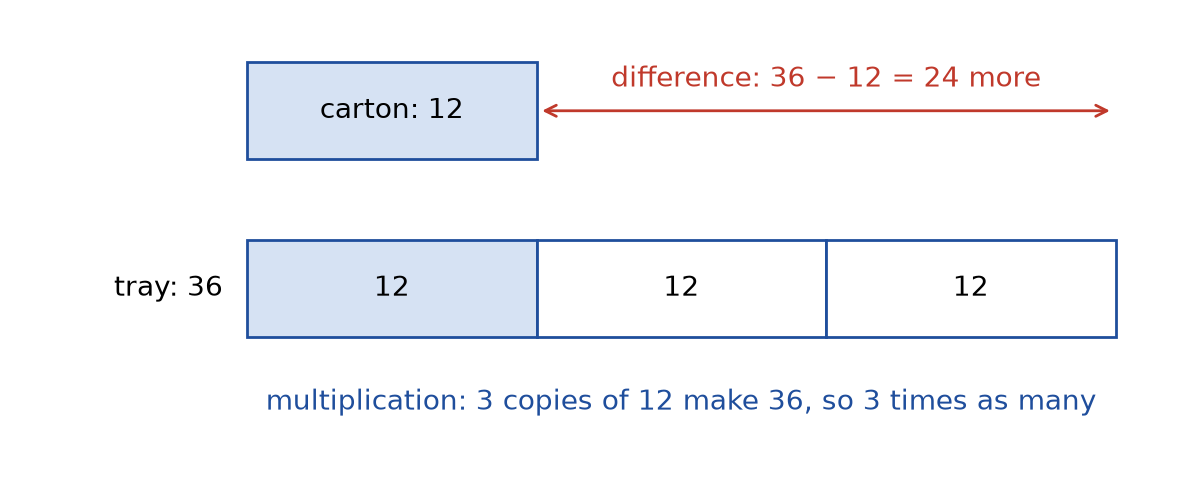
A carton holds 12 eggs. A tray holds 36 eggs.
By difference: 36 − 12 = 24. The tray holds 24 more eggs than the carton.
By multiplication: 36 ÷ 12 = 3. The tray holds 3 times as many eggs as the carton.
Check: 3 × 12 = 36. ✓ Figure 1.1 shows both comparisons at once.
Turn it around. Now let’s describe the carton, using the tray as the reference amount: 12 ÷ 36 = 1/3. The carton holds one-third as many eggs as the tray. Changing the reference amount changes the factor. This is why the order of a comparison matters. Chapter 2 explains fractions like 1/3 fully.
“Times as much” versus “times more”
A $45 concert ticket is 3 times as much as a $15 ticket, because 3 × $15 = $45. It is also $30 more, because $45 − $15 = $30.
You will often hear “three times more.” Some people mean “3 times as much” ($45). Others read it as the original plus three times the original ($15 + $45 = $60). Because it’s ambiguous, this book avoids it. Say “3 times as much” or “$30 more” instead.
Check yourself 1.3 A small pack has 8 batteries and a bulk pack has 48. Compare them both ways. Answer: By difference, 48 − 8 = 40 more batteries. By multiplication, 48 ÷ 8 = 6, so the bulk pack has 6 times as many. Check: 6 × 8 = 48. ✓
Good stopping point.
1.5 Which comparison fits the decision?
Let’s go back to Amira and Ben.
Worked Example 1.4 · Two $100 increases
| Before | After | Difference | Factor (after ÷ before) | |
|---|---|---|---|---|
| Amira’s rent | $900 | $1,000 | $100 | 1,000 ÷ 900 ≈ 1.1 |
| Ben’s storage | $50 | $150 | $100 | 150 ÷ 50 = 3 |
(The symbol ≈ means “is approximately equal to.” The exact value of 1,000 ÷ 900 is 1.111…, which goes on forever. Chapter 3 covers decimals like this one.)
What each comparison tells us: - By difference: each of them has $100 less to spend every month. If they have similar budgets, the strain on their money is the same. - By multiplication: Ben’s cost tripled, while Amira’s rose by about a tenth. Measured against what each used to pay, Ben’s jump is far larger.
Neither is “the right one.” An honest description often gives both.
The reverse also happens. A $2 item that rises to $4 and a $200 item that rises to $400 have both doubled (factor 2). But the differences are $2 and $200. A shopper might ignore the first change and feel the second one hard.
A quick guide
| Use the difference when you need to know… | Use the factor when you need to know… |
|---|---|
| whether something fits a fixed budget | how big a change is compared with where it started |
| how much extra time, money, or material you need | how to scale something up or down (recipes, materials) |
| an amount you can count or spend | how to compare changes that started from different sizes |
Looking ahead. A percent is a multiplicative comparison “per hundred.” Ben’s storage cost rose by 200% and Amira’s rent by about 11%. You will calculate these in Chapters 8 and 9.
Good stopping point.
1.6 Units travel with numbers
A number without its unit is only half a fact. “It takes 2” means nothing until you know whether it’s 2 minutes or 2 days. You can compare amounts directly only when they are in the same unit. If they aren’t, convert first.
Here are some conversions used in this chapter.
| Larger unit | Equals |
|---|---|
| 1 hour | 60 minutes |
| 1 day | 24 hours |
| 1 week | 7 days |
| 1 dozen | 12 items |
| 1 kilogram (kg) | 1,000 grams (g) |
| 1 meter (m) | 100 centimeters (cm) |
| 1 foot (ft) | 12 inches (in) |
A practical tip: convert to the smaller unit. This usually keeps every number whole.
Worked Example 1.5 · Bus or train?
The bus to work takes 1 hour 30 minutes. The train takes 30 minutes.
A tempting mistake: “1 against 30.” Those numbers are in different units, so comparing them means nothing.
Step 1: Convert. 1 hour 30 minutes = 60 + 30 = 90 minutes.
Step 2: Compare by difference. 90 − 30 = 60. The bus takes 60 minutes longer each way.
Step 3: Compare by multiplication. 90 ÷ 30 = 3. The bus takes 3 times as long. Check: 3 × 30 = 90. ✓
Step 4: Ask what the decision needs. Traveling there and back 5 days a week, the extra time is 60 minutes × 2 trips × 5 days = 600 minutes, and 600 ÷ 60 = 10 hours a week. That’s the number to weigh against the train fare.
Good stopping point.
Practical activity · Your two-way comparison log
Time: 15 to 20 minutes. Materials: paper, plus any receipts, bills, timetables, or labels you have. You can also work from memory.
- Find three pairs of amounts from your own week. Each pair must be the same kind of thing: two prices, two travel times, two bills, or hours worked in two weeks.
- Write both amounts in the same unit. Convert if you need to.
- Compare each pair by difference and by multiplication (larger ÷ smaller). If the division doesn’t come out evenly, write it as a division, such as “84 ÷ 63.” You will learn neater forms in Chapters 2 and 3.
- For each pair, write one sentence: which comparison matters more for a decision, and why?
A sample row:
| Pair | A | B | Difference | Factor |
|---|---|---|---|---|
| Water bill, spring and summer | $40 | $80 | $40 | 80 ÷ 40 = 2 |
Sample sentence: “For my budget, the $40 difference matters most, because I need to set aside $40 more for summer months.”
Keep your log. You will build on it in the Chapter 12 project.
Common mistakes
- Comparing different units. “2 hours against 30 minutes” is not “2 against 30.” Convert first: 120 minutes against 30 minutes.
- Dividing in the wrong order. “How many times as much is A as B?” means A ÷ B. Say the comparison out loud, then check it by multiplying back. The factor times the reference amount should give the amount being described.
- Saying “times more.” It’s ambiguous. Use “times as much” for a factor, and “more” with a difference.
- Ignoring what the remainder means. 50 ÷ 8 gives 6 full rows, but seating everyone takes 7.
- Treating a big difference as a big change, or the other way round. A $100 rise is small next to rent and huge next to a storage fee. Check both comparisons.
Going further (optional) · Why the checks work
Every check in this chapter relies on multiplication and division undoing each other: if A ÷ B = n, then n × B = A. For example, 36 ÷ 12 = 3 and 3 × 12 = 36. This is an established result of arithmetic. It holds for any numbers A and B, provided B is not zero.
Why not zero? Dividing 5 by 0 would ask, “What number times 0 gives 5?” Any number times 0 is 0, so no such number exists. That’s why division by zero is undefined.
Claims about the world are different. “Prices are three times what they were” is only as reliable as the two prices behind it and the dates chosen. Chapter 11 shows how to question such claims.
Summary
- In place value, each place is worth 10 times the place to its right.
- With division, the situation decides what a remainder means.
- Difference (subtracting) tells you how much more, in the original units.
- Factor (dividing) tells you how many times as much, measured against a reference amount.
- The two answer different questions. Honest descriptions often use both.
- Compare only amounts in the same unit. Convert first.
Key terms: whole numbers · digits · place value · sum · difference · product · quotient · remainder · comparison by difference · comparison by multiplication · factor · reference amount · unit · convert
Review questions
Try each question before you look at the answers. Questions 1 to 6 practice single skills. Questions 7 to 9 ask you to combine them.
- Write 2,050,316 in words. What is the 5 worth?
- A food bank has 75 cans to pack into boxes of 12. (a) How many boxes can be filled completely? (b) How many cans are left over? (c) If every can must be packed, how many boxes are needed?
- Job A pays $320 a week and Job B pays $275 a week. What is the difference per week? Over 4 weeks?
- Kim earns $32 an hour and Dana earns $16 an hour. (a) How many times as much does Kim earn per hour? (b) What is the difference per hour? (c) What is the difference over a 30-hour week?
- A ticket cost $20 last year and costs $60 this year. Write one correct sentence comparing the prices by difference and one comparing them by multiplication. Why should you avoid “three times more”?
- A clerk types $1,050 as $150. How much too low is the typed amount? How many times as large is the correct amount?
- For each situation, say whether a difference or a factor better fits the question, and explain why. (a) You have $50 left for the week. Can you afford the more expensive shampoo? (b) Which price jumped more compared with where it started: $2 to $6, or $30 to $40?
- Find the error and correct it: “The walk takes 45 minutes and the bus takes 1 hour, so the walk takes 44 minutes longer.”
- Challenge. Family A’s weekly groceries rose from $120 to $150. Family B’s rose from $300 to $330. (a) Compare the two increases by difference. (b) Compare each family’s new bill with its old bill by multiplication. Which family’s bill changed more relative to where it started? (c) How much extra will each family pay over a 52-week year?
Explained answers
1. Two million, fifty thousand, three hundred sixteen. The 5 is in the ten-thousands place, so it is worth 50,000. Check: 2,000,000 + 50,000 + 300 + 10 + 6 = 2,050,316. ✓
2. 75 ÷ 12 = 6 remainder 3, because 6 × 12 = 72 and 75 − 72 = 3. (a) 6 boxes can be filled. (b) 3 cans are left. (c) Those 3 cans still need a box, so 7 boxes are needed.
3. $320 − $275 = $45 a week. Over 4 weeks, $45 × 4 = $180. Check: $320 × 4 = $1,280, $275 × 4 = $1,100, and $1,280 − $1,100 = $180. ✓
4. (a) $32 ÷ $16 = 2, so Kim earns 2 times as much per hour. Check: 2 × 16 = 32. ✓ (b) $32 − $16 = $16 an hour. (c) $16 × 30 = $480. Check: Kim earns $960 and Dana earns $480 for 30 hours, and $960 − $480 = $480. ✓
5. By difference: “This year’s ticket costs $40 more than last year’s” ($60 − $20 = $40). By multiplication: “This year’s ticket costs 3 times as much as last year’s” ($60 ÷ $20 = 3). “Three times more” is ambiguous. Some readers would take it to mean $20 + 3 × $20 = $80, which is wrong here.
6. $1,050 − $150 = $900 too low. And $1,050 ÷ $150 = 7, so the correct amount is 7 times as large as the typed one. Check: 7 × 150 = 1,050. ✓ One missing zero caused a large error.
7. (a) Difference. You need to know whether the extra money fits within $50, so the actual dollar amount is what matters. (b) Factor. The question asks about the change compared with each starting price. $6 ÷ $2 = 3, so the first price tripled. $40 ÷ $30 = 1⅓ (about 1.33), so the second rose by a third. The $2-to-$6 jump is bigger relative to its start, even though its difference ($4) is smaller than the other one ($10).
8. The error is mixing units: it treats “1 hour” as 1 and subtracts it from 45. Convert first: 1 hour = 60 minutes. Then 60 − 45 = 15. The walk takes 15 minutes less than the bus, not 44 minutes more.
9. (a) Family A: $150 − $120 = $30. Family B: $330 − $300 = $30. The same $30 increase. (b) Family A: 150 ÷ 120 = 1.25, so the new bill is 1¼ times the old one. Family B: 330 ÷ 300 = 1.1, so the new bill is 1 and one-tenth times the old one. Family A’s bill changed more relative to where it started. (In Chapter 9 you will describe this as a 25% rise against a 10% rise.) (c) Each family pays $30 × 52 = $1,560 more over a year. Check: 30 × 50 = 1,500, plus 30 × 2 = 60, gives 1,560. ✓
Connections
- Chapter 2 makes answers like “one-third as many” precise with fractions.
- Chapters 4 and 8 to 10 build ratios and percents on multiplicative comparison.
- Other MORI books: U02 Algebra: Expressions, Equations, and Models turns “A = n × B” into equations you can solve. F24 Personal Finance and Consumer Decision-Making uses both kinds of comparison for real budgets.
Sources consulted for scope and accuracy: OpenStax, Prealgebra 2e (Chapter 1, Whole Numbers, and Section 5.6, Ratios and Rate), https://openstax.org/details/books/prealgebra-2e, CC BY 4.0. NIST SP 811 for unit names and conversions, https://www.nist.gov/pml/special-publication-811. All examples and exercises in this chapter are original to MORI University.
Chapter 2 · Pieces of a Whole: Fractions
U01 Ratios, Proportions, and Percent · MORI University · Foundation level
Time needed: about 75 to 90 minutes in total, in eight short sections. Each section ends at a good place to stop. You need: a pencil and paper. Measuring cups or a few strips of paper are helpful for the activity, but you can do without them.
Learning goals
By the end of this chapter, you will be able to:
- Describe a fraction as part of a whole, as a point on a number line, and as a division.
- Recognize equivalent fractions and write a fraction in simplest form.
- Compare two fractions using a common denominator.
- Add, subtract, multiply, and divide fractions in measuring and sharing situations.
- Convert between mixed numbers and improper fractions.
Start here
In Chapter 1, a carton of 12 eggs held one-third as many eggs as a tray of 36. That answer wasn’t a whole number, and you can’t count it on your fingers. Yet it is perfectly precise. It says that three cartons fill exactly one tray.
Fractions let us describe amounts that fall between whole numbers. You need them for half a cup of rice, three-quarters of a tank of gas, or a two-thirds share of the rent. They are also the first step toward ratios and percents, which are really just fractions put to work.
If fractions were the point where math stopped making sense at school, you are in good company. This chapter goes slowly and stays concrete.
2.1 What a fraction means
A fraction describes equal parts of a whole. It is written with two whole numbers, one above the other:
- The denominator (the bottom number) says how many equal parts the whole is cut into.
- The numerator (the top number) says how many of those parts we have.
A pizza cut into 8 equal slices, with 3 slices eaten, gives the fraction 3/8: 3 parts out of 8 equal parts. The other 5/8 is left.
Two details matter.
- The parts must be equal. If one slice is enormous and the others are tiny, “3 out of 8 slices” no longer means 3/8 of the pizza.
- The whole must be stated. Half of a small pizza is less food than half of a large one. “1/2” alone says nothing about size until we know “1/2 of what.” Keep this question in mind, because it becomes central in Chapter 8.
On a number line. Picture a line from 0 to 1, cut into 8 equal steps. The fraction 3/8 sits at the end of the third step. Every fraction is a single point on the number line, just as every whole number is. Fractions such as 9/8, where the numerator is larger, sit past 1.
Check yourself 2.1 A week has 7 days. You work 5 of them. What fraction of the week do you work, and what fraction is free? Answer: You work 5/7 of the week. The free fraction is 2/7. Check: 5/7 + 2/7 = 7/7 = 1 whole week. ✓
Good stopping point.
2.2 Fractions as division
A fraction is also a division waiting to happen: a/b means a ÷ b.
Worked Example 2.1 · Sharing pizza
Three pizzas are shared equally among 4 people. How much does each person get?
Step 1: Write the division. 3 ÷ 4.
Step 2: Write it as a fraction. 3 ÷ 4 = 3/4 of a pizza each.
Step 3: Check by picturing it. Cut each pizza into 4 quarters. That makes 12 quarters. Shared among 4 people, each person gets 3 quarters, which is 3/4. ✓
This is why the fraction bar and the division sign mean the same thing. When a sharing problem doesn’t come out evenly, the fraction is the exact answer. In Chapter 1, the remainder told us what was left over. Here we cut the leftovers into equal pieces instead.
Good stopping point.
2.3 Equivalent fractions and simplest form
Cut a pizza into 2 halves and take 1 piece: 1/2. Cut the same pizza into 4 quarters and take 2 pieces: 2/4. Cut it into 8 slices and take 4: 4/8. The amount of pizza is the same each time.
Fractions that name the same amount are equivalent fractions. You make one by multiplying (or dividing) the numerator and the denominator by the same number:
1/2 = (1 × 4)/(2 × 4) = 4/8
This works because multiplying top and bottom by 4 is the same as multiplying by 4/4, which equals 1. Multiplying by 1 never changes an amount.
A fraction is in simplest form when no whole number larger than 1 divides both the numerator and the denominator. To simplify, divide both by a number that divides each of them evenly. That number is called a common factor. Repeat until no common factor remains.
Example: 18/24. Both numbers can be divided by 6: 18 ÷ 6 = 3 and 24 ÷ 6 = 4. So 18/24 = 3/4. If you only spotted 2 at first, you’d get 9/12. Then you could divide by 3 to get 3/4. You end up in the same place.
Check yourself 2.2 Simplify 16/40. Answer: Both are divisible by 8: 16 ÷ 8 = 2 and 40 ÷ 8 = 5, giving 2/5. Check: 2 × 8 = 16 and 5 × 8 = 40. ✓
Good stopping point.
2.4 Comparing fractions
When two fractions have the same denominator, the parts are the same size. You just compare numerators: 5/8 is more than 3/8.
When the denominators differ, rewrite both fractions over a common denominator. This is a number that both denominators divide into evenly. Multiplying the two denominators together always works, though a smaller common denominator may also exist.
Worked Example 2.2 · Which car has more gas?
One car’s gauge shows 5/8 of a tank. Another shows 3/5 of a tank. Both tanks are the same size. Which car has more gas?
Step 1: Find a common denominator. 8 × 5 = 40.
Step 2: Rewrite both fractions. - 5/8 = (5 × 5)/(8 × 5) = 25/40 - 3/5 = (3 × 8)/(5 × 8) = 24/40
Step 3: Compare. 25/40 is more than 24/40, so 5/8 of a tank is more. The difference is only 1/40 of a tank, so the gauges look almost the same.
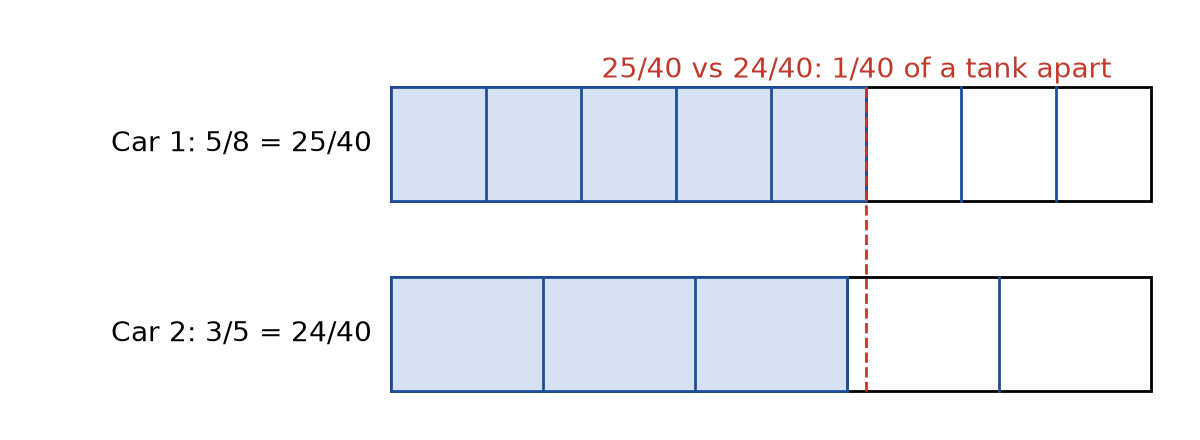
Notice “both tanks are the same size.” If one tank held 12 gallons and the other 18 gallons, 3/5 of the larger tank would be more gas. The whole always matters.
Worked Example 2.3 · Fair shares at two tables
At Table A, 2 pizzas are shared among 3 people. At Table B, 3 pizzas are shared among 5 people. Where does each person get more?
- Table A: 2 ÷ 3 = 2/3 each.
- Table B: 3 ÷ 5 = 3/5 each.
With a common denominator of 15, 2/3 = 10/15 and 3/5 = 9/15. Table A wins, by 1/15 of a pizza per person.
A size-sense shortcut. A larger denominator means smaller pieces. Compare 1/3 with 1/4: thirds are bigger than quarters, so 1/3 is more, even though 4 is bigger than 3.
Good stopping point.
2.5 Adding and subtracting fractions
You can only add parts of the same size. With the same denominator, add (or subtract) the numerators and keep the denominator:
3/8 + 2/8 = 5/8
The denominator stays 8 because the pieces are still eighths. You simply have more of them.
With different denominators, first rewrite both fractions over a common denominator.
Worked Example 2.4 · Flour for two recipes
One recipe needs 3/4 cup of flour and another needs 2/3 cup. How much flour do you need altogether?
Step 1: Common denominator. 4 × 3 = 12.
Step 2: Rewrite. 3/4 = 9/12, and 2/3 = 8/12.
Step 3: Add. 9/12 + 8/12 = 17/12 cups.
Step 4: Make sense of it. 17/12 is more than 12/12, so it’s more than 1 cup. 17/12 = 1 whole cup plus 5/12 of a cup. (Section 2.8 shows this conversion.)
Step 5: Estimate to check. 3/4 is a bit under 1, and 2/3 is a bit under 1, so the total should be a bit under 2 cups. 1 and 5/12 cups fits. ✓
Subtraction works the same way. If you have 17/12 cups of flour and use 1/2 cup (6/12), you have 11/12 cup left.
Good stopping point.
2.6 Multiplying: “a fraction of an amount”
In everyday language, “of” next to a fraction means multiply. “Two-thirds of $1,200” means 2/3 × 1,200.
To multiply a fraction by a whole number, you can divide by the denominator and then multiply by the numerator.
Worked Example 2.5 · A share of the budget
A household spends 2/3 of its $1,200 monthly budget on rent and utilities. How much is that?
Step 1: Find one-third. $1,200 ÷ 3 = $400.
Step 2: Take two of those thirds. $400 × 2 = $800.
Check: The remaining third is $400, and $800 + $400 = $1,200. ✓
To multiply two fractions, multiply the numerators together and the denominators together:
1/2 × 3/4 = (1 × 3)/(2 × 4) = 3/8
You can read this as “half of three-quarters.” If 3/4 of a pan of lasagna is left and you eat half of what’s left, you have eaten 3/8 of the original pan.
Check yourself 2.3 What is 3/4 of $56? Answer: $56 ÷ 4 = $14, and $14 × 3 = $42. Check: the remaining quarter is $14, and $42 + $14 = $56. ✓
Good stopping point.
2.7 Dividing: “how many portions fit?”
Dividing by a fraction answers a grouping question: how many of these portions fit into that amount?
Worked Example 2.6 · Cutting a board
You have a board 6 meters long. You need pieces 3/4 of a meter long. How many full pieces can you cut? (Ignore the small width lost to each saw cut.)
Step 1: Think in quarters. 6 meters is 6 × 4 = 24 quarter-meters.
Step 2: Count portions. Each piece uses 3 quarter-meters. 24 ÷ 3 = 8 pieces.
Step 3: See the rule. We multiplied by 4 and divided by 3. That is the same as multiplying by 4/3:
6 ÷ 3/4 = 6 × 4/3 = 24/3 = 8
The rule: to divide by a fraction, multiply by its reciprocal, which is the fraction turned upside down. The reciprocal of 3/4 is 4/3.
Check: 8 pieces × 3/4 meter = 24/4 = 6 meters. ✓
Check yourself 2.4 How many 2/3-cup servings are in 4 cups of soup? Answer: 4 ÷ 2/3 = 4 × 3/2 = 12/2 = 6 servings. Check: 6 × 2/3 = 12/3 = 4 cups. ✓
Good stopping point.
2.8 Mixed numbers
A fraction with a numerator at least as large as its denominator, such as 17/12, is called an improper fraction. There’s nothing wrong with it. “Improper” is just a traditional name. In recipes and measurements we often write the same amount as a mixed number: a whole number plus a fraction, such as 1 5/12.
Improper to mixed: divide the numerator by the denominator. The quotient is the whole number, and the remainder goes over the denominator. 17 ÷ 12 = 1 remainder 5, so 17/12 = 1 5/12.
Mixed to improper: multiply the whole number by the denominator, add the numerator, and keep the denominator. 2 3/4 = (2 × 4 + 3)/4 = 11/4.
For multiplying and dividing, convert mixed numbers to improper fractions first. For adding, you can add the whole numbers and the fractions separately:
1 1/2 + 2 3/4 = (1 + 2) + (2/4 + 3/4) = 3 + 5/4 = 3 + 1 1/4 = 4 1/4
Good stopping point.
Practical activity · Build a fraction kit
Time: 20 minutes. Materials: a set of measuring cups and some water, or four strips of paper the same length.
Option A: kitchen. 1. Fill the 1/4 cup and pour it into the 1-cup measure. How many quarter-cups fill one cup? Repeat with the 1/3 cup. 2. Pour 1/2 cup and then 1/4 cup into the 1-cup measure. Where does the water reach? Write the sum as a fraction. 3. Predict, then test: do two 1/3-cups hold more or less than 3/4 cup?
Option B: paper strips. 1. Leave one strip whole. Fold the others into halves, quarters, and eighths, then cut along the folds. 2. Lay pieces against the whole strip to show that 2/4 = 4/8 = 1/2. 3. Show 3/8 + 1/4 with the pieces, and write the answer.
Record: three equivalences and two sums you found, each written as a number sentence.
Common mistakes
- Adding tops and bottoms. 1/2 + 1/3 is not 2/5. Rewrite as 3/6 + 2/6 = 5/6. A quick check catches this mistake: 2/5 is less than 1/2, and adding something can’t make the total smaller than what you started with.
- Thinking a bigger denominator means a bigger fraction. 1/8 is smaller than 1/4, because the pieces are smaller.
- Comparing fractions of different wholes. 1/2 of an 18-gallon tank holds more than 1/2 of a 12-gallon tank.
- Turning over the wrong fraction. In 6 ÷ 3/4, only the divisor (3/4) is flipped: 6 × 4/3, not 1/6 × 3/4.
- “Simplifying” by subtracting. 6/8 doesn’t become 4/6 by taking 2 from each. Divide by the same number: 6/8 = 3/4.
Going further (optional) · Why the common-denominator method is reliable
Why can we change 3/4 into 9/12 before adding? Because 9/12 is exactly the same number as 3/4, so it sits at the same point on the number line. All we’ve done is cut the same amount into smaller, equal pieces. The rule “multiply top and bottom by the same number” is an established result: (a × n)/(b × n) = a/b for any whole numbers a, b, and n, as long as b and n are not 0. Every fraction method in this book, and every equivalent ratio in Chapter 6, rests on this one fact.
Summary
- A fraction counts equal parts (the numerator) out of a whole cut into a number of parts (the denominator). Always ask, “of what whole?”
- A fraction is also a division: a/b = a ÷ b.
- Multiplying or dividing top and bottom by the same number gives an equivalent fraction.
- To compare, add, or subtract fractions, first rewrite them over a common denominator.
- “Of” means multiply. To divide by a fraction, multiply by its reciprocal.
- Mixed numbers and improper fractions are two ways to write the same amount.
Key terms: fraction · whole · numerator · denominator · equivalent fractions · simplest form · common factor · common denominator · reciprocal · improper fraction · mixed number
Review questions
Questions 1 to 6 practice single skills. Questions 7 to 9 combine them.
- A pizza is cut into 8 equal slices, and 3 are eaten. What fraction is eaten, and what fraction is left?
- Simplify (a) 45/60 and (b) 14/35.
- Which is larger, 7/12 or 5/8? By how much?
- Calculate (a) 1/2 + 1/3 and (b) 5/6 − 1/4.
- What is 3/5 of $85?
- Write 2 3/4 as an improper fraction, and write 23/5 as a mixed number.
- A bread recipe uses 1 1/2 cups of white flour and 2 3/4 cups of whole-wheat flour. How much flour is that in total? Estimate first, then calculate.
- A shelf board is 2 1/4 yards long. How many 3/8-yard pieces can you cut from it (ignoring saw cuts)?
- Jo says, “1/2 + 1/3 = 2/5, because you add the tops and add the bottoms.” Explain to Jo, kindly and precisely, why this can’t be right, and give the correct answer.
Explained answers
1. Eaten: 3/8. Left: 8 − 3 = 5 slices, so 5/8. Check: 3/8 + 5/8 = 8/8 = 1. ✓
2. (a) Both 45 and 60 are divisible by 15: 45 ÷ 15 = 3 and 60 ÷ 15 = 4, so 3/4. (Dividing by 5 first gives 9/12, then dividing by 3 gives 3/4.) (b) Both are divisible by 7: 2/5.
3. A common denominator is 24: 7/12 = 14/24, and 5/8 = 15/24. So 5/8 is larger, by 1/24.
4. (a) 1/2 = 3/6 and 1/3 = 2/6, so the sum is 5/6. (b) 5/6 = 10/12 and 1/4 = 3/12, so the difference is 7/12. Check (b): 7/12 + 3/12 = 10/12 = 5/6. ✓
5. $85 ÷ 5 = $17, and $17 × 3 = $51. Check: the remaining 2/5 is $34, and $51 + $34 = $85. ✓
6. 2 3/4 = (2 × 4 + 3)/4 = 11/4. And 23 ÷ 5 = 4 remainder 3, so 23/5 = 4 3/5.
7. Estimate: about 1 1/2 + 3 = 4 1/2, but a little less, because 2 3/4 is under 3. Calculate: the wholes give 1 + 2 = 3. The fractions give 1/2 + 3/4 = 2/4 + 3/4 = 5/4 = 1 1/4. Total: 3 + 1 1/4 = 4 1/4 cups. This fits the estimate. ✓
8. 2 1/4 = 9/4 yards. Then 9/4 ÷ 3/8 = 9/4 × 8/3 = 72/12 = 6 pieces. Check: 6 × 3/8 = 18/8 = 9/4 = 2 1/4 yards. ✓ The board makes exactly 6 pieces with nothing left over, in theory. In practice, each saw cut removes a little wood, so the last piece would come out slightly short. Chapter 7 deals with allowances like this.
9. Adding tops and bottoms treats halves and thirds as if they were the same size of piece, and they aren’t. You can also see that 2/5 must be wrong because it is less than 1/2, and adding 1/3 to 1/2 has to give more than 1/2. Rewrite both in sixths: 1/2 = 3/6 and 1/3 = 2/6, so 1/2 + 1/3 = 5/6.
Connections
- Chapter 3 turns fractions into decimals: 3/4 = 0.75, the form a calculator and a price tag use.
- Chapter 4 writes ratios as fractions, and Chapter 8 shows that a percent is a fraction with denominator 100.
- Chapter 7 uses fraction multiplication to scale recipes.
- Other MORI books: U22 Measure and Lay Out Before Making uses fractional inches constantly, and F16 Nutrition, Meal Planning, and Kitchen Economics uses fractional servings.
Sources consulted for scope and accuracy: OpenStax, Prealgebra 2e (Chapter 4, Fractions), https://openstax.org/details/books/prealgebra-2e, CC BY 4.0. All examples and exercises are original to MORI University.
Chapter 3 · Decimals, Money, and Rounding
U01 Ratios, Proportions, and Percent · MORI University · Foundation level
Time needed: about 75 minutes in total, in six short sections. Each section ends at a good place to stop. You need: a pencil, paper, a calculator (a phone calculator is fine), and, if you have one, a recent store receipt.
Learning goals
By the end of this chapter, you will be able to:
- Read decimal place value to the thousandths and compare decimals correctly.
- Convert between fractions and decimals, including repeating decimals.
- Add, subtract, multiply, and divide amounts of money accurately.
- Choose how to round, and in which direction, based on the situation.
- Use an estimate to catch calculator and keying errors.
- Read decimal measurements in metric and US units, and convert decimal parts of US units.
Start here
Prices, paychecks, gas pumps, and kitchen scales all speak in decimals. A decimal is just a fraction written in place-value form. $3.49 means 3 dollars plus 49 hundredths of a dollar.
Decimals are easy to type into a calculator, and that makes them easy to get wrong without noticing. A misplaced point turns $10.68 into $106.80. This chapter builds the habits that catch errors like that before they cost you anything.
3.1 Decimal place value
In Chapter 1, each place was worth 10 times the place to its right. Decimals simply continue that pattern to the right of the ones place. The dot that separates whole numbers from parts is the decimal point.
| Place | ones | . | tenths | hundredths | thousandths |
|---|---|---|---|---|---|
| Value | 1 | . | 1/10 | 1/100 | 1/1,000 |
| Digits of 4.075 | 4 | . | 0 | 7 | 5 |
So 4.075 means 4 + 0/10 + 7/100 + 5/1,000. You say it “four and seventy-five thousandths.”
Comparing decimals. Line up the decimal points and compare place by place from the left. To compare 0.6 with 0.58, look at the tenths first: 6 tenths beats 5 tenths, so 0.6 is larger. The number of digits doesn’t matter. It helps to write a trailing zero, so 0.6 becomes 0.60. Now you are comparing 60 hundredths with 58 hundredths. Adding a zero at the end of a decimal never changes its value.
Check yourself 3.1 Put in order from smallest to largest: 0.3, 0.29, 0.305. Answer: Write all three to thousandths: 0.300, 0.290, 0.305. The order is 0.29, 0.3, 0.305.
Good stopping point.
3.2 Fractions and decimals
Decimal to fraction. Read the decimal aloud and write what you hear. 0.35 is “thirty-five hundredths,” so it is 35/100. That simplifies to 7/20.
Fraction to decimal. A fraction is a division (Chapter 2), so divide the numerator by the denominator.
- 3/4 = 3 ÷ 4 = 0.75
- 5/8 = 5 ÷ 8 = 0.625
- 1/3 = 1 ÷ 3 = 0.333…
The last one never stops, because the 3s go on forever. It is a repeating decimal, sometimes written with a bar over the repeating digit. A calculator shows 0.33333333 because the screen runs out of room. It isn’t showing the exact value.
Worked Example 3.1 · Thirds of a bill
Three friends split a dinner bill of $47.80 equally. How much does each person pay?
Step 1: Divide. $47.80 ÷ 3 = $15.9333…, which repeats.
Step 2: Round to cents. That is about $15.93 each.
Step 3: Check the total. 3 × $15.93 = $47.79. That is 1 cent short.
Step 4: Fix it fairly. Two people pay $15.93 and one pays $15.94. $15.93 + $15.93 + $15.94 = $47.80. ✓
This is not a mistake in your arithmetic. $47.80 simply can’t be split into three equal whole-cent amounts. Banks and payroll systems deal with this leftover penny all the time.
Check yourself 3.2 Write 3/8 as a decimal. Answer: 3 ÷ 8 = 0.375. Check: 0.375 × 8 = 3. ✓
Good stopping point.
3.3 Money arithmetic
Adding and subtracting: line up the decimal points, not the last digits. Write every amount with two decimal places, so $5 becomes $5.00.
Worked Example 3.2 · Checking a receipt
A receipt lists the following:
| Item | Price |
|---|---|
| Bread | $3.49 |
| Coffee | $12.99 |
| 3 limes at $0.89 each | ? |
| Cheese | $5.25 |
Step 1: Multiply the limes. 3 × $0.89 = $2.67.
Step 2: Add, with points lined up. $3.49 + $12.99 + $2.67 + $5.25 = $24.40.
Step 3: Estimate to check. Round each price to the nearest dollar: 3 + 13 + 3 + 5 = $24. The calculated $24.40 is close to that. ✓
Multiplying decimals. Multiply as if the decimal points weren’t there. Then count the decimal places in both factors together, and put the same number of decimal places in the answer. For 2.5 × 3.98, multiply 25 × 398 = 9,950. The factors have 1 + 2 = 3 decimal places, so the answer is 9.950, or $9.95. That is the cost of 2.5 pounds of apples at $3.98 a pound. Estimate: 2.5 × 4 = 10. ✓
Dividing by a whole number. Divide as usual and keep the decimal point in line. $125.00 ÷ 4 = $31.25 exactly.
Dividing by a decimal. Move the decimal point in the divisor to the right until it becomes a whole number, and move the point in the number being divided the same number of places. Both numbers are then multiplied by the same power of 10, so the answer doesn’t change. This is the same idea as equivalent fractions in Chapter 2.
Worked Example 3.3 · How many bottles?
A 1.5-liter bottle of water costs $1.20. You have $9.00. How many bottles can you buy?
Step 1: Set up the division. $9.00 ÷ $1.20.
Step 2: Make the divisor whole. Move both points one place to the right: 90 ÷ 12.
Step 3: Divide. 90 ÷ 12 = 7.5. You can’t buy half a bottle, so you can buy 7 bottles.
Step 4: Check. 7 × $1.20 = $8.40, which leaves $0.60. That isn’t enough for an eighth bottle. ✓
Check yourself 3.3 You pay for a $13.67 order with a $20 bill. How much change should you get? Answer: $20.00 − $13.67 = $6.33. Check by “counting up,” the way a cashier does: $13.67 + $0.33 = $14.00, and $14.00 + $6.00 = $20.00. So the change is $0.33 + $6.00 = $6.33. ✓
Good stopping point.
3.4 Rounding with a reason
Rounding replaces a number with a nearby, simpler one. The usual rule for rounding to a chosen place: look at the next digit to the right. If it is 5 or more, round up. If it is 4 or less, round down.
- 2.346 to the nearest tenth: the next digit is 4, so 2.3.
- 2.346 to the nearest hundredth: the next digit is 6, so 2.35.
The usual rule is only a default. The situation decides which way you should round.
| Situation | Direction | Why |
|---|---|---|
| Paint needed: 2.3 gallons | Up, to 3 gallons | 2 gallons won’t finish the job |
| Books 7.5 inches thick on a 100-inch shelf: 13.3 fit | Down, to 13 | a third of a book won’t fit |
| A price to the cent | Nearest | that’s the convention for money |
| A middle step of a calculation | Don’t round yet | early rounding adds up to errors |
Worked Example 3.4 · Paying at the pump
US gas prices are usually posted to a tenth of a cent, such as $3.459 per gallon. You pump 12.5 gallons. What do you pay?
Step 1: Multiply. 12.5 × $3.459 = $43.2375.
Step 2: Round only at the end, to the nearest cent. The digit after the cents place is 7, so you pay $43.24.
Step 3: Estimate. 12.5 × $3.50 is about $43.75, which is close. ✓
The “.9” at the end of the price is nine-tenths of a cent. For this fill-up it adds 12.5 × $0.009 = $0.1125, about 11 cents. It’s small, but it’s real.
Check yourself 3.4 A job needs 7.2 square yards of carpet, and the store sells it only in whole square yards. How much should you buy? Which way did you round, and why? Answer: 8 square yards. You round up, because 7 square yards would leave part of the floor bare.
Good stopping point.
3.5 Calculators and sanity checks
A calculator does exactly what you type. If you hit the wrong key, it gives you the wrong answer without any warning. An estimate is your defense. Round the numbers to friendly values, work the problem roughly in your head, and compare.
Worked Example 3.5 · A misplaced decimal point
A dozen pens cost $0.89 each. A coworker’s calculator shows the total as $106.80. Is that right?
Step 1: Estimate. About $1 each × 12 = about $12.
Step 2: Compare. $106.80 is roughly ten times the estimate. That points to a decimal slip. The coworker probably typed 8.9 instead of 0.89.
Step 3: Recalculate. 12 × $0.89 = $10.68. That is close to $12. ✓
Three quick checks to use with any calculator result: 1. Size: Is it about as big as your estimate? 2. Direction: Did a total go up when you added? Is each share less than the whole? 3. Reverse: Undo it. Here, $10.68 ÷ 12 = $0.89. ✓ (This is the inverse-operation check from Chapter 1.)
Check yourself 3.5 Estimate 4.9 × 19.8, then calculate it. Answer: Estimate 5 × 20 = 100. Exact: 97.02, which is close to 100. ✓
Good stopping point.
3.6 Decimals in measurement: metric and US units
The metric system is built on 10, just like decimals. That makes metric conversions a matter of moving the decimal point:
- 1 kilogram (kg) = 1,000 grams (g), so 1.25 kg = 1,250 g.
- 1 liter (L) = 1,000 milliliters (mL), so 0.75 L = 750 mL.
- 1 meter (m) = 100 centimeters (cm), so 2.4 m = 240 cm.
US customary units are not built on 10, so a decimal part of a US unit has to be converted with care:
- 1 pound (lb) = 16 ounces (oz), so 1.5 lb = 1 lb + 0.5 × 16 oz = 1 lb 8 oz.
- 1 foot (ft) = 12 inches (in), so 2.75 ft = 2 ft + 0.75 × 12 in = 2 ft 9 in.
Worked Example 3.6 · Reading a deli scale
A deli scale shows 1.3 lb of cheese. How many pounds and ounces is that?
Step 1: Keep the whole pounds. That’s 1 lb.
Step 2: Convert the decimal part. 0.3 × 16 oz = 4.8 oz.
Step 3: Answer. 1 lb 4.8 oz, or about 1 lb 5 oz. It is not 1 lb 3 oz. That reading would come from treating the “.3” as if it meant 3 ounces.
Measurements are rounded, too. A kitchen scale that reads to the nearest gram, or a tape measure marked to 1/16 inch, gives a rounded value. When you calculate with measured amounts, don’t report more decimal places than the measurement supports. A board measured as 2.4 m is not “exactly 2.400 m.”
Check yourself 3.6 Convert 0.25 ft to inches, and 3.2 kg to grams. Answer: 0.25 × 12 in = 3 in. And 3.2 × 1,000 g = 3,200 g.
Good stopping point.
Practical activity · Audit a receipt
Time: 15 to 20 minutes. Materials: a store receipt (or the sample in Worked Example 3.2), a pencil, and a calculator.
- Estimate the total before you add anything, by rounding each line to the nearest dollar.
- Add the item prices exactly. Check any lines for multiple items (quantity × unit price).
- Compare your total with the receipt’s subtotal. If they differ, find the line that explains the difference.
- If the receipt shows tax, note the tax amount. You’ll work out its rate in Chapter 8.
- Write one sentence: “My estimate was , the exact subtotal was , and they differ by ___.”
Common mistakes
- Lining up the last digits instead of the decimal points. $12.99 + $5 isn’t $13.04. Write $5.00, and the sum is $17.99.
- “More digits means bigger.” 0.29 is less than 0.3. Add trailing zeros to compare: 0.29 vs 0.30.
- Rounding too early. Round once, at the end. Rounding each step can leave you several cents off.
- Rounding in the wrong direction. For materials you need to finish a job, round up. For how many will fit, round down.
- Trusting the screen. Always compare a calculator answer with an estimate.
- Reading a decimal US unit as if it were a mixed unit. 1.3 lb is 1 lb 4.8 oz, not 1 lb 3 oz, and 5.5 ft is 5 ft 6 in, not 5 ft 5 in. A pound has 16 ounces and a foot has 12 inches, not 10, so the decimal part must be multiplied out.
Going further (optional) · Which fractions end, and which repeat?
Some fractions become decimals that end, such as 3/4 = 0.75. Others repeat forever, such as 1/3 = 0.333…. Here is the rule. Take a fraction in simplest form. Its decimal ends exactly when the denominator’s only prime factors are 2 and 5, the prime factors of 10. So 3/8 ends, because 8 = 2 × 2 × 2. And 7/20 ends, because 20 = 2 × 2 × 5. But 1/3, 1/6 and 1/7 repeat. This is an established result of number theory. It explains why some prices can’t be split evenly to the cent, as in Worked Example 3.1.
Summary
- Decimal places continue the place-value pattern: tenths, hundredths, thousandths.
- To compare decimals, line up the points and compare from the left. Trailing zeros help.
- A fraction becomes a decimal by division. Some decimals repeat forever.
- With money, line up the points, count decimal places when multiplying, and round to the cent at the end.
- Round in the direction the situation needs, not just by the default rule.
- Estimate before you trust a calculator.
- Metric conversions move the decimal point. A decimal part of a US unit has to be converted: 0.5 lb is 8 oz, not 5 oz.
Key terms: decimal · decimal point · trailing zero · repeating decimal · rounding · estimate · metric system · US customary units
Review questions
Questions 1 to 6 practice single skills. Questions 7 to 9 combine them.
- Write 4.07 in words, and name the value of the 7.
- Which is larger, 0.45 or 0.5? Explain in one sentence.
- Convert 5/8 to a decimal and 0.35 to a fraction in simplest form.
- Round 7.4962 to the nearest hundredth.
- Three roommates split a $100.00 utility bill. Show a fair split in whole cents.
- Apples cost $3.98 a pound. What do 2.5 pounds cost? Also write 2.5 pounds in pounds and ounces.
- A worker’s timesheet shows 3.5 hours at $32.84 an hour, and the payment shows $1,149.50. Estimate, decide whether that’s plausible, and find the correct amount.
- You pump 14.2 gallons at $3.879 a gallon. Estimate, then find what you pay.
- A recipe calls for 0.75 liter of stock, and you have a 2-liter carton. How many full batches can you make, and should you round up or down?
Explained answers
1. “Four and seven hundredths.” The 7 is in the hundredths place, so it is worth 7/100, or 0.07.
2. 0.5 is larger. Written to hundredths it is 0.50, and 50 hundredths is more than 45 hundredths.
3. 5 ÷ 8 = 0.625. And 0.35 = 35/100 = 7/20. Check: 7 ÷ 20 = 0.35. ✓
4. The digit after the hundredths place is 6, so round up: 7.50. Keep the trailing zero. It shows that the number was rounded to hundredths.
5. $100.00 ÷ 3 = $33.333…, which can’t be split evenly to the cent. A fair split is $33.33, $33.33, and $33.34. Check: 33.33 + 33.33 + 33.34 = 100.00. ✓
6. 2.5 × $3.98 = $9.95. Estimate: 2.5 × $4 = $10. ✓ In pounds and ounces, 0.5 × 16 oz = 8 oz, so 2.5 lb = 2 lb 8 oz.
7. Estimate: 3.5 × $33 is about $115. $1,149.50 is roughly ten times that, so it’s not plausible. Someone probably slipped a decimal point. Correct: 3.5 × $32.84 = $114.94. Reverse check: $114.94 ÷ 3.5 = $32.84. ✓
8. Estimate: 14 × $4 = $56. Exact: 14.2 × $3.879 = $55.0818, which rounds to $55.08. It’s close to the estimate. ✓
9. 2 ÷ 0.75 = 2.666…, so you can make 2 full batches. Round down, because two-thirds of a batch is not a full batch. You’ll have 2 − 1.5 = 0.5 liter of stock left over.
Connections
- Chapter 5 uses decimal division to find unit prices and hourly pay.
- Chapter 8 turns decimals into percents: 0.75 = 75%.
- Chapter 11 expands the estimate-and-check habit into a full toolkit for checking claims.
- Other MORI books: F24 Personal Finance and Consumer Decision-Making applies money arithmetic to budgets and bills. U04 Statistics: Samples, Center, and Spread discusses rounding and precision in reported data.
Sources consulted for scope and accuracy: OpenStax, Prealgebra 2e (Chapter 5, Decimals), https://openstax.org/details/books/prealgebra-2e, CC BY 4.0; NIST Special Publication 811 on writing numbers, https://www.nist.gov/pml/special-publication-811. All examples and exercises are original to MORI University. Example prices are illustrative, not current market data.
Chapter 4 · Ratios: Part-to-Part and Part-to-Whole
U01 Ratios, Proportions, and Percent · MORI University · Foundation level
Time needed: about 75 minutes in total, in six short sections. Each section ends at a good place to stop. You need: a pencil and paper. A calculator is optional.
Learning goals
By the end of this chapter, you will be able to:
- Write a ratio in words, with a colon, and as a fraction.
- Tell a part-to-part ratio from a part-to-whole ratio, and convert one into the other.
- Simplify ratios, including ratios with decimals, fractions, or different units.
- Split a total in a given ratio, including ratios with three parts.
- Explain why the order and the labels of a ratio matter.
Start here
A bottle of juice concentrate says: “Mix 1 part concentrate with 4 parts water.” What fraction of the finished drink is concentrate?
Many people answer 1/4. The correct answer is 1/5. One cup of concentrate plus four cups of water makes five cups of drink, and only one of those five is concentrate.
The difference between “1 to 4” and “1 out of 5” is the main idea of this chapter. It’s a small distinction, but mixing the two up causes real errors in recipes, building materials, workplace reports, and news stories.
4.1 What a ratio compares
A ratio compares two or more quantities by multiplication, the way Chapter 1 compared amounts by asking “how many times as much?” If a class has 12 women and 8 men, the ratio of women to men is 12 to 8. For every 3 women there are 2 men, so there are 1.5 times as many women as men.
A ratio describes a relationship, not the actual amounts. A class of 3 women and 2 men has the same ratio as a class of 12 women and 8 men, or one of 30 women and 20 men. The numbers in a ratio are called its terms.
Ratios usually compare quantities of the same kind, such as people with people or cups with cups. When the two quantities have different units, such as dollars and hours, we call the comparison a rate. Rates are the subject of Chapter 5.
Good stopping point.
4.2 Three ways to write a ratio
The women-to-men ratio can be written three ways:
| Form | Example | Read as |
|---|---|---|
| Words | 12 to 8 | “twelve to eight” |
| Colon | 12 : 8 | “twelve to eight” |
| Fraction | 12/8 | “twelve to eight” (here, not “twelve eighths of a whole”) |
All three say the same thing. The colon form is common in recipes, building and model scales, and mixing instructions. The fraction form is handy for calculating, but be careful. The fraction 12/8 here doesn’t mean “12 parts of a whole cut into 8.” It is just another way of writing “12 compared with 8.” Section 4.3 explains when a ratio really is a part of a whole.
Check yourself 4.1 A parking lot has 25 cars and 10 trucks. Write the ratio of cars to trucks in all three forms. Answer: 25 to 10, 25 : 10, and 25/10. (Section 4.4 will simplify this to 5 : 2.)
Good stopping point.
4.3 Part-to-part versus part-to-whole
When a group is split into parts, there are two kinds of ratio:
- A part-to-part ratio compares one part with another part.
- A part-to-whole ratio compares one part with the whole, which is all the parts added together. A part-to-whole ratio is a fraction in the Chapter 2 sense, and it is exactly what a percent describes (Chapter 8).
Worked Example 4.1 · Volunteers and staff
A food bank shift has 6 volunteers and 9 paid staff.
Part-to-part: volunteers to staff = 6 : 9, which simplifies to 2 : 3.
Part-to-whole: First find the whole: 6 + 9 = 15 people. Volunteers to all workers = 6 : 15. As a fraction, 6/15 = 2/5 of the shift are volunteers.
Check: Staff make up 9/15 = 3/5, and 2/5 + 3/5 = 1 whole shift. ✓
Worked Example 4.2 · Juice concentrate
The label says to mix concentrate and water in the ratio 1 : 4.
Step 1: Find the whole. 1 + 4 = 5 parts in total.
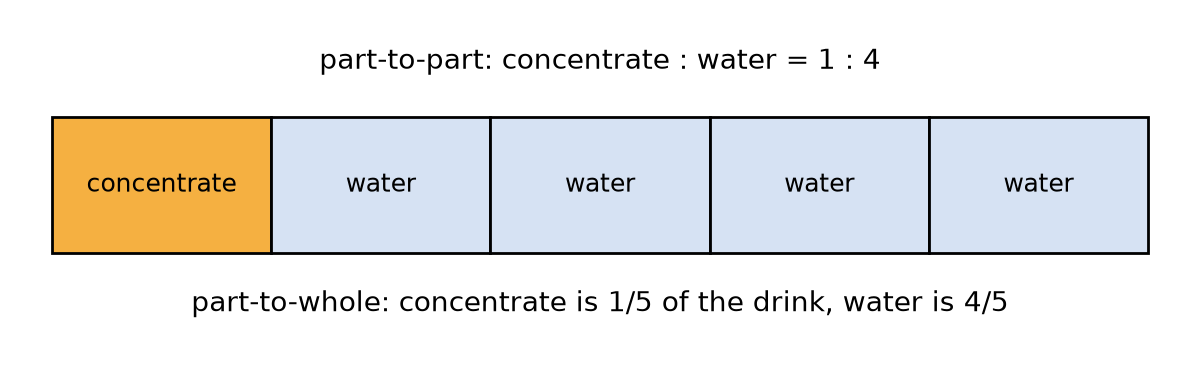
Step 2: Write the part-to-whole fractions. Concentrate is 1/5 of the drink, and water is 4/5.
Step 3: Use it. To make 5 cups of drink, use 1 cup of concentrate and 4 cups of water. To make 2 liters, concentrate is 1/5 × 2 L = 0.4 L (400 mL) and water is 1.6 L.
Check: 0.4 L + 1.6 L = 2 L, and 1.6 ÷ 0.4 = 4, so the ratio is still 1 : 4. ✓
Converting between the two kinds: - From part-to-part a : b, the part-to-whole fractions are a/(a + b) and b/(a + b). - From a part-to-whole fraction such as 2/5, the rest of the whole is 5 − 2 = 3 parts, so the part-to-part ratio is 2 : 3.
“1 in 4” is not “1 to 4.” “One in four adults” means 1 out of every 4 adults, so it is part-to-whole and equals 1/4. “One to four” means 1 part for every 4 other parts, so it is part-to-part and equals 1/5 of the whole. News reports and labels use both. Read the small words carefully.
Check yourself 4.2 In a bag of 20 tiles, 8 are cracked. Give the ratio of cracked to uncracked tiles, and the fraction of all tiles that are cracked. Answer: Uncracked tiles: 20 − 8 = 12. Cracked : uncracked = 8 : 12 = 2 : 3 (part-to-part). Cracked as a fraction of all tiles = 8/20 = 2/5 (part-to-whole).
Good stopping point.
4.4 Simplifying ratios
A ratio is in simplest form when its terms are whole numbers with no common factor larger than 1. You simplify it the same way you simplify a fraction (Chapter 2): divide every term by the same number.
- 12 : 8. Divide both terms by 4 to get 3 : 2.
- 25 : 10. Divide both terms by 5 to get 5 : 2.
Ratios with decimals. Multiply every term by 10, 100, or whatever power of 10 makes them whole, then simplify.
0.75 : 2.25. Multiply by 100 to get 75 : 225. Divide by 75 to get 1 : 3.
Ratios with fractions. Multiply every term by a common denominator.
1/2 : 3/4. Multiply both terms by 4 to get 2 : 3.
Ratios with different units. Convert to the same unit first, then drop the units.
30 cm : 2 m. Write 2 m as 200 cm to get 30 : 200, which simplifies to 3 : 20. If you skipped the conversion, you’d get 30 : 2 = 15 : 1, and that is wildly wrong.
Check yourself 4.3 Simplify 1.5 : 4.5 and 2/3 : 1/2. Answer: 1.5 : 4.5 → (multiply by 10) 15 : 45 → (divide by 15) 1 : 3. And 2/3 : 1/2 → (multiply by 6) 4 : 3.
Good stopping point.
4.5 Ratios with three parts
A ratio can compare more than two quantities. Mixing instructions often do this.
Worked Example 4.3 · A concrete mix
A simple concrete mix is described by volume as 1 : 2 : 3 (cement : sand : gravel). You want 12 buckets of dry mix. How many buckets of each ingredient do you need?
Safety and accuracy note: this is a common teaching ratio, not a specification. Real mixes vary with the job and the product. Follow the manufacturer’s instructions and local building guidance, and wear gloves and eye protection when handling cement.
Step 1: Find the total number of parts. 1 + 2 + 3 = 6 parts.
Step 2: Find the size of one part. 12 buckets ÷ 6 parts = 2 buckets per part.
Step 3: Multiply each term. - Cement: 1 × 2 = 2 buckets - Sand: 2 × 2 = 4 buckets - Gravel: 3 × 2 = 6 buckets
Check: 2 + 4 + 6 = 12. ✓ And 2 : 4 : 6 simplifies back to 1 : 2 : 3. ✓
As part-to-whole fractions, cement is 1/6, sand is 2/6 = 1/3, and gravel is 3/6 = 1/2 of the dry mix.
This “find one part” method splits any total in any ratio. You’ll use it in Review Question 8 to share tips by hours worked.
Check yourself 4.4 Split $900 in the ratio 2 : 3 : 4. Answer: There are 2 + 3 + 4 = 9 parts, and $900 ÷ 9 = $100 per part. The shares are $200, $300, and $400. Check: they sum to $900. ✓
Good stopping point.
4.6 Order and labels
A ratio means nothing without labels, and the order of the terms must match the order of the labels.
“The ratio of women to men is 3 : 2” means more women than men. “The ratio of men to women is 3 : 2” means the opposite. Swapping the order flips the meaning. On the other hand, 3 : 2 and 6 : 4 say the same thing.
Good practice: - Always write the labels with the numbers: “cement : sand : gravel = 1 : 2 : 3.” - When you read a ratio, ask, “Which quantity comes first?” - When you read a part-to-whole statement, ask, “What is the whole?”
A ratio also hides the actual sizes. “Applicants to places is 4 : 1” could mean 40 applicants for 10 places or 4,000 for 1,000. Both have the same ratio, but they are very different situations to plan for. When the actual counts matter, report them alongside the ratio.
Check yourself 4.5 A report says “the ratio of staff to residents is 1 : 6” at a care home with 90 residents. How many staff is that? Could it also mean 6 staff for every resident? Answer: 90 ÷ 6 = 15 staff. It can’t mean 6 staff per resident, because the order “staff to residents” puts staff first, so 1 staff member goes with every 6 residents.
Good stopping point.
Practical activity · A ratio survey
Time: 20 minutes. Materials: a pencil, paper, and something countable around you. Examples: cutlery in a drawer (forks, spoons, knives), books on a shelf by type, cars in a parking lot by color, or buses passing a stop by route.
- Choose two or three categories and count each one.
- Write every part-to-part ratio, with labels, and simplify each.
- Find the whole, and write each part as a part-to-whole fraction.
- Check that your part-to-whole fractions add up to 1.
- Write one sentence that uses a part-to-part ratio and one that uses a part-to-whole fraction, each clearly labeled.
Keep your counts. Chapter 8 turns them into percents.
Common mistakes
- Reading a part-to-part ratio as part-to-whole. A 1 : 4 mix is 1/5 concentrate, not 1/4.
- Reversing the order. “Staff to residents 1 : 6” isn’t the same as “residents to staff 1 : 6.”
- Comparing mixed units. Convert to the same unit before simplifying: 30 cm : 2 m is 3 : 20, not 15 : 1.
- Simplifying by subtracting. 12 : 8 isn’t the same as 6 : 2 (subtracting 6 from each). Divide every term by the same number: 3 : 2.
- Forgetting that a ratio hides size. “4 : 1” says nothing about whether you have 5 people or 5,000. Report the counts when they matter.
Going further (optional) · Odds versus chances
Ratios appear in games and in risk in two forms that are easy to confuse. The chance (probability) of an event is part-to-whole: if 1 ticket in 5 wins, the chance of winning is 1/5. The odds of the event are usually given part-to-part: 1 winning ticket to 4 losing tickets, or “odds of 1 to 4.” The same situation can be described as “1 in 5” or “1 to 4.” Neither is wrong, but if you mix them up, your answer will be wrong. U04 Statistics: Samples, Center, and Spread develops chance and risk more fully. Chapter 11 of this book shows how risk claims can mislead.
Summary
- A ratio compares quantities by multiplication. It can be written “a to b”, a : b, or a/b.
- Part-to-part compares one part with another. Part-to-whole compares a part with the total of all parts.
- From a : b, the part-to-whole fractions are a/(a + b) and b/(a + b).
- To simplify, divide (or multiply) every term by the same number. Convert to the same unit first.
- To split a total in a ratio, add the parts, find the size of one part, and multiply.
- Order and labels carry the meaning. A ratio alone hides the actual counts.
Key terms: ratio · terms (of a ratio) · part-to-part ratio · part-to-whole ratio · chance · odds
Review questions
Questions 1 to 6 practice single skills. Questions 7 to 9 combine them.
- A bag holds 5 red and 7 green apples. Write (a) red to green, (b) green to red, and (c) red apples as a fraction of all the apples.
- Simplify (a) 24 : 36 and (b) 45 : 15.
- Simplify 40 cm : 1.2 m.
- One-third of an 18-person office works remotely. What is the ratio of remote to in-office workers, in simplest form?
- A mortar is mixed as 1 : 3 (cement : sand) by volume. How many buckets of each do you need for 20 buckets of dry mix?
- Which of these is a part-to-whole statement: “1 in 3 households,” or “1 household to 3”? Write each as a fraction of all households.
- A drink is mixed as 1 : 6 (concentrate : water). How much concentrate and how much water make 2.1 liters? Check your answer.
- Three restaurant workers share $480 in tips in proportion to the hours they worked: 5, 3, and 4 hours. How much does each get?
- A town has 400 applicants for 100 apartment places. A flyer says, “The ratio of applicants to places is 1 : 4.” What’s wrong, and what is the correct statement?
Explained answers
1. (a) 5 : 7. (b) 7 : 5. (c) The whole is 5 + 7 = 12 apples, so red apples are 5/12 of the total.
2. (a) Divide both terms by 12 to get 2 : 3. (b) Divide both terms by 15 to get 3 : 1.
3. Convert first: 1.2 m = 120 cm. Then 40 : 120 = 1 : 3.
4. Remote workers: 18 ÷ 3 = 6, and in-office workers: 18 − 6 = 12. Remote : in-office = 6 : 12 = 1 : 2. Shortcut: 1/3 remote means 1 part remote for every 2 parts in-office.
5. There are 1 + 3 = 4 parts, and 20 ÷ 4 = 5 buckets per part. So you need 5 buckets of cement and 15 of sand. Check: 5 + 15 = 20. ✓
6. “1 in 3 households” is part-to-whole: 1/3 of households. “1 household to 3” is part-to-part, so the whole is 1 + 3 = 4 and the fraction is 1/4 of households.
7. There are 1 + 6 = 7 parts, so concentrate is 1/7 of the drink. 2.1 L ÷ 7 = 0.3 L of concentrate (300 mL), and water is 6 × 0.3 = 1.8 L. Check: 0.3 + 1.8 = 2.1 L, and 1.8 ÷ 0.3 = 6. ✓
8. There are 5 + 3 + 4 = 12 hours in total, and $480 ÷ 12 = $40 per hour. The shares are $200, $120, and $160. Check: $200 + $120 + $160 = $480. ✓
9. The order is reversed. Applicants come first in the statement, so it should read 400 : 100 = 4 : 1, meaning 4 applicants for every place. “1 : 4” would mean 4 places for every applicant. That is the opposite situation, and empty apartments would be waiting. A clear statement gives the counts too: “400 applicants for 100 places, which is 4 applicants per place.”
Connections
- Chapter 5 extends ratios to rates, where the two quantities have different units.
- Chapter 6 builds tables of equivalent ratios, and Chapter 7 scales mixtures and materials.
- Chapter 8 writes part-to-whole ratios as percents.
- Other MORI books: U22 Measure and Lay Out Before Making uses mixing ratios and scale ratios. U04 Statistics: Samples, Center, and Spread uses part-to-whole proportions throughout.
Sources consulted for scope and accuracy: OpenStax, Prealgebra 2e, Section 5.6 “Ratios and Rate,” https://openstax.org/books/prealgebra-2e/pages/5-6-ratios-and-rate, CC BY 4.0; Common Core State Standards, Grade 6 Ratios and Proportional Relationships, https://www.thecorestandards.org/Math/Content/6/RP/. All examples and exercises are original to MORI University. The concrete and mortar ratios are teaching examples only.
Chapter 5 · Rates, Units, and Unit Rates
U01 Ratios, Proportions, and Percent · MORI University · Foundation level
Time needed: about 80 minutes in total, in six short sections. Each section ends at a good place to stop. You need: a pencil, paper, and a calculator. A visit to a store shelf (or a shopping website) helps with the activity.
Learning goals
By the end of this chapter, you will be able to:
- Tell a rate (two different units) from a ratio (the same kind of unit).
- Calculate unit rates and unit prices, and state their units.
- Compare pay given hourly, weekly, yearly, and per job, including unpaid time and costs.
- Convert units using conversion factors, and check that the units cancel.
- Turn a rate around (“dollars per pound” or “pounds per dollar”) and choose the direction that answers the question.
Start here
Two boxes of the same cereal sit side by side on a shelf. One is 12 ounces for $3.99. The other is 18 ounces for $5.49. Which is the better buy?
You can’t tell just by looking at the prices, because the boxes hold different amounts. To compare them, you need to put both on the same footing: price per ounce. That is a rate, and rates are how we compare things that come in different sizes. They work the same way for prices, pay, speed, and fuel.
5.1 Rates carry two units
A rate compares two quantities measured in different units. Some examples:
- 55 miles per hour (miles and hours)
- $3.98 per pound (dollars and pounds)
- $19.50 per hour (dollars and hours)
- 8 liters per 100 kilometers (liters and kilometers)
The word per means “for each,” and it is written with a slash: mi/h, $/lb, L/100 km.
A ratio compares like with like: cups to cups, people to people. When the units are the same, they cancel out and the ratio has no units. A rate keeps both of its units, and the units are part of the answer. “50” means nothing. “50 miles per hour” and “50 dollars per hour” mean very different things.
Good stopping point.
5.2 Unit rates
A unit rate tells you how much of the first quantity goes with one unit of the second. To find it, divide.
A car travels 150 miles in 3 hours. 150 miles ÷ 3 hours = 50 miles per hour.
When the units are written into the division, the answer’s units appear automatically:
150 miles / 3 hours = 50 miles/hour
Check yourself 5.1 A printer prints 84 pages in 4 minutes. What is its unit rate? Answer: 84 ÷ 4 = 21 pages per minute. Check: 21 × 4 = 84. ✓
Good stopping point.
5.3 Unit prices and better buys
A unit price is the price for one unit of the item: per ounce, per pound, per count, per liter. Many US stores print unit prices on shelf labels. Those labels are useful, but it’s worth checking them, because a store doesn’t always use the same unit on every size.
Worked Example 5.1 · Two cereal boxes
Box A holds 12 oz for $3.99. Box B holds 18 oz for $5.49.
Step 1: Find each unit price. - A: $3.99 ÷ 12 oz = $0.3325 per oz, about 33.3¢ per oz - B: $5.49 ÷ 18 oz = $0.305 per oz, 30.5¢ per oz
Step 2: Compare. B is cheaper, by about 2.8¢ per ounce.
Step 3: Put that in context. On 36 oz of cereal, that’s 36 × $0.0275 = $0.99 saved. You’d need three boxes of A ($11.97) or two boxes of B ($10.98) to get 36 oz, and the difference is $0.99. ✓
Step 4: Ask what the numbers leave out. The bigger box is a better buy only if you’ll eat it before it goes stale, have room to store it, and can afford the higher price up front. A unit price answers “which costs less per ounce.” It doesn’t answer “which should I buy.” That question also depends on your situation.
Check yourself 5.2 Which is cheaper per ounce: a 16-oz jar of peanut butter for $2.88, or a 24-oz jar for $4.08? Answer: $2.88 ÷ 16 = $0.18 per oz, and $4.08 ÷ 24 = $0.17 per oz. The 24-oz jar is cheaper, by 1¢ per ounce.
Good stopping point.
5.4 Wages and pay rates
Pay can be quoted per hour, per week, per year, or per job. To compare pay offers, convert them all to the same rate. Hourly pay is usually the clearest.
Worked Example 5.2 · Weekly versus hourly
Job A pays $720 for a 40-hour week. Job B pays $19.50 per hour, also for 40 hours. How do they compare?
Step 1: Find Job A’s hourly rate. $720 ÷ 40 h = $18.00 per hour.
Step 2: Compare. Job B pays $19.50 − $18.00 = $1.50 more per hour.
Step 3: Scale up. Over a 40-hour week that’s 40 × $1.50 = $60 more. Over 50 working weeks it’s $3,000 more.
Check: Job B’s weekly pay is 40 × $19.50 = $780, and $780 − $720 = $60. ✓
Worked Example 5.3 · Per-job pay and hidden time
A handyman app offers $90 per job. A typical job takes 3 hours of work. Getting there and back takes another 1.5 hours, which isn’t paid, and fuel for the trip costs $12. What does the job really pay per hour?
Step 1: Count all the time. 3 + 1.5 = 4.5 hours.
Step 2: Subtract costs. $90 − $12 = $78.
Step 3: Divide. $78 ÷ 4.5 h = $17.33 per hour (rounded).
If you divided only by the 3 working hours, you’d get $30 per hour, which looks very different. Both numbers are correct arithmetic. They answer different questions. The second one, $17.33, is what you actually earn for the time the job takes. When you compare jobs, use the same rule for every offer: count all the time and all the costs.
Check yourself 5.3 A salary of $52,000 a year assumes 40 hours a week for 52 weeks. What hourly rate is that? Answer: 40 × 52 = 2,080 hours, and $52,000 ÷ 2,080 = $25.00 per hour.
Good stopping point.
5.5 Converting units with conversion factors
A conversion factor is a fraction whose top and bottom are equal amounts in different units, such as 12 in / 1 ft. Because the top equals the bottom, the fraction equals 1. Multiplying by it changes the units without changing the amount.
The test: write the units in, and the unit you’re converting from must cancel. If it doesn’t cancel, flip the factor.
Worked Example 5.4 · Feet and inches, then centimeters
Convert 3 ft 6 in to inches, then to centimeters.
Step 1: Convert the feet. 3 ft × (12 in / 1 ft) = 36 in. The “ft” units cancel.
Step 2: Add the inches. 36 in + 6 in = 42 in.
Step 3: Convert to centimeters. By definition, 1 in = 2.54 cm exactly. 42 in × (2.54 cm / 1 in) = 106.68 cm, about 107 cm.
Check: 106.68 ÷ 2.54 = 42. ✓
A few useful US-to-metric facts (exact values from NIST; the rounded ones are marked ≈):
| US customary | Metric |
|---|---|
| 1 inch | 2.54 cm (exact) |
| 1 foot | 30.48 cm (exact) |
| 1 mile | 1.609344 km (exact) |
| 1 pound | 0.45359237 kg (exact) ≈ 454 g |
| 1 US gallon | 3.785411784 L (exact) ≈ 3.79 L |
Check yourself 5.4 Convert 60 miles per hour to kilometers per hour. Answer: 60 mi/h × (1.609344 km / 1 mi) = 96.56 km/h (rounded). The “mi” units cancel, leaving km/h.
Good stopping point.
5.6 Rates in both directions
Every rate can be turned upside down. $4.50 for 3 lb gives $1.50 per pound, and it also gives 3 lb ÷ $4.50 = 0.67 pound per dollar (rounded). Both are true. Choose the one that answers your question:
- “What will 5 lb cost?” Use dollars per pound: 5 × $1.50 = $7.50.
- “How much can I get for $10?” Use pounds per dollar: 10 × 0.667 ≈ 6.7 lb.
Worked Example 5.5 · Fuel economy, two ways
In the US, fuel economy is usually given in miles per gallon (distance per fuel). Much of the world uses liters per 100 kilometers (fuel per distance). With miles per gallon, a higher number is better. With liters per 100 km, a lower number is better.
Car A gets 15 km per liter. Car B uses 6.5 L per 100 km. Which uses less fuel?
Step 1: Put A into B’s units. To go 100 km at 15 km per liter, Car A needs 100 ÷ 15 = 6.67 L (rounded).
Step 2: Compare. Car B uses 6.5 L per 100 km, which is less than Car A’s 6.67 L, so Car B uses less fuel.
Check by converting the other way. Car B goes 100 ÷ 6.5 = 15.4 km per liter, which is more than Car A’s 15. ✓
Check yourself 5.5 On a 300-mile trip, how much gasoline does a 30 mpg car use, compared with a 25 mpg car? Answer: 300 ÷ 30 = 10 gallons, and 300 ÷ 25 = 12 gallons. The 30 mpg car uses 2 gallons less.
Good stopping point.
Practical activity · Shelf-label audit
Time: 20 to 30 minutes. Materials: a store shelf or a grocery website, a pencil, and a calculator.
- Choose one product that comes in at least three sizes, such as rice, detergent, or coffee.
- Record each size, price, and the shelf label’s unit price, including its unit.
- Calculate each unit price yourself, using one consistent unit.
- Note any label that uses a different unit from the others (per oz on one, per lb on another, or per count). Convert as needed.
- Write two sentences. First: “The cheapest per ___ is , at .” Second: one reason you might still choose a different size.
Keep your data. Chapter 12’s project can build on it.
Common mistakes
- Dropping the units. “0.18” isn’t an answer. “$0.18 per ounce” is.
- Dividing the wrong way round. Dollars ÷ ounces gives dollars per ounce. Ounces ÷ dollars gives ounces per dollar. Write the units and see which one you get.
- Comparing labels with different units. $0.25 per ounce is $4.00 per pound, which is more than $3.60 per pound.
- Forgetting unpaid time and costs. Per-job pay must be divided by all the hours, after costs, to be fair to compare.
- Using a conversion factor upside down. If the units don’t cancel, flip the factor.
- “Bigger is always cheaper.” Not always true. Check the unit prices.
Going further (optional) · The miles-per-gallon illusion
Which saves more fuel over 1,000 miles: replacing a 10 mpg truck with a 20 mpg one, or replacing a 30 mpg car with a 50 mpg one? The second upgrade looks bigger (20 more mpg against 10), but compare the fuel used:
| Upgrade | Fuel before | Fuel after | Fuel saved |
|---|---|---|---|
| 10 → 20 mpg | 100 gal | 50 gal | 50 gal |
| 30 → 50 mpg | 33.3 gal | 20 gal | 13.3 gal |
The first upgrade saves about 3.75 times as much fuel. Fuel used is distance ÷ mpg, so a gain in mpg saves the most when the starting mpg is low. Researchers who reported this as a common judgment error called it the “MPG illusion” (Larrick and Soll, Science, 2008). It is one reason “fuel per distance” can be the clearer direction for the rate. The arithmetic in the table is an established result. The claim that many people misjudge it is an observation from studies of people’s choices.
Summary
- A rate compares quantities with different units. Its units are part of the answer.
- A unit rate is “per one,” and you find it by division.
- Unit prices compare products of different sizes. Check that the units match.
- To compare pay, convert to the same rate, and count all the time and costs.
- A conversion factor equals 1. Make sure the units cancel.
- Every rate can be turned around. Choose the direction that answers your question.
Key terms: rate · per · unit rate · unit price · conversion factor
Review questions
Questions 1 to 6 practice single skills. Questions 7 to 9 combine them.
- A car goes 240 miles on 8 gallons. Find its fuel economy in miles per gallon.
- Grapes cost $4.50 for 3 lb. Find the price per pound and the pounds per dollar.
- Convert 5 ft 9 in to inches, and then to centimeters.
- A typist types 1,800 words in 30 minutes. Find the unit rate in words per minute.
- Which is cheaper per ounce: 16 oz for $2.88, or 24 oz for $4.08?
- A car uses 7.5 L per 100 km. How much fuel does it use on a 340 km trip?
- A delivery shift pays $84 for 5 hours. You drive 70 miles, and you estimate your car costs $0.30 per mile to run. What is your hourly pay after car costs? How does it compare with a $15-per-hour job with no driving?
- A store labels a 2-lb bag of coffee at $0.25 per ounce and a 12-oz bag at $3.60 per pound. Which is cheaper per pound?
- A friend converts 50 km to miles like this: 50 × 1.609344 = 80.5 miles. Use units to explain the error, and give the correct answer.
Explained answers
1. 240 mi ÷ 8 gal = 30 miles per gallon.
2. $4.50 ÷ 3 lb = $1.50 per pound. And 3 lb ÷ $4.50 = 0.67 pound per dollar (rounded). Check: 0.667 × $1.50 ≈ 1. Each rate is the other turned upside down. ✓
3. 5 ft × 12 in/ft = 60 in, and 60 in + 9 in = 69 in. Then 69 in × 2.54 cm/in = 175.26 cm, about 175 cm.
4. 1,800 ÷ 30 = 60 words per minute.
5. 16 oz: $2.88 ÷ 16 = $0.18 per oz. 24 oz: $4.08 ÷ 24 = $0.17 per oz. The 24-oz size is cheaper, by 1¢ per ounce.
6. 340 km × (7.5 L / 100 km) = 25.5 L. The “km” units cancel. Estimate: 3.4 × 7.5 ≈ 25. ✓
7. Car costs: 70 × $0.30 = $21. Net pay: $84 − $21 = $63. Hourly: $63 ÷ 5 = $12.60 per hour. That is $2.40 per hour less than the $15 job, even though $84 ÷ 5 = $16.80 per hour looks higher before costs. (The $0.30-per-mile figure is your own estimate. State it as an assumption.)
8. Convert the first label: $0.25 per oz × 16 oz per lb = $4.00 per pound. The second label is $3.60 per pound. So the 12-oz bag is cheaper per pound, by $0.40, even though it’s the smaller bag.
9. Write the units: 50 km × 1.609344 km/mi gives “km²/mi,” which isn’t miles. The factor is upside down. Use 1 mi / 1.609344 km instead: 50 km × (1 mi / 1.609344 km) = 31.07 miles (rounded). The km units now cancel. Sense check: a mile is longer than a kilometer, so there should be fewer miles than kilometers. ✓
Connections
- Chapter 6 organizes rates in ratio tables, and Chapter 7 uses unit rates to solve proportions.
- Chapter 10 compares a pay raise with rising prices.
- Chapter 12’s project relies on unit prices and hourly comparisons.
- Other MORI books: U08 Energy Systems: Power, Efficiency, and Budgets uses rates such as kilowatt-hours and dollars per kWh. U20 Account for Stock and Flow treats rates as flows over time. F24 Personal Finance and Consumer Decision-Making compares pay and prices.
Sources consulted for scope and accuracy: OpenStax, Prealgebra 2e, Section 5.6 “Ratios and Rate,” https://openstax.org/books/prealgebra-2e/pages/5-6-ratios-and-rate, CC BY 4.0; NIST, “SI Units,” https://www.nist.gov/pml/owm/metric-si/si-units, and NIST Special Publication 811, https://www.nist.gov/pml/special-publication-811 (conversion definitions); Larrick, R. P., and Soll, J. B. (2008), “The MPG Illusion,” Science 320(5883), 1593–1594. All examples and exercises are original to MORI University. Prices and pay are illustrative, not current market data.
Chapter 6 · Equivalent Ratios and Ratio Tables
U01 Ratios, Proportions, and Percent · MORI University · Foundation level
Time needed: about 70 minutes in total, in five short sections. Each section ends at a good place to stop. You need: a pencil and paper, and a calculator. Measuring cups, a drink concentrate, and water are needed for the activity.
Learning goals
By the end of this chapter, you will be able to:
- Make equivalent ratios by multiplying or dividing every term by the same number.
- Build and read a ratio table.
- Use a ratio table or a unit rate to find a missing value.
- Test whether two ratios are equivalent, in at least two different ways.
- Explain why adding the same number to each term does not keep a ratio the same.
Start here
A paint store mixes a pale blue by stirring 2 cans of blue into 5 cans of white. You need a bigger batch of exactly the same color. How much white goes with 6 cans of blue? And if you only want a small test pot, how much white goes with 1 can of blue?
Every one of these batches has the same relationship between blue and white, so the color stays the same. Ratios with the same relationship are called equivalent ratios. Organizing them in a table is one of the most useful tools in this book.
6.1 Same relationship, different sizes
Two ratios are equivalent ratios when one can be made from the other by multiplying (or dividing) every term by the same number. This is the same rule that gives equivalent fractions (Chapter 2).
For the paint, blue : white = 2 : 5. - Multiply both terms by 3 to get 6 : 15. Six cans of blue need 15 cans of white. - Divide both terms by 2 to get 1 : 2.5. One can of blue needs 2.5 cans of white.
Why does this keep the color the same? In every batch, blue is 2/7 of the total paint: 2/(2 + 5) = 2/7, and 6/(6 + 15) = 6/21 = 2/7. The part-to-whole fraction (Chapter 4) doesn’t change, so the mix doesn’t change.
Check yourself 6.1 Write three ratios equivalent to 3 : 4. Answer: For example, 6 : 8, 9 : 12, and 30 : 40 (multiplying by 2, 3, and 10). Also 1.5 : 2 (dividing by 2). There are infinitely many.
Good stopping point.
6.2 Ratio tables
A ratio table lists equivalent ratios in rows or columns, so you can see the pattern and read off the amounts you need.
Worked Example 6.1 · A paint ratio table
Blue : white = 2 : 5.
| Blue (cans) | 1 | 2 | 4 | 6 | 10 |
|---|---|---|---|---|---|
| White (cans) | 2.5 | 5 | 10 | 15 | 25 |
How each column was made: - 2 : 5 is the given ratio. - 4 : 10 doubles it, and 6 : 15 triples it. - 1 : 2.5 halves the given ratio. That is the unit rate: 2.5 cans of white per can of blue. - 10 : 25 adds the 4 : 10 column to the 6 : 15 column. You can add two columns of a ratio table, because both of them are mixes of the same color. Pour them together and the color doesn’t change.
Check any column: white ÷ blue should be 2.5 every time. 25 ÷ 10 = 2.5. ✓
Description for screen readers: a two-row table. Blue cans 1, 2, 4, 6, 10 pair with white cans 2.5, 5, 10, 15, 25. In every column, white is 2.5 times as much as blue.
Check yourself 6.2 A rice recipe uses 1 cup of rice to 2 cups of water. Fill in a table for 1, 1.5, 3, and 4 cups of rice. Answer: Water: 2, 3, 6, and 8 cups. Check: water ÷ rice = 2 in every column. ✓
Good stopping point.
6.3 Finding a missing value
There are two reliable ways to find a missing value:
- Scale from a known column by finding a multiplier.
- Use the unit rate: find “per one,” then multiply.
Worked Example 6.2 · Adults for a school trip
A school requires 1 adult for every 8 children on a trip. 54 children are going. How many adults are needed?
Step 1: Use the unit rate. It’s 1/8 adult per child. 54 × 1/8 = 54 ÷ 8 = 6.75 adults.
Step 2: Round with a reason (Chapter 3). You can’t bring three-quarters of an adult. If you round down to 6, then 6 adults cover only 6 × 8 = 48 children, which breaks the rule. So you round up to 7 adults.
Check: 7 adults cover up to 7 × 8 = 56 children, and 56 is at least 54. ✓
Worked Example 6.3 · Filling in a fuel table
A car uses 3 gallons of gas per 100 miles on the highway. Complete the table.
| Miles | 100 | 250 | 40 | ? |
|---|---|---|---|---|
| Gallons | 3 | ? | ? | 10.5 |
Unit rate: 3 ÷ 100 = 0.03 gallon per mile.
- 250 miles: 250 × 0.03 = 7.5 gallons.
- 40 miles: 40 × 0.03 = 1.2 gallons.
- 10.5 gallons: turn the rate around (Chapter 5). 100 ÷ 3 = 33.33… miles per gallon, and 10.5 × 100/3 = 350 miles.
Check with multipliers: 350 is 3.5 × 100, so the gallons should be 3.5 × 3 = 10.5. ✓
Check yourself 6.3 Lemonade is mixed as 3 cups of concentrate to 5 cups of water. How much water goes with 12 cups of concentrate? Answer: 12 is 4 × 3, so the water is 4 × 5 = 20 cups.
Good stopping point.
6.4 Testing whether two ratios are equivalent
Are 12 : 18 and 20 : 30 equivalent? Here are three tests. Each one is a check on the others.
Test 1: Simplify both. 12 : 18 = 2 : 3 (divide by 6), and 20 : 30 = 2 : 3 (divide by 10). They’re the same, so the ratios are equivalent.
Test 2: Compare unit rates. 18 ÷ 12 = 1.5, and 30 ÷ 20 = 1.5. They’re the same, so they’re equivalent.
Test 3: Cross-products. For a : b and c : d, the ratios are equivalent exactly when a × d = b × c. Here 12 × 30 = 360 and 18 × 20 = 360. They’re equal, so they’re equivalent.
Now try 3 : 5 and 5 : 8. The cross-products are 3 × 8 = 24 and 5 × 5 = 25. They differ, so these ratios are not equivalent. The difference is small, which is why careful checking matters: 3 : 5 is 37.5% blue paint, while 5 : 8 is about 38.5%. (Chapter 8 explains these percents.)
Check yourself 6.4 Are 15 : 25 and 9 : 15 equivalent? Answer: The cross-products are 15 × 15 = 225 and 25 × 9 = 225, so yes. Both simplify to 3 : 5. ✓
Good stopping point.
6.5 The adding trap
A very common mistake is to “scale up” a ratio by adding the same amount to each term. Say 2 cans of blue : 5 cans of white becomes 4 : 7, by adding 2 cans to each. Is that the same color?
| Mix | Blue | White | Blue as fraction of total |
|---|---|---|---|
| Original | 2 | 5 | 2/7 ≈ 0.286 |
| Multiply by 2 | 4 | 10 | 4/14 ≈ 0.286 ✓ same |
| Add 2 to each | 4 | 7 | 4/11 ≈ 0.364 ✗ darker |
Adding the same amount to both terms keeps the difference the same, which is 3 cans in each case. It doesn’t keep the ratio the same. This is Chapter 1’s two ways to compare, appearing again. A ratio is a comparison by multiplication, so to keep it, you must multiply.
Check yourself 6.5 A cook doubles a sauce that uses 1 tablespoon of vinegar to 3 tablespoons of oil by using 2 of vinegar and 4 of oil. Is the taste the same? Answer: No. 2 : 4 = 1 : 2, which is sharper than 1 : 3. Doubling correctly gives 2 : 6.
Good stopping point.
Practical activity · Two strengths of a drink
Time: 20 minutes. Materials: a drink concentrate (such as lemonade or fruit squash), water, two glasses, and measuring spoons or cups.
Safety note: use only food and drink for this activity. Never experiment by mixing cleaning products. Some combinations, such as bleach with ammonia or with acids, release dangerous gases.
- Read the label’s mixing ratio (for example, 1 : 4 concentrate : water). If there’s no label ratio, use 1 : 4.
- Make a small glass at the label ratio and record the amounts.
- Build a ratio table for 1 cup, 1 liter, and a full jug of your choice.
- Make a second glass using the adding trap: add the same extra amount to both the concentrate and the water. Taste both. Which is stronger?
- Write the part-to-whole fraction of concentrate for both glasses, and explain the difference in taste using the numbers.
Common mistakes
- Adding instead of multiplying. 2 : 5 doesn’t become 4 : 7. It becomes 4 : 10.
- Multiplying only one term. Doubling the blue but not the white changes the color.
- Rounding a requirement the wrong way. If a rule says “at least 1 adult per 8 children,” round the number of adults up.
- Trusting one test alone. When it matters, confirm equivalence with a second test, such as cross-products and a unit rate.
- Reading the table the wrong way. Keep the labels on every row, so you don’t mix up which quantity is which.
Going further (optional) · Picturing equivalent ratios as a line through zero
Take the paint table and plot each column as a point, with cans of blue across the bottom and cans of white up the side: (1, 2.5), (2, 5), (4, 10), (6, 15), (10, 25). The points fall on a straight line, and that line passes through (0, 0). No blue means no white.
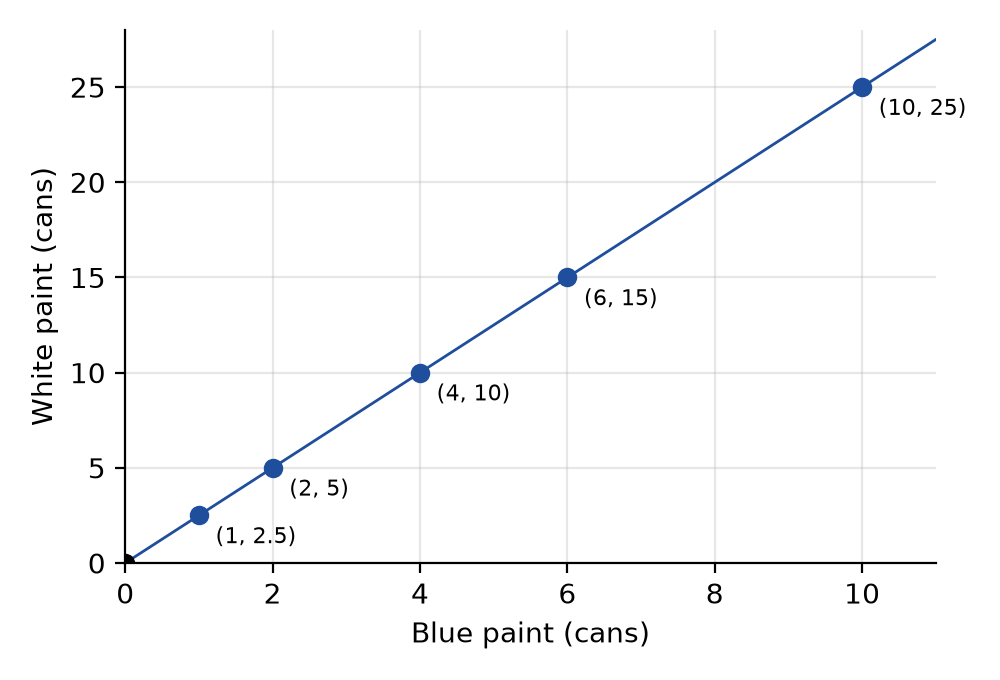
The steepness of the line is the unit rate, 2.5 cans of white per can of blue. Every point on that line is an equivalent mix, and any mix off the line is a different color. A relationship whose graph is a straight line through zero is called a proportional relationship. That is the subject of Chapter 7.
A taxi that charges $3 to start the ride plus $2 a mile also has a straight-line graph, but its line starts at $3, not at 0. So its fare is not proportional to distance: 2 miles cost $7, but 4 miles cost $11, not $14. U02 Algebra: Expressions, Equations, and Models develops these lines and their equations.
Text description for readers who cannot see a graph: the points rise steadily from the corner of the graph at zero, climbing 2.5 units for every 1 unit across. All of them lie on one straight line.
Summary
- Equivalent ratios come from multiplying or dividing every term by the same number.
- A ratio table shows equivalent ratios. You can scale columns, and you can add two columns.
- Find a missing value with a multiplier or with the unit rate, and round with a reason.
- Test equivalence by simplifying, by comparing unit rates, or by cross-products (a × d = b × c).
- Adding the same amount to both terms keeps the difference, not the ratio.
- Equivalent ratios lie on a straight line through zero.
Key terms: equivalent ratios · ratio table · cross-products · proportional relationship
Review questions
Questions 1 to 6 practice single skills. Questions 7 to 9 combine them.
- Write two ratios equivalent to 5 : 2, one larger and one smaller.
- Rice uses 1 cup of rice to 2 cups of water. How much water goes with 1.5 cups of rice? With 3 cups?
- Are 4 : 6 and 6 : 8 equivalent? Use cross-products.
- Are 12 : 18 and 20 : 30 equivalent? Use unit rates.
- A rule requires 1 adult per 8 children. How many adults are needed for 30 children?
- Complete the table for a car that gets 28 miles per gallon: 2.5 gallons → ? miles; ? gallons → 196 miles.
- A cook makes 3 cups of lemonade concentrate into a jug at 3 : 5 (concentrate : water). How much water should be added, and how much drink does that make? If a guest wants a weaker drink, does adding 1 more cup of each make it weaker or stronger?
- Someone “scales” a 2 : 5 paint mix by adding 3 cans to each, getting 5 : 8. Is the color the same? Compare the blue fractions.
- A job pays $18 per hour. Make a ratio table for 1, 7.5, and 37.5 hours. What does the table say about pay for 0 hours, and why does that make this relationship proportional?
Explained answers
1. For example, 10 : 4 (multiply by 2) and 2.5 : 1 (divide by 2).
2. The water is twice the rice: 3 cups for 1.5 cups of rice, and 6 cups for 3 cups of rice.
3. The cross-products are 4 × 8 = 32 and 6 × 6 = 36. They aren’t equal, so the ratios are not equivalent. (4 : 6 = 2 : 3 and 6 : 8 = 3 : 4.)
4. 18 ÷ 12 = 1.5 and 30 ÷ 20 = 1.5. They’re equal, so the ratios are equivalent.
5. 30 ÷ 8 = 3.75, so round up to 4 adults. Check: 3 adults would cover only 24 children. ✓
6. 2.5 × 28 = 70 miles. And 196 ÷ 28 = 7 gallons.
7. Scale 3 : 5 by 1, since the concentrate is already 3 cups: add 5 cups of water, for 8 cups of drink. Adding 1 cup of each gives 4 : 6. Concentrate goes from 3/8 = 0.375 of the drink to 4/10 = 0.4, so the drink becomes stronger, not weaker. To weaken it, add water only.
8. No. The original blue fraction is 2/7 ≈ 0.286. The new one is 5/13 ≈ 0.385. The new mix is noticeably darker. A correct larger batch would be 6 : 15 (multiplying by 3).
9. The table gives 1 h → $18, 7.5 h → $135, and 37.5 h → $675. Zero hours earns $0. The pay is a fixed multiple of the hours (18), so every column is an equivalent ratio, and the graph is a straight line through zero. That is what makes it proportional. (A job with a fixed sign-on bonus would not be proportional.)
Connections
- Chapter 7 uses ratio tables and unit rates to scale recipes and materials, and shows when scaling breaks.
- Chapter 8 writes part-to-whole fractions as percents.
- Other MORI books: U02 Algebra: Expressions, Equations, and Models turns proportional relationships into the equation y = kx. U03 Geometry: Measure, Diagonals, and Scale uses equivalent ratios for similar shapes and scale.
Sources consulted for scope and accuracy: OpenStax, Prealgebra 2e, https://openstax.org/details/books/prealgebra-2e, CC BY 4.0; Common Core State Standards, Grade 6 Ratios and Proportional Relationships (ratio tables), https://www.thecorestandards.org/Math/Content/6/RP/. All examples and exercises are original to MORI University.
Chapter 7 · Proportional Scaling: Recipes, Mixtures, and Materials
U01 Ratios, Proportions, and Percent · MORI University · Foundation level
Time needed: about 85 minutes in total, in six short sections. Each section ends at a good place to stop. You need: a pencil, paper, and a calculator. A favorite recipe, or a small project’s materials list, is needed for the activity.
Learning goals
By the end of this chapter, you will be able to:
- Find and use a scale factor to scale quantities up or down.
- Solve a proportion three ways (unit rate, scale factor, and cross-multiplication) and check the answer.
- Recognize situations that are not proportional, such as fixed fees, cooking times, and pack sizes.
- Estimate material quantities with a waste allowance, and round to units you can buy, giving your reason.
- Convert between a scale drawing or map and real lengths.
Start here
Your recipe serves 4, and 10 people are coming to dinner. Most cooks would scale the ingredients by 2.5. That works for the flour and the milk. But does it work for the oven temperature? For the baking time? For the size of the pan?
Proportional scaling is very powerful, but it doesn’t apply to everything. This chapter shows how to scale, and how to recognize when scaling would give you the wrong answer.
7.1 Scale factors
A scale factor is the number you multiply by to go from the original size to the new size:
scale factor = new amount ÷ original amount
- From 4 servings to 10 servings: 10 ÷ 4 = 2.5.
- From 8 servings to 2 servings: 2 ÷ 8 = 0.25, which is 1/4.
A scale factor larger than 1 makes things bigger. A scale factor between 0 and 1 makes them smaller. Multiplying every proportional quantity by the same scale factor keeps all the ratios the same. That is the equivalent-ratio rule from Chapter 6.
Check yourself 7.1 Find the scale factor from 6 servings to 15 servings. Answer: 15 ÷ 6 = 2.5.
Good stopping point.
7.2 Scaling a recipe
Worked Example 7.1 · Four servings to ten
A casserole recipe for 4 servings uses:
| Ingredient | For 4 | × 2.5 | For 10 |
|---|---|---|---|
| Flour | 2 cups | 2 × 2.5 | 5 cups |
| Milk | 3/4 cup | 0.75 × 2.5 | 1.875 cups (1 7/8 cups) |
| Eggs | 2 | 2 × 2.5 | 5 eggs |
| Salt | 1 tsp | 1 × 2.5 | 2.5 tsp (2 1/2 tsp) |
| Oven | 375°F | don’t scale | 375°F |
| Baking time | 25 min | don’t simply scale | check: likely longer |
Step 1: Scale factor. 10 ÷ 4 = 2.5.
Step 2: Multiply each ingredient. These are shown in the table. For 1 7/8 cups of milk, measure 1 cup, then 3/4 cup, then 1/8 cup. Or think of it as just under 2 cups.
Step 3: Think about what doesn’t scale. The oven temperature stays at 375°F. Baking time depends on how deep the food is in the pan, not on how much food there is. A dish 2.5 times as large in one deep pan cooks more slowly. Split into three pans of the original size, it takes about the original time. Check for doneness rather than multiplying the time.
Metric note. If you cook by weight or with metric measures, scale the same way. A US cup is about 240 mL, so 1.875 cups is roughly 450 mL. Nutrition labels in the US use 240 mL for a cup. A traditional US customary cup is slightly smaller, at about 237 mL.
Check yourself 7.2 A recipe for 6 uses 1.5 cups of rice. How much rice serves 10? Answer: Scale factor 10 ÷ 6 = 5/3, and 1.5 × 5/3 = 2.5 cups. Check with the unit rate: 1.5 ÷ 6 = 0.25 cup per person, and 0.25 × 10 = 2.5. ✓
Good stopping point.
7.3 Solving proportions three ways
A proportion is an equation that says two ratios are equal:
3 lb / $7.50 = 8 lb / ?
Worked Example 7.2 · Pricing by weight
If 3 lb of chicken costs $7.50, what do 8 lb cost (at the same price per pound)?
Method 1: Unit rate. $7.50 ÷ 3 = $2.50 per pound. Then 8 × $2.50 = $20.00.
Method 2: Scale factor. 8 ÷ 3 = 8/3. Then $7.50 × 8/3 = $20.00.
Method 3: Cross-multiplication. Write 3/7.50 = 8/x. The cross-products are equal (Chapter 6), so 3 × x = 7.50 × 8 = 60. Then x = 60 ÷ 3 = $20.00.
Check: Does $20 for 8 lb give the same unit price? $20 ÷ 8 = $2.50 per lb. ✓
Keep the setup consistent. When you write a proportion, both ratios must be in the same order, for example pounds over dollars on both sides. If you write 3/7.50 = x/8, you get x = 3.2. That answer has no meaning here.
All three methods give the same answer. Use whichever is easiest for the numbers, and use a second method as your check.
Check yourself 7.3 Solve 5/8 = x/36. Answer: 8x = 5 × 36 = 180, so x = 22.5. Check: 22.5/36 = 0.625 = 5/8. ✓
Good stopping point.
7.4 When scaling breaks
Proportional scaling works only when double the input means double the output, and zero input means zero output (the line through zero from Chapter 6). Many everyday situations break this rule.
Worked Example 7.3 · A taxi with a fixed charge
A taxi charges $3.50 to start plus $2.25 per mile.
- 4 miles: $3.50 + 4 × $2.25 = $12.50.
- 8 miles: $3.50 + 8 × $2.25 = $21.50.
Doubling the distance did not double the fare: 2 × $12.50 = $25.00, which is more than $21.50. The $3.50 start fee is a fixed charge: it is charged once, however far you go. The per-mile part is proportional, but the whole fare isn’t.
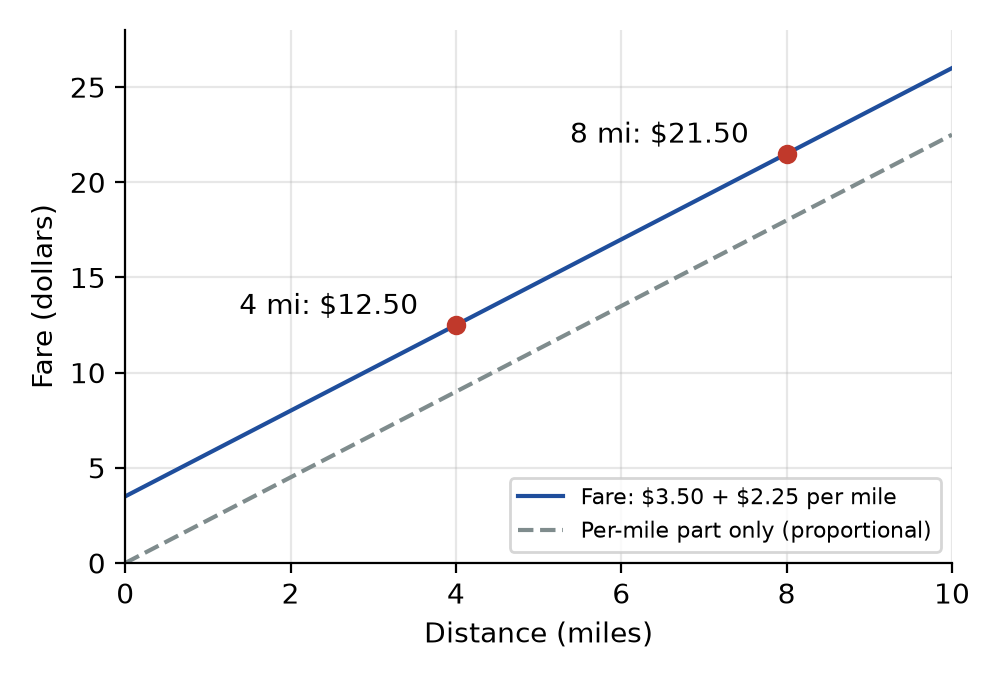
Other common cases that don’t scale:
| Situation | Why it isn’t proportional |
|---|---|
| Fixed fees (delivery, setup, membership) | charged once, whatever the size |
| Cooking and baking times | depend on depth and heat, not amount |
| Pack sizes | you can’t buy 2.5 eggs or 1.3 cans |
| Bulk discounts and free-shipping thresholds | the price per unit changes with quantity |
| Pay with a fixed bonus | the bonus doesn’t grow with hours worked |
The fix: split the situation into a fixed part and a proportional part. Scale only the proportional part, then add the fixed part back.
Good stopping point.
7.5 Material quantities and waste allowances
For building and decorating, you scale a coverage rate to the area. You add a waste allowance for cuts, breakage, and mistakes. Then you round up to units you can actually buy.
Worked Example 7.4 · Paint for a bedroom
A room measures 12 ft by 14 ft, with walls 8 ft high. There is one door (about 21 sq ft) and one window (about 15 sq ft). You want two coats. The can says one gallon covers about 350 sq ft. (Check your product’s label. Coverage claims vary, often between 250 and 400 sq ft per gallon.)
Step 1: Wall area. The perimeter is 12 + 14 + 12 + 14 = 52 ft. Then 52 × 8 = 416 sq ft.
Step 2: Subtract the openings. 416 − 21 − 15 = 380 sq ft.
Step 3: Two coats. 380 × 2 = 760 sq ft.
Step 4: Gallons. 760 ÷ 350 = 2.17 gallons (rounded).
Step 5: Round up to buyable units. You could buy 3 gallons. Or you could buy 2 gallons plus 1 quart. A quart is 1/4 gallon, so it covers about 87.5 sq ft, and 700 + 87.5 = 787.5 sq ft. That’s enough. Either way, round up, because running out halfway through a wall leaves a visible line.
Worked Example 7.5 · Floor tiles with 10% waste
A floor is 120 sq ft. The installer recommends a 10% waste allowance. Each box of tiles covers 15 sq ft.
Step 1: Add the allowance. 10% of 120 is 120 ÷ 10 = 12 sq ft, so you need 120 + 12 = 132 sq ft. (Chapter 8 shows that this is the same as 120 × 1.10.)
Step 2: Boxes. 132 ÷ 15 = 8.8 boxes, so 9 boxes.
Check: 9 boxes cover 9 × 15 = 135 sq ft, which is at least 132. ✓ In metric, 120 sq ft is about 11.1 m² (1 sq ft = 0.09290304 m²).
Check yourself 7.4 A gallon of primer covers 300 sq ft. How many gallons do you need for 820 sq ft, with one coat? Answer: 820 ÷ 300 = 2.73…, so buy 3 gallons.
Good stopping point.
7.6 Scale drawings and maps
A scale on a drawing or map is a ratio: drawing length : real length.
Metric plans often use ratios such as 1 : 50, meaning 1 cm on the plan is 50 cm in reality. A wall measuring 9 cm on the plan is 9 × 50 = 450 cm = 4.5 m long.
US architectural plans often say 1/4 in = 1 ft. One foot is 12 inches, and 12 ÷ 1/4 = 48, so the ratio is 1 : 48. A wall measuring 3.5 in on the plan is 3.5 ÷ 1/4 = 14 ft long.
US topographic maps from the US Geological Survey often use 1 : 24,000. One inch on the map is 24,000 in = 2,000 ft in reality.
Area does not scale by the same factor. On a 1 : 50 plan, lengths are scaled by 50, but areas are scaled by 50 × 50 = 2,500. Review Question 9 shows this. U03 Geometry: Measure, Diagonals, and Scale explains why.
Check yourself 7.5 On a 1 : 24,000 map, two trailheads are 3.5 inches apart. How far apart are they in reality, in feet and in miles? Answer: 3.5 × 24,000 = 84,000 in. Divide by 12 to get 7,000 ft. Then 7,000 ÷ 5,280 = 1.33 miles (rounded).
Good stopping point.
Practical activity · Scale a real list
Time: 25 minutes. Materials: one recipe or one small project materials list, a pencil, paper, and a calculator.
- Write the original quantities and the size the list was made for (servings, square feet, or number of items).
- Choose a new size and find the scale factor.
- For each line, decide scale or don’t scale, and give a one-phrase reason (“fixed fee,” “cooking time,” “pack size”).
- Scale the proportional lines. Round to amounts you can measure or buy, and say which way you rounded and why.
- Check one line with a second method (unit rate or cross-multiplication).
Common mistakes
- Scaling everything. Oven temperatures, fixed fees, and cooking times usually don’t scale.
- Inconsistent proportion setup. Keep the same order on both sides, such as pounds over dollars = pounds over dollars.
- Forgetting the waste allowance, or rounding material quantities down.
- Rounding too early. Scale with exact values, then round once at the end.
- Scaling area by the length factor. On a 1 : 50 plan, areas are scaled by 2,500, not by 50.
Going further (optional) · Why cross-multiplication works
Start with a/b = c/d, where b and d are not zero. Multiply both sides by b × d. On the left, (a/b) × b × d = a × d. On the right, (c/d) × b × d = c × b. So a × d = b × c. Doing the same thing to both sides of an equation keeps it true. That is an established result of algebra, and it’s why the method is reliable. It isn’t a trick to memorize. U02 Algebra: Expressions, Equations, and Models builds on this idea of keeping an equation balanced.
Summary
- Scale factor = new ÷ original. Multiply every proportional quantity by it.
- Solve proportions by unit rate, by scale factor, or by cross-multiplication, and use one method to check another.
- Proportional means double in, double out, and zero in, zero out. Fixed fees, times, and pack sizes break this.
- For materials, scale by coverage, add a waste allowance, and round up to buyable units.
- Scales on plans and maps are ratios. Areas are scaled by the square of the length factor.
Key terms: scale factor · proportion · cross-multiplication · fixed charge · waste allowance · scale (of a drawing or map)
Review questions
Questions 1 to 6 practice single skills. Questions 7 to 9 combine them.
- Find the scale factor (a) from 6 to 15 servings, and (b) from 8 to 2 servings.
- Solve 5/8 = x/36.
- 4 lb of apples cost $9.96. What do 7 lb cost? Solve two ways.
- Which of these are proportional? (a) The cost of gas by the gallon. (b) A phone plan at $20 a month plus $0.10 per minute. (c) The baking time for a batch of cookies, as the number of cookies changes.
- On a 1/4 in = 1 ft plan, a room measures 3 in by 2.5 in. What are its real dimensions?
- On a 1 : 24,000 map, how many feet does 2 inches represent?
- A floor measures 9 ft by 11 ft. With a 10% waste allowance, and boxes that cover 20 sq ft, how many boxes should you buy? How much spare tile will that leave?
- A taxi charges $3.00 plus $2.50 per mile. A 6-mile ride costs $18.00. A friend says a 12-mile ride must cost $36.00. Find the correct fare and explain the error.
- On a 1 : 50 plan, a room measures 8.4 cm by 6 cm. Find its real dimensions and its real area. Then show that the area is 2,500 times the plan area.
Explained answers
1. (a) 15 ÷ 6 = 2.5. (b) 2 ÷ 8 = 0.25.
2. 8x = 180, so x = 22.5. Check: 22.5/36 = 0.625 = 5/8. ✓
3. Unit rate: $9.96 ÷ 4 = $2.49 per lb, and 7 × $2.49 = $17.43. Cross-multiplication: 4/9.96 = 7/x, so 4x = 69.72 and x = 17.43. ✓
4. (a) Proportional: zero gallons cost $0, and double the gallons cost double. (b) Not proportional: the $20 is a fixed charge. (c) Not proportional: a larger batch baked on several trays at once takes about the same time.
5. 3 ÷ 1/4 = 12 ft and 2.5 ÷ 1/4 = 10 ft. The room is 12 ft by 10 ft.
6. 2 × 24,000 = 48,000 in, and 48,000 ÷ 12 = 4,000 ft.
7. Area: 9 × 11 = 99 sq ft. With the allowance: 99 + 9.9 = 108.9 sq ft. Boxes: 108.9 ÷ 20 = 5.445, so 6 boxes. They cover 120 sq ft, so after covering the floor you’ll have 120 − 99 = 21 sq ft to spare, including the allowance. ✓
8. The correct fare is $3.00 + 12 × $2.50 = $33.00. The friend doubled the whole fare, which also doubled the $3.00 start fee. That fee is charged only once. Only the per-mile part is proportional.
9. Real lengths: 8.4 × 50 = 420 cm = 4.2 m, and 6 × 50 = 300 cm = 3.0 m. Real area: 4.2 × 3.0 = 12.6 m². Plan area: 8.4 × 6 = 50.4 cm². Then 50.4 cm² × 2,500 = 126,000 cm². Since 1 m² = 100 cm × 100 cm = 10,000 cm², that’s 126,000 ÷ 10,000 = 12.6 m². ✓
Connections
- Chapter 8 explains the 10% waste allowance as a percent, and Chapter 9 writes it as the multiplier 1.10.
- Chapter 12’s model project scales recipes for a week of meals.
- Other MORI books: U22 Measure and Lay Out Before Making applies material estimates and waste allowances on real jobs. U03 Geometry: Measure, Diagonals, and Scale covers area, similar figures, and scale. F16 Nutrition, Meal Planning, and Kitchen Economics scales recipes and servings.
Sources consulted for scope and accuracy: OpenStax, Prealgebra 2e, https://openstax.org/details/books/prealgebra-2e, CC BY 4.0; NIST Special Publication 811 (unit conversions), https://www.nist.gov/pml/special-publication-811; US FDA, 21 CFR 101.9(b)(5)(viii) (“a cup means 240 mL” for nutrition labeling), https://www.ecfr.gov/current/title-21/chapter-I/subchapter-B/part-101/subpart-A/section-101.9 (checked October 22, 2026); US Geological Survey, topographic map scales. All examples and exercises are original to MORI University. Paint coverage and waste allowances are typical illustrative values. Check product labels and installer guidance.
Chapter 8 · Reference Quantities and the Meaning of Percent
U01 Ratios, Proportions, and Percent · MORI University · Foundation level
Time needed: about 80 minutes in total, in seven short sections. Each section ends at a good place to stop. You need: a pencil, paper, and a calculator. Collect a few bills, labels, or news articles with percentages for the activity.
Learning goals
By the end of this chapter, you will be able to:
- Explain a percent as a part-to-whole ratio per 100.
- Convert between percents, fractions, and decimals.
- Name the reference quantity in any percentage statement, or notice when it is missing.
- Solve the three basic percent problems: find the part, find the percent, and find the whole.
- Use benchmark percents (1%, 10%, 25%, 50%) to calculate in your head.
Start here
A club newsletter announces: “30% of members want to move meetings to Saturday.” The club has 200 members. Only 50 of them answered the survey, and 15 of those said yes.
Is the newsletter right? 15 out of 50 is 30%, but that’s 30% of the people who answered, not 30% of the members. Measured against all 200 members, 15 yes votes is 7.5%. Both numbers are correct arithmetic. They differ because they use different reference quantities.
This chapter teaches how percent works. It also teaches the question that keeps percent honest: “percent of what?”
8.1 Percent means “per hundred”
Percent comes from the Latin per centum, “for each hundred.” The symbol is %.
35% means 35 for every 100, or 35/100.
Figure 8.1 shows a grid of 100 small squares, 10 rows of 10, with 35 of them shaded. The shaded part is 35% of the grid.
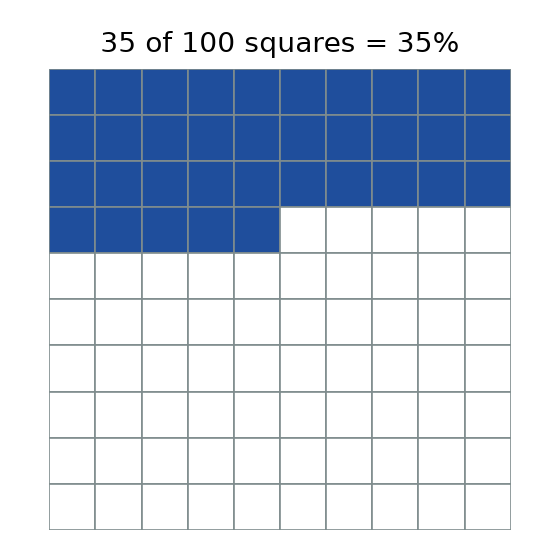
A percent is a part-to-whole ratio (Chapter 4) scaled so that the whole is 100. That scaling is what makes percents useful: two groups of different sizes can be compared on the same 0-to-100 scale.
- 100% is the whole thing.
- 50% is half.
- 0% is none.
Check yourself 8.1 A 100-question test has 83 correct answers. What percent is correct? What percent is wrong? Answer: 83% correct, and 100% − 83% = 17% wrong. Together they make 100%. ✓
Good stopping point.
8.2 Converting among percents, decimals, and fractions
| To get | From a percent | Example |
|---|---|---|
| Decimal | divide by 100 (move the point two places left) | 35% = 0.35; 6% = 0.06; 125% = 1.25 |
| Fraction | write over 100, then simplify | 35% = 35/100 = 7/20 |
| Percent from a decimal | multiply by 100 (move the point two places right) | 0.4 = 40%; 0.075 = 7.5% |
| Percent from a fraction | divide, then multiply by 100 | 3/8 = 0.375 = 37.5% |
Benchmark equivalents worth knowing by heart:
| Fraction | 1/2 | 1/4 | 3/4 | 1/5 | 1/10 | 1/8 | 1/3 | 2/3 |
|---|---|---|---|---|---|---|---|---|
| Decimal | 0.5 | 0.25 | 0.75 | 0.2 | 0.1 | 0.125 | 0.333… | 0.666… |
| Percent | 50% | 25% | 75% | 20% | 10% | 12.5% | 33.3…% | 66.6…% |
Watch small percents. 0.5% is half of one percent, which is 0.005 as a decimal. It is not the same as 0.5, which is 50%. A misplaced decimal point here can make an answer a hundred times too big.
Worked Example 8.1 · Converting an awkward fraction
A team won 5 of its 7 games. What percent is that, to the nearest tenth of a percent?
Step 1: Divide. 5 ÷ 7 = 0.714285… (the decimal repeats, as Chapter 3 explained).
Step 2: Multiply by 100. 71.4285…%.
Step 3: Round. The digit after the tenths place is 2, so round down to 71.4%.
Check: 71.4% of 7 = 0.714 × 7 = 4.998, which is very close to 5. ✓ The small gap is the rounding. When you report a rounded percent, give the counts too (“5 of 7 games”) so a reader can recover the exact value.
Check yourself 8.2 Write 6% as a decimal, 0.075 as a percent, and 3/8 as a percent. Answer: 0.06, 7.5%, and 37.5%.
Good stopping point.
8.3 The reference quantity: always ask “of what?”
Every percent is a percent of something. That something is the reference quantity, also called the base or the whole. It’s the amount that counts as 100%. The same part gives a different percent when it’s measured against a different reference quantity.
Worked Example 8.2 · Members versus respondents
The club in “Start here” has 200 members. 50 answered the survey, and 15 said yes.
| Reference quantity | Calculation | Percent |
|---|---|---|
| Respondents (50) | 15 ÷ 50 | 30% |
| Members (200) | 15 ÷ 200 | 7.5% |
An honest statement names the reference quantity and gives the counts: “Of the 50 members who answered (25% of the club), 15, or 30% of respondents, prefer Saturday.”
What we can and can’t say. The 30% is an observation about respondents. Saying “30% of all members prefer Saturday” would be an inference, and it would rely on the respondents being typical of everyone. People who feel strongly are often more likely to answer, so that inference may not hold. U04 Statistics: Samples, Center, and Spread covers how surveys handle this.
Percents over 100%. A part can’t be more than 100% of a whole it belongs to. You can’t have 120% of a pizza’s slices. But a percent can compare any two amounts. If this year’s attendance is 300 and last year’s was 200, this year’s attendance is 300 ÷ 200 = 1.5 = 150% of last year’s. Here last year is the reference quantity, and this year isn’t a part of it. Chapter 9 calls this a 50% increase.
Worked Example 8.3 · Percent Daily Value on a food label
US Nutrition Facts labels show % Daily Value (%DV). For sodium, the reference quantity is a Daily Value of 2,300 mg per day, which the FDA sets for labeling. A can of soup lists 690 mg of sodium per serving.
Step 1: Name the reference quantity. It’s 2,300 mg, the Daily Value, not the whole can and not your own needs.
Step 2: Divide. 690 ÷ 2,300 = 0.30, which is 30% DV per serving.
Step 3: Read the serving size. If the can holds 2 servings, eating the whole can gives 2 × 690 = 1,380 mg, which is 60% DV.
Check: 0.60 × 2,300 = 1,380. ✓
So two reference quantities matter here: the Daily Value and the serving. A label percent describes one serving measured against the Daily Value. F16 Nutrition, Meal Planning, and Kitchen Economics covers labels in depth.
When the reference quantity is missing. Some statements give a percent with no clear reference quantity: “Now with 25% less sugar!” Less than what? It could be the old recipe, a competitor’s product, or the average of similar products. Until you know, you can’t use the number. Chapter 11 returns to this.
Check yourself 8.3 A store says “40% of our customers use the app.” On a given day, 600 people visit and 240 use the app. What is the reference quantity, and is the claim consistent with that day? Answer: The reference quantity is customers, meaning that day’s 600 visitors. 240 ÷ 600 = 0.4 = 40%, so the claim is consistent with that day. (One day might not be typical, though.)
Good stopping point.
8.4 Finding a percentage of an amount
part = percent (as a decimal) × whole
Worked Example 8.4 · A 15% tip on $64
Method 1: Decimal. 0.15 × $64 = $9.60.
Method 2: Benchmarks. 10% of $64 is $6.40. 5% is half of that, $3.20. Then 15% = $6.40 + $3.20 = $9.60. ✓
Sales tax is the same calculation. With a 7% sales tax rate on an $85 purchase, the tax is 0.07 × $85 = $5.95, and the total is $90.95. (US sales tax rates are set by states and localities, and they differ from place to place. 7% is used here only as an example.)
Check yourself 8.4 What is 35% of 80? Answer: 0.35 × 80 = 28. With benchmarks: 25% of 80 is 20, 10% is 8, and 20 + 8 = 28. ✓
Good stopping point.
8.5 Finding what percent one amount is of another
percent = part ÷ whole × 100%
Worked Example 8.5 · Students who passed
18 of 45 students passed a certification exam on the first try. What percent is that?
Step 1: Divide part by whole. 18 ÷ 45 = 0.4.
Step 2: Convert to a percent. 0.4 × 100% = 40%.
Check: 40% of 45 = 0.4 × 45 = 18. ✓
Finding a tax rate from a receipt. A receipt shows $4.20 tax on a $56.00 subtotal. The rate is 4.20 ÷ 56.00 = 0.075, which is 7.5%.
Check yourself 8.5 27 of 36 apartments in a building have been renovated. What percent is that? Answer: 27 ÷ 36 = 0.75, so 75%.
Good stopping point.
8.6 Finding the whole from a part
whole = part ÷ percent (as a decimal)
Worked Example 8.6 · Commission and sales
A salesperson earns a 20% commission and was paid $153 in commission last week. What were their total sales?
Step 1: Set up. 20% of the sales = $153, so 0.20 × sales = $153.
Step 2: Divide. Sales = $153 ÷ 0.20 = $765.
Step 3: Check. 20% of $765 = 0.20 × $765 = $153. ✓
Benchmark reasoning works here too. If 20% is $153, then 10% is $76.50, and 100% is 10 × $76.50 = $765. ✓
The three percent problems all come from one relationship, part = percent × whole:
| You know | You want | Calculate |
|---|---|---|
| percent and whole | part | percent × whole |
| part and whole | percent | part ÷ whole |
| part and percent | whole | part ÷ percent |
Check yourself 8.6 30% of a number is 42. What is the number? Answer: 42 ÷ 0.30 = 140. Check: 0.30 × 140 = 42. ✓
Good stopping point.
8.7 Mental benchmarks
You can do most everyday percents in your head with a few building blocks:
- 10%: move the decimal point one place left. 10% of $64 is $6.40.
- 1%: move it two places left. 1% of $64 is $0.64.
- 5%: half of 10%.
- 20%: double 10%.
- 25%: a quarter (divide by 4). 50%: half.
- Combine them: 15% = 10% + 5%. 18% = 20% − 2%. 35% = 25% + 10%.
A swap trick. A percent of a number can be swapped around: 8% of 50 = 50% of 8 = 4. This works because both are 8 × 50 ÷ 100.
Check yourself 8.7 Without a calculator, find 18% of $250. Answer: 20% is $50, 2% is $5, and $50 − $5 = $45. Check: 0.18 × 250 = 45. ✓
Good stopping point.
Practical activity · Five percentage statements
Time: 20 to 30 minutes. Materials: bills, food labels, store signs, news articles, or the counts from your Chapter 4 ratio survey.
- Collect five statements that contain a percent, such as “% Daily Value,” a sales tax line, “40% off,” or “unemployment fell to…”.
- For each one, write down: the percent, the reference quantity (what counts as 100%), and the part, if you can work it out.
- If the reference quantity is missing or unclear, write “missing” and say what you’d need to know.
- For one statement, check the arithmetic yourself.
- Turn your Chapter 4 survey counts into percents, and check that the parts add up to 100% (allowing for rounding).
Common mistakes
- Using the wrong reference quantity. 15 of 50 respondents isn’t “30% of members.”
- Dividing the wrong way. “What percent is 18 of 45?” is 18 ÷ 45, not 45 ÷ 18.
- Misplacing the decimal point. 0.5% = 0.005, not 0.5.
- Adding percents of different wholes. 10% of your income plus 10% of your partner’s income isn’t 20% of anything unless the two incomes are equal.
- Ignoring the serving size. A %DV is per serving. Two servings means double the percent.
- Rounded parts that don’t sum to 100%. 1/3 + 1/3 + 1/3 rounds to 33% + 33% + 33% = 99%. That’s rounding, not an error. Say so in a note.
Going further (optional) · A percent of a percent
What is 40% of 50%? Multiply the decimals: 0.40 × 0.50 = 0.20, which is 20%. For example, if 50% of a town’s adults have a library card, and 40% of cardholders visited this month, then 20% of all adults visited. Notice the reference quantity changes at each step. The 40% is of cardholders, and the 20% is of all adults. Chained percents like this are common in reports, and Chapter 10 uses the same multiplying for successive changes. Whenever a percent is applied to another percent, write out the reference quantity at each step.
Summary
- Percent means per hundred. It is a part-to-whole ratio with the whole set to 100.
- Convert a percent to a decimal by dividing by 100, and a decimal to a percent by multiplying by 100.
- Every percent has a reference quantity. Ask “percent of what?” and say what it is.
- part = percent × whole. Rearrange it to find the percent or the whole.
- Use 10%, 1%, 5%, 25%, and 50% as mental building blocks.
- Percents over 100% compare an amount with a reference quantity it isn’t part of.
Key terms: percent · reference quantity · percent Daily Value (%DV)
Review questions
Questions 1 to 6 practice single skills. Questions 7 to 9 combine them.
- Write 0.06 as a percent, 125% as a decimal, and 3/8 as a percent.
- What is 35% of 80?
- 27 of 36 tenants signed a petition. What percent is that?
- A sales tax rate of 6.25% is applied to a $48 purchase. What is the tax?
- 30% of a number is 42. Find the number.
- Find a 15% tip on $72 using benchmarks only.
- A company has 1,200 employees, and 300 answered a satisfaction survey. 240 respondents said they were satisfied. An ad says “80% of our staff are satisfied.” Calculate both possible percents and rewrite the claim honestly.
- A worker’s gross monthly pay is $3,200, and 22% is withheld for taxes and benefits. Find the amount withheld, the take-home pay, and take-home as a percent of gross.
- A household earns $4,000 a month and pays $1,400 in rent, including utilities. What percent of income goes to rent? The US Department of Housing and Urban Development (HUD) describes households whose housing costs, including utilities, are more than 30% of income as “cost burdened.” What rent would be exactly 30% of this income?
Explained answers
1. 0.06 × 100% = 6%. 125% ÷ 100 = 1.25. 3 ÷ 8 = 0.375 = 37.5%.
2. 0.35 × 80 = 28.
3. 27 ÷ 36 = 0.75 = 75%.
4. 0.0625 × $48 = $3.00. Check: 6.25% is 1/16, and $48 ÷ 16 = $3. ✓
5. 42 ÷ 0.30 = 140.
6. 10% of $72 is $7.20, 5% is $3.60, and $7.20 + $3.60 = $10.80.
7. Of respondents: 240 ÷ 300 = 80%. Of all staff: 240 ÷ 1,200 = 20%. The ad treats respondents as if they were all the staff. An honest version is: “Of the 300 employees who answered our survey (25% of staff), 240, or 80% of respondents, said they were satisfied.” The 900 who didn’t answer may feel differently. We don’t know.
8. Withheld: 0.22 × $3,200 = $704. Take-home: $3,200 − $704 = $2,496. As a percent of gross: 100% − 22% = 78%. Check: 0.78 × $3,200 = $2,496. ✓
9. $1,400 ÷ $4,000 = 0.35 = 35% of income. 30% of $4,000 = $1,200. By HUD’s definition, this household is cost burdened, since 35% is more than 30%. The 30% line is a policy definition, not a law of mathematics. It’s a reference point that HUD has chosen.
Connections
- Chapter 9 uses the starting value as the reference quantity for percentage change.
- Chapter 10 chains percents, and Chapter 11 catches claims with a missing reference quantity.
- Other MORI books: U04 Statistics: Samples, Center, and Spread covers surveys, response rates, and samples. U14 Follow a Claim to Its Evidence traces percent claims to their sources. F24 Personal Finance and Consumer Decision-Making covers withholding, tax, and housing costs.
Sources consulted for scope and accuracy: OpenStax, Contemporary Mathematics, Section 6.1 “Understanding Percent,” https://openstax.org/books/contemporary-mathematics/pages/6-1-understanding-percent, CC BY 4.0; OpenStax, Prealgebra 2e, Chapter 6 “Percents,” https://openstax.org/details/books/prealgebra-2e, CC BY 4.0; US Food and Drug Administration, “Daily Value on the Nutrition and Supplement Facts Labels” (sodium Daily Value 2,300 mg), https://www.fda.gov/food/nutrition-facts-label/daily-value-nutrition-and-supplement-facts-labels; US Department of Housing and Urban Development, CHAS background, definition of cost burden (monthly housing costs including utilities exceeding 30% of monthly income), https://www.huduser.gov/portal/datasets/cp/CHAS/bg_chas.html (checked October 22, 2026). All examples and exercises are original to MORI University. Tax and pay figures are illustrative.
Chapter 9 · Percentage Change: Increases, Decreases, and Percentage Points
U01 Ratios, Proportions, and Percent · MORI University · Foundation level
Time needed: about 85 minutes in total, in five short sections. Each section ends at a good place to stop. You need: a pencil, paper, and a calculator. An old receipt, bill, or price you remember will help with the activity.
Learning goals
By the end of this chapter, you will be able to:
- Compute a percentage change as (new − old) ÷ old.
- Apply an increase or decrease in one step using a multiplier.
- Work backward from a changed value to the original value.
- Tell a change in percentage points from a percentage change.
- Read an official inflation figure, giving its source, date, and place.
Start here
Your rent letter says the rent is going from $1,150 to $1,265 a month. Your landlord calls it “a modest increase.” Is it?
The rent goes up by $115. But “$115” doesn’t tell you how big the change is compared with what you were paying. That’s what a percentage change does. It measures the change against the starting value, and turns the result into a percent.
$115 ÷ $1,150 = 0.10. The rent is rising by 10%.
Chapter 8 taught you to ask “percent of what?” For percentage change the answer is nearly always the starting value (the old value). This chapter shows how to use that, how to run it backward, and how to read the percent changes in news about prices.
9.1 Change compared with a starting value
percentage change = (new value − old value) ÷ old value × 100%
A positive result is an increase. A negative result is a decrease.
Worked Example 9.1 · A rent increase
Step 1: Find the change. $1,265 − $1,150 = $115.
Step 2: Divide by the old value. $115 ÷ $1,150 = 0.10.
Step 3: Convert. 0.10 = 10% increase.
Check: 10% of $1,150 is $115, and $1,150 + $115 = $1,265. ✓
Worked Example 9.2 · A smaller bill
A monthly gas bill falls from $80 to $68.
Step 1: Change. $68 − $80 = −$12.
Step 2: Divide by the old value. −12 ÷ 80 = −0.15.
Step 3: Convert. The bill fell by 15%.
“Percent of” or “percent change”? These are easy to confuse, so say them carefully. The new rent of $1,265 is 110% of the old rent ($1,265 ÷ $1,150 = 1.10). It’s also a 10% increase on the old rent. Both describe the same thing. “Percent of” compares the whole new value with the old one. “Percent change” compares only the difference. To get one from the other, subtract 100%: 110% of the old value is 110% − 100% = a 10% increase. Likewise, a price that is 85% of what it was has fallen 15%.
Direction matters. Going from $1,265 back down to $1,150 is a change of −$115. But now the starting value is $1,265, so the change is −115 ÷ 1,265 ≈ −0.0909, about a 9.1% decrease. The same dollar change gives different percents because the reference quantity is different. Chapter 10 explains why this matters when changes are undone.
Big changes, said clearly. If a town grows from 1,500 people to 4,500, the change is 3,000, and 3,000 ÷ 1,500 = 2 = a 200% increase. The new population is 3 times as much as the old. A 100% increase means double, and a 200% increase means triple. In this series we avoid the phrase “times more” because readers take it in different ways (see Chapter 1). Say “3 times as much,” or give the percentage increase, and the meaning is clear.
Check yourself 9.1 A coffee goes from $4.00 to $4.60. What is the percentage change? Answer: (4.60 − 4.00) ÷ 4.00 = 0.60 ÷ 4.00 = 0.15, a 15% increase.
Good stopping point.
9.2 Multipliers: 1 + r and 1 − r
To apply a percentage change, you can find the change and add or subtract it. A quicker way, and one that will help you in Chapter 10, is to use a multiplier.
- An increase of r: multiply by 1 + r. (A 10% increase means × 1.10.)
- A decrease of r: multiply by 1 − r. (A 25% decrease means × 0.75.)
Here r is the percent written as a decimal.
The multiplier says what fraction of the old value you end up with. After a 25% discount you pay 75% of the price. After a 10% increase you have 110% of the old value.
Worked Example 9.3 · A 25% sale
A jacket costs $68, and it’s 25% off.
Method 1: Subtract the discount. 25% of $68 = $17, and $68 − $17 = $51.
Method 2: Multiplier. $68 × 0.75 = $51. ✓
Worked Example 9.4 · A 12% price increase
A $250 monthly gym membership rises by 12%.
Multiplier: $250 × 1.12 = $280.
Check: 12% of $250 = $30, and $250 + $30 = $280. ✓
Check yourself 9.2 Write the multiplier for a 6% increase, a 6% decrease, and a 100% increase. Answer: 1.06, 0.94, and 2 (double).
Good stopping point.
9.3 Finding the original value
Sometimes you know the value after a change and want the value before it. Because new = old × multiplier, divide:
old value = new value ÷ multiplier
Worked Example 9.5 · Finding the pre-tax price
A receipt total is $54.00, which includes an 8% sales tax. What was the price before tax?
Step 1: Multiplier. Adding 8% tax means × 1.08.
Step 2: Divide. $54.00 ÷ 1.08 = $50.00.
Step 3: Check. $50.00 × 1.08 = $54.00. ✓ The tax was $4.00.
The tempting shortcut is wrong. Taking 8% of $54 gives $4.32, and $54 − $4.32 = $49.68. That’s wrong because the tax was 8% of the pre-tax price, not of the total. When you work backward, the reference quantity is the original value, which is the number you don’t know yet. So divide by the multiplier.
Worked Example 9.6 · Before the sale
A sale tag says “$51, now 25% off.” What was the original price?
$51 ÷ 0.75 = $68. Check: $68 × 0.75 = $51. ✓ (Adding 25% of $51 back gives $63.75, which is wrong for the same reason.)
Check yourself 9.3 After a 6% tax, a bill is $63.60. What was it before tax? Answer: $63.60 ÷ 1.06 = $60.00. Check: $60 × 1.06 = $63.60. ✓
Good stopping point.
9.4 Percentage points versus percent
When the quantity that changes is itself a percent, there are two ways to describe the change. They give different numbers.
- Percentage points measure the plain difference between two percents: new percent − old percent.
- Percentage change (relative change) measures that difference against the old percent.
Worked Example 9.7 · An interest rate rises from 4% to 5%
Percentage points: 5% − 4% = 1 percentage point.
Percentage change: (5 − 4) ÷ 4 = 0.25 = a 25% increase in the rate.
Both are true. “Rates rose 1 point” and “rates rose 25%” describe the same event. On a $10,000 balance, a year’s simple interest goes from $400 to $500. That is $100 more, and $100 is 25% of $400. So the 25% describes the cost to you, and the 1 point describes the change in the rate itself.
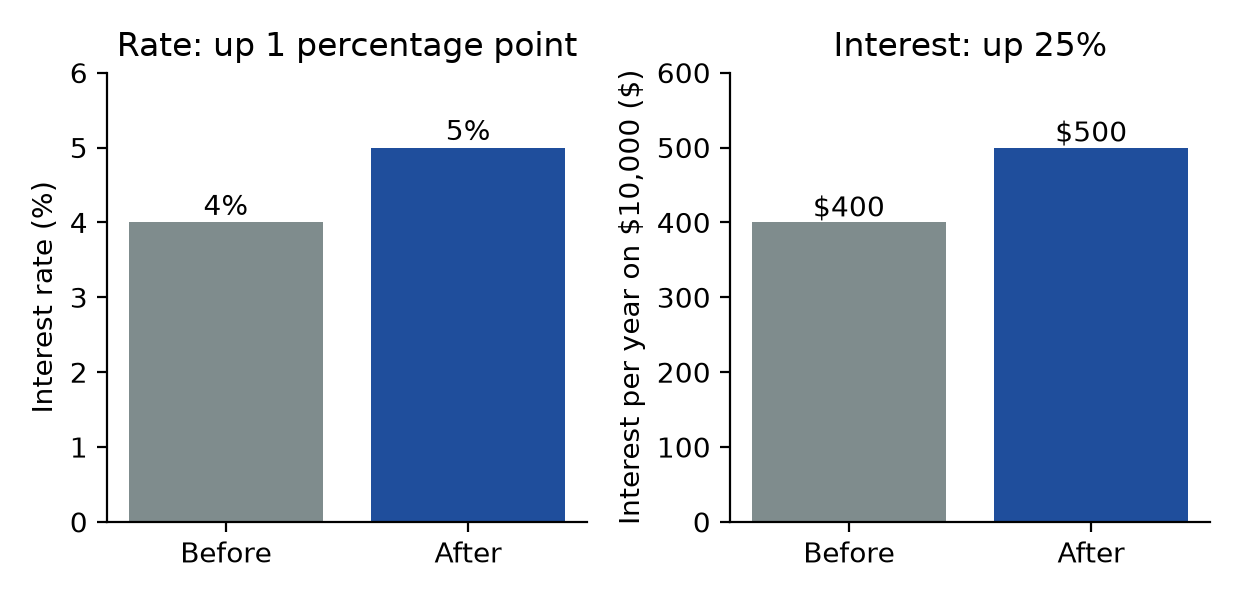
Which one is being used? A headline that says “rates rose 25%” sounds dramatic. “Rates rose 1 point” sounds small. Honest reporting gives both, or says which one it’s using. Watch for the word “points.” If it’s missing, check the numbers yourself.
A decrease works the same way. A loan rate falling from 6.5% to 6.0% is a drop of 0.5 percentage points. As a relative change, that’s −0.5 ÷ 6.5 ≈ −7.7%.
Reading the news. Suppose a report says a region’s unemployment rate “rose from 4.0% to 4.4%.” That’s 0.4 percentage points. As a relative change, it’s 0.4 ÷ 4.0 = 0.10, a 10% increase in the rate. It is not a 10% increase in the number of people out of work unless the labor force stayed the same size. With a different reference quantity, you get a different statement. Before you repeat a figure, name which change it is and what it’s measured against.
Check yourself 9.4 A survey’s approval rating goes from 40% to 46%. Give the change in percentage points and as a percentage change. Answer: 6 percentage points. As a percentage change: 6 ÷ 40 = 0.15, a 15% increase.
Good stopping point.
9.5 Prices over time: consumer price indexes
Inflation is a general rise in prices over time. In the United States, the best-known measure is the Consumer Price Index (CPI), published monthly by the US Bureau of Labor Statistics (BLS). The headline version, CPI-U, tracks prices paid by urban consumers for a fixed “basket” of goods and services such as food, housing, energy, transportation, and medical care.
A price index is a number that tracks prices compared with a reference period. When an index goes from one value to another, the percentage change in the index is the price change. For instance, if an index went from 300.0 to 311.1, that’s (311.1 − 300.0) ÷ 300.0 = 0.037, or a 3.7% rise. (These index values are an illustration, not real CPI levels.)
What the data said when this chapter was written. The table below shows US data. It was retrieved from the BLS on October 22, 2026.
| CPI-U, United States, 12 months ending September 2026, not seasonally adjusted | Change |
|---|---|
| All items | +3.7% |
| Food | +2.5% |
| Food at home | +1.8% |
| Energy | +20.4% |
| Gasoline (all types) | +34.2% |
| Shelter | +3.2% |
| All items less food and energy (“core”) | +2.6% |
Source: US Bureau of Labor Statistics, Consumer Price Index news release for September 2026, https://www.bls.gov/cpi/ (retrieved October 22, 2026). The next release (October 2026 data) is scheduled for November 10, 2026. Recheck before you rely on these figures.
Reading the table. These are observations: measured changes in an average basket over one stated year, for the United States. They aren’t forecasts, and they aren’t your prices. Gasoline rose much faster than prices in general. Food at home rose more slowly. Your own inflation depends on what you buy. If you don’t drive, gasoline matters little to you. If you rent, the shelter line matters a lot.
Worked Example 9.8 · What the headline rate means for a basket
Suppose a basket of goods cost $200 in September 2025, and its price rose at the all-items rate of 3.7%.
$200 × 1.037 = $207.40 in September 2026.
This is a model. It assumes the basket rose at the average rate. A basket that’s mostly gasoline would have risen far more: $200 × 1.342 = $268.40.
Other countries publish their own price indexes, such as Statistics Canada’s CPI, the UK Office for National Statistics’ CPI, and Eurostat’s Harmonised Index of Consumer Prices for the euro area. They use different baskets and methods, so always say which country and which index a figure comes from.
Check yourself 9.5 Using the table, by how many percentage points did gasoline’s 12-month change exceed the all-items change? Answer: 34.2 − 3.7 = 30.5 percentage points.
Good stopping point.
Practical activity · Track one price
Time: 20 to 30 minutes. Materials: an old receipt, bill, or a price you clearly remember, with its date.
- Choose one item you buy regularly, such as a gallon of milk, a bus fare, or a haircut. Write down its old price, the date, and the place.
- Find today’s price for the same item, the same size, from the same kind of store.
- Compute the dollar change and the percentage change. Check it with the multiplier: old × (1 + r) should give the new price.
- Look up the latest CPI-U 12-month change at https://www.bls.gov/cpi/. Write down the figure, the category, the month it covers, and the date you looked it up.
- Compare. Did your item rise faster or slower than the official all-items rate? Give one reason why (store, size, season, or a category that’s rising faster). Remember that one item and one time span don’t make a trend.
Common mistakes
- Dividing by the new value. Percentage change uses the old value as the reference quantity.
- Reversing a change by subtracting the same percent. To undo 8% tax, divide by 1.08. Don’t subtract 8% of the total.
- Mixing up points and percent. 4% → 5% is 1 percentage point, but a 25% increase.
- Treating the CPI as your own price change. It’s an average basket for a stated country and period.
- Using undated figures. An inflation number without a month, a place, and a source can’t be checked.
- Saying “times more.” Say “3 times as much,” or give the percentage increase (200%).
Going further (optional) · Small starting values
Percentage changes from small starting values can look huge. A new bus route that carried 2 riders on its first day and 5 on its second grew 150%. That’s arithmetically correct, but it tells you almost nothing. The same is true of a local crime count going from 1 to 3 (a 200% increase). When the starting value is small, report the counts as well as the percent. Chapter 11 develops this idea as absolute versus relative change. U04 Statistics: Samples, Center, and Spread covers why small counts vary a lot by chance.
Summary
- Percentage change = (new − old) ÷ old. The starting value is the reference quantity.
- Increase by r: multiply by 1 + r. Decrease by r: multiply by 1 − r.
- To find the original value, divide the new value by the multiplier.
- Percentage points are a plain difference between percents. Percentage change is relative.
- A consumer price index measures average price change for a stated basket, place, and period. Quote it with its source and date.
Key terms: percentage change · starting value · multiplier · percentage point · inflation · Consumer Price Index (CPI) · price index
Review questions
Questions 1 to 6 practice single skills. Questions 7 to 9 combine them.
- A value goes from 40 to 52. Find the percentage change.
- A value goes from $250 to $210. Find the percentage change.
- Apply a 15% increase to $360 using a multiplier.
- Find the sale price of an $80 item at 35% off.
- A total of $63.60 includes 6% tax. Find the pre-tax amount.
- A rate goes from 3.5% to 4.2%. Give the change in percentage points and as a percentage change.
- Rent went from $1,150 to $1,265 (a 10% increase). If it then went back to $1,150, what percentage decrease would that be? Explain why it isn’t 10%.
- An item cost $4.00 in September 2025 and $4.30 in September 2026. Find its percentage change and compare it with the CPI-U all-items and food-at-home figures in Section 9.5, giving the source.
- A worker earned $52,000 a year. What salary a year later would just keep pace with the 3.7% all-items CPI change in Section 9.5? If the town’s population tripled in the same period, what percentage increase is that?
Explained answers
1. (52 − 40) ÷ 40 = 12 ÷ 40 = 0.30, a 30% increase.
2. (210 − 250) ÷ 250 = −40 ÷ 250 = −0.16, a 16% decrease.
3. $360 × 1.15 = $414. Check: 15% of $360 = $54, and $360 + $54 = $414. ✓
4. $80 × 0.65 = $52.
5. $63.60 ÷ 1.06 = $60.00.
6. 4.2 − 3.5 = 0.7 percentage points. As a percentage change: 0.7 ÷ 3.5 = 0.20, a 20% increase.
7. −$115 ÷ $1,265 ≈ −0.0909, about a 9.1% decrease. It isn’t 10% because the reference quantity is now the higher starting value of $1,265, and $115 is a smaller share of it.
8. (4.30 − 4.00) ÷ 4.00 = 0.075 = 7.5%. That’s about twice the all-items rate of 3.7% (7.5 ÷ 3.7 ≈ 2.0) and more than four times the food-at-home rate of 1.8% (7.5 ÷ 1.8 ≈ 4.2). Source: BLS CPI-U, US, 12 months ending September 2026, retrieved October 22, 2026. This compares one item with an average, so it doesn’t show that “prices” rose 7.5%.
9. $52,000 × 1.037 = $53,924. Tripling means the new population is 3 times as much as the old, which is a 200% increase.
Connections
- Chapter 10 combines several percentage changes and compares raises with inflation.
- Chapter 11 shows how percentage-point and percent claims can mislead.
- Other MORI books: U29 Economics: Choices, Markets and Price Changes explains how price indexes are built and what inflation does. F24 Personal Finance and Consumer Decision-Making applies interest rates and price changes to budgets. U04 Statistics: Samples, Center, and Spread explains index numbers and sampling.
Sources consulted for scope and accuracy: US Bureau of Labor Statistics, Consumer Price Index, https://www.bls.gov/cpi/ (September 2026 data, retrieved October 22, 2026); OpenStax, Contemporary Mathematics, Chapter 6 “Money and Personal Finance,” https://openstax.org/books/contemporary-mathematics/pages/6-1-understanding-percent, CC BY 4.0. All examples and exercises are original to MORI University. Prices other than the BLS figures are illustrative.
Chapter 10 · Successive Changes, Discounts, and Reversals
U01 Ratios, Proportions, and Percent · MORI University · Foundation level
Time needed: about 80 minutes in total, in five short sections. Each section ends at a good place to stop. You need: a pencil, paper, and a calculator. A store flyer or online sale page will help with the activity.
Learning goals
By the end of this chapter, you will be able to:
- Combine successive percentage changes by multiplying their multipliers.
- Explain why a 20% rise followed by a 20% fall doesn’t return to the start.
- Undo a percentage change correctly.
- Apply discounts, coupons, and taxes in order, and recognize when the order matters.
- Compare a raise with inflation in plain language, using nominal and real values.
Start here
A store sign says: “30% off everything, plus an extra 20% off at the register!” That sounds like 50% off. It isn’t.
Take a $100 item. 30% off makes it $70. The extra 20% is taken off the new price of $70, not the original $100. 20% of $70 is $14, so you pay $56. The total discount is $44, which is 44% off.
The second discount had a smaller reference quantity. That’s the whole story of this chapter. When percentage changes come one after another, each one applies to the result of the one before. That’s why they multiply instead of adding.
10.1 Changes in sequence
In Chapter 9, a percentage change became a multiplier: a 10% increase means × 1.10, and a 30% decrease means × 0.70. Changes that happen one after another are called successive changes. To combine them, multiply the multipliers.
overall multiplier = first multiplier × second multiplier × …
Worked Example 10.1 · Two raises
A worker’s pay of $1,000 a week gets a 10% raise, then a 5% raise six months later.
Step 1: Multipliers. 1.10 and 1.05.
Step 2: Multiply. 1.10 × 1.05 = 1.155.
Step 3: Apply. $1,000 × 1.155 = $1,155.
Step 4: Interpret. The overall multiplier 1.155 is a 15.5% increase, not 15%. The second raise was 5% of $1,100, which is $55, not 5% of $1,000.
Check, step by step: $1,000 × 1.10 = $1,100, and $1,100 × 1.05 = $1,155. ✓
Check yourself 10.1 A $500 value rises 10% and then another 10%. What’s the final value and the overall percentage change? Answer: $500 × 1.10 × 1.10 = $500 × 1.21 = $605, a 21% increase.
Good stopping point.
10.2 Why percentages don’t simply add
Worked Example 10.2 · Up 20%, then down 20%
A price of $100 rises 20% and then falls 20%.
Step 1: Multiply. 1.20 × 0.80 = 0.96.
Step 2: Apply. $100 × 0.96 = $96.
The price ends 4% lower than it started, not back at $100. The 20% rise was 20% of $100, which is $20. The 20% fall was 20% of $120, which is $24. The fall was measured against a bigger reference quantity.
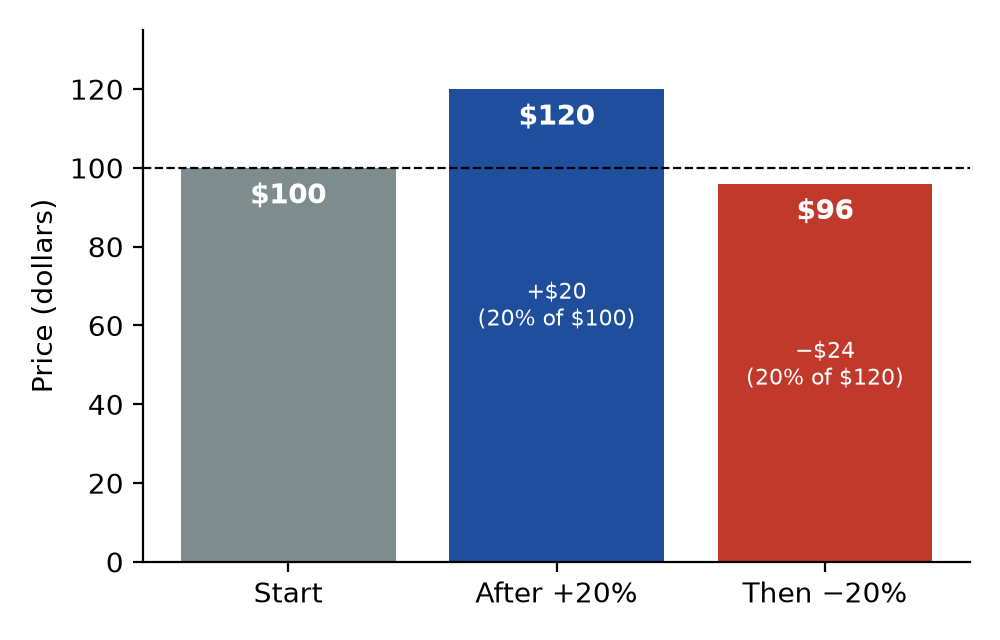
Order doesn’t matter here. Down 20% then up 20% is 0.80 × 1.20 = 0.96 too, because multiplication can be done in either order. ($100 → $80 → $96.)
Worked Example 10.3 · A share that rises 50% and then falls 50%
A share is bought for $40. It rises 50%, then falls 50%.
Multipliers: 1.50 × 0.50 = 0.75.
Result: $40 × 0.75 = $30, an overall 25% loss.
Check: $40 → $60 (up $20) → $30 (down $30). ✓
A headline that says “the share is back where it was after a 50% rebound” may be wrong. A 50% fall needs a 100% rise to recover, because the multiplier needed is 1 ÷ 0.50 = 2. This is an established result of arithmetic, not a market forecast. U29 Economics: Choices, Markets and Price Changes and F24 Personal Finance and Consumer Decision-Making say more about investment risk.
Check yourself 10.2 A value of $80 falls 25% and then rises 25%. What is the final value? Answer: $80 × 0.75 × 1.25 = $80 × 0.9375 = $75.
Good stopping point.
10.3 Undoing a change
To undo a change, you need the multiplier that brings you back: 1 ÷ the original multiplier.
| Change | Multiplier | To undo, multiply by | Which is |
|---|---|---|---|
| +8% tax | 1.08 | 1 ÷ 1.08 ≈ 0.9259 | divide by 1.08 |
| −20% | 0.80 | 1 ÷ 0.80 = 1.25 | a 25% increase |
| +50% | 1.50 | 1 ÷ 1.50 ≈ 0.6667 | about a 33.3% decrease |
| −50% | 0.50 | 1 ÷ 0.50 = 2 | a 100% increase |
Worked Example 10.4 · Removing 8% sales tax
A receipt total is $86.40, which includes 8% sales tax. What is the pre-tax price, and how much was the tax?
Step 1: Divide by the multiplier. $86.40 ÷ 1.08 = $80.00.
Step 2: Tax. $86.40 − $80.00 = $6.40.
Check: 8% of $80 is $6.40. ✓ (Subtracting 8% of $86.40, which is $6.91, would give $79.49, which is wrong. See Chapter 9.)
Worked Example 10.5 · A markup followed by a “sale”
A store raises a $60 lamp’s price by 25% (a markup), then advertises “20% off!” a month later. Is the sale price a bargain?
Step 1: Multipliers. 1.25 for the markup, then 0.80 for the sale.
Step 2: Multiply. 1.25 × 0.80 = 1.00.
Step 3: Apply. $60 × 1.25 = $75, then $75 × 0.80 = $60.
The “sale” price is exactly the original price. A 20% cut undoes a 25% rise, as the undo table above shows. When you judge a discount, ask “20% off what?” The reference quantity is the price just before the sale, and that may have been raised. Chapter 11 returns to this.
Check yourself 10.3 A price falls 20% to $64. What percentage increase would bring it back to its original price? Answer: The original was $64 ÷ 0.80 = $80. Getting back takes $16 on top of $64, and 16 ÷ 64 = 0.25, a 25% increase. ✓ That matches 1 ÷ 0.80 = 1.25.
Good stopping point.
10.4 Stacked discounts, coupons, and taxes
Worked Example 10.6 · “30% off, plus an extra 20% off”
Take a $150 jacket.
Step 1: Multiply the multipliers. 0.70 × 0.80 = 0.56. You pay 56% of the price.
Step 2: Apply. $150 × 0.56 = $84.
Step 3: Total discount. 1 − 0.56 = 0.44, which is 44% off ($66 saved), not 50%.
Step 4: Add 8% tax. $84 × 1.08 = $90.72.
Check: $150 × 0.70 = $105, $105 × 0.80 = $84, and $84 × 1.08 = $90.72. ✓
When every step is a percentage change, the order doesn’t change the result: 0.70 × 0.80 × 1.08 is the same in any order.
When order does matter: fixed-dollar coupons. A dollar amount off is a subtraction, not a multiplication, so the order changes the result.
Worked Example 10.7 · A $20 coupon and 25% off
A $100 purchase qualifies for a $20-off coupon and a 25% discount.
| Order | Calculation | You pay |
|---|---|---|
| Coupon first, then 25% off | ($100 − $20) × 0.75 | $60 |
| 25% off first, then coupon | $100 × 0.75 − $20 | $55 |
The order changes the price by $5. Taking the percent off first is better for you, because the percent then applies to a bigger amount. Store policy decides the order, so read the terms. How sales tax treats coupons and discounts also depends on the state and the type of coupon, so check your receipt.
Check yourself 10.4 What single discount is the same as 40% off followed by an extra 10% off? Answer: 0.60 × 0.90 = 0.54, so you pay 54%. That’s 46% off.
Good stopping point.
10.5 Raises and prices together
A raise is worth less if prices are rising too. Two words help:
- A nominal value is measured in the dollars of its own time, the number on the paycheck.
- A real value has been adjusted for changes in prices. It measures what the money can actually buy, which is its purchasing power.
To compare a raise with inflation, divide the wage multiplier by the price multiplier:
real multiplier = wage multiplier ÷ price multiplier
Worked Example 10.8 · A 10% raise when prices rose 3.7%
Suppose a worker got a 10% raise over the 12 months to September 2026. Over the same period, US consumer prices (CPI-U, all items) rose 3.7% (BLS, retrieved October 22, 2026; see Chapter 9).
Step 1: Multipliers. Wages × 1.10. Prices × 1.037.
Step 2: Divide. 1.10 ÷ 1.037 ≈ 1.0608.
Step 3: Interpret. Real pay rose about 6.1%. Subtracting (10% − 3.7% = 6.3%) gives a close estimate, but not the exact answer.
Check with dollars: $1,000 a week becomes $1,100. At the new prices, $1,100 buys what $1,100 ÷ 1.037 ≈ $1,060.75 bought a year earlier. That’s 6.1% more than $1,000. ✓
A quick table. With prices up 3.7% (the same BLS figure), here is what a few raises do to real pay:
| Nominal raise | Real multiplier (wage ÷ 1.037) | Real change |
|---|---|---|
| 2% | 1.02 ÷ 1.037 ≈ 0.9836 | about −1.6% |
| 3.7% | 1.037 ÷ 1.037 = 1 | 0% |
| 5% | 1.05 ÷ 1.037 ≈ 1.0125 | about +1.3% |
| 10% | 1.10 ÷ 1.037 ≈ 1.0608 | about +6.1% |
A raise has to match the rate of price rises just to stand still.
A raise that falls behind. A 3% raise in the same year gives 1.03 ÷ 1.037 ≈ 0.9932. The paycheck grew, but its purchasing power fell by about 0.7%.
What kind of claim is this? The 3.7% is an observation about an average US basket. Applying it to one worker is a model: it assumes that worker’s spending looks like the average basket. U29 Economics: Choices, Markets and Price Changes treats real and nominal values in depth.
Check yourself 10.5 Prices rise 4% and pay rises 4%. What happens to real pay? Answer: 1.04 ÷ 1.04 = 1, so real pay is unchanged.
Good stopping point.
Practical activity · Two offers that sound alike
Time: 20 to 30 minutes. Materials: a store flyer or sale web page, and a calculator.
- Design two discount offers for the same $120 item that sound similar, for example “40% off” and “25% off, then an extra 20% off,” or “$30 off, then 10% off” and “10% off, then $30 off.”
- For each offer, write the multipliers and any subtractions, in order.
- Compute the final price two ways: step by step, and with a single combined multiplier where you can.
- Decide which offer is better, or whether they’re equal, and by how much in dollars and as a percent of $120.
- Find one real stacked offer in a flyer and work out its true total discount.
Common mistakes
- Adding successive percents. 30% off then 20% off is 44% off, not 50%.
- Expecting +20% then −20% to cancel. The result is 0.96, a 4% loss.
- Undoing by the same percent. A 20% fall needs a 25% rise to recover.
- Removing tax by subtracting the rate from the total. Divide by 1 + the tax rate.
- Ignoring order with dollar coupons. Order matters when one step is a subtraction.
- Subtracting inflation from a raise. It’s a fine estimate, but the exact real change comes from dividing.
Going further (optional) · Repeated growth
The same multiplier applied again and again is called compounding. If a price rises 3% a year for 10 years, the overall multiplier is 1.03 multiplied by itself 10 times, written 1.03¹⁰ ≈ 1.344. That’s about a 34.4% increase, not 30%. Each year’s 3% is taken on a larger amount. Savings interest, loan balances, and population growth all follow this pattern. U02 Algebra: Expressions, Equations, and Models writes it with exponents, U20 Account for Stock and Flow models it, and F24 Personal Finance and Consumer Decision-Making applies it to savings and debt. A rule of thumb for doubling. People often estimate how long something growing at r% a year takes to double by computing 72 ÷ r. At 3% a year, 72 ÷ 3 = 24 years. The exact answer is about 23.4 years, because 1.03²³ ≈ 1.974 (just short of double) and 1.03²⁴ ≈ 2.033 (just past double). The “rule of 72” is an approximation, not an exact result. It works well for rates from about 2% to 10%. Check it against the multiplier when the answer matters.
Summary
- Successive percentage changes multiply: overall multiplier = the product of the multipliers.
- Equal rises and falls don’t cancel. +20% then −20% leaves 96%.
- To undo a change, multiply by 1 ÷ the multiplier. Remove tax by dividing by 1 + the rate.
- When every step is a percent, the order doesn’t matter. With a fixed-dollar coupon, it does.
- Real change = wage multiplier ÷ price multiplier. Nominal is the paycheck; real is purchasing power.
Key terms: successive changes · overall multiplier · markup · nominal value · real value · purchasing power · compounding
Review questions
Questions 1 to 6 practice single skills. Questions 7 to 9 combine them.
- A value of $500 rises 10% and then 10% again. Find the final value and the overall change.
- An $80 price falls 25% and then rises 25%. Find the final price.
- What single discount equals 40% off followed by an extra 10% off?
- A total of $97.20 includes 8% tax. Find the pre-tax price and the tax.
- A price fell 20% to $64. What percentage increase returns it to the original price?
- A $40 share rises 50% and then falls 50%. Find the final price and the overall change.
- For a $120 item, compare Offer A, “40% off,” with Offer B, “25% off, then an extra 20% off.” Which is better?
- A $150 order qualifies for a $25 coupon and a 20% discount. Find the price both ways, and say which order is better for you and by how much.
- Pay rose from $20.00 to $20.80 an hour while prices rose 3.7%. Find the nominal change, the real change, and what $20.80 is worth in the prices of a year earlier.
Explained answers
1. 1.10 × 1.10 = 1.21. $500 × 1.21 = $605, a 21% increase.
2. 0.75 × 1.25 = 0.9375. $80 × 0.9375 = $75, a 6.25% overall decrease.
3. 0.60 × 0.90 = 0.54, so 46% off.
4. $97.20 ÷ 1.08 = $90.00. Tax = $7.20. Check: 8% of $90 = $7.20. ✓
5. The original was $64 ÷ 0.80 = $80. (80 − 64) ÷ 64 = 25%.
6. $40 × 1.50 × 0.50 = $30, a 25% loss.
7. A: $120 × 0.60 = $72. B: $120 × 0.75 × 0.80 = $120 × 0.60 = $72. They’re equal. 0.75 × 0.80 = 0.60, so “25% then 20%” is exactly 40% off. They sound different but are the same deal.
8. Coupon first: ($150 − $25) × 0.80 = $100. Percent first: $150 × 0.80 − $25 = $95. Percent first is better by $5.
9. Nominal: (20.80 − 20.00) ÷ 20.00 = 4%. Real: 1.04 ÷ 1.037 ≈ 1.0029, about 0.3% more purchasing power. In the prices of a year earlier: $20.80 ÷ 1.037 ≈ $20.06. (The 3.7% is the CPI-U all-items figure for the 12 months to September 2026, from the BLS, retrieved October 22, 2026.)
Connections
- Chapter 9 introduced multipliers and the CPI data used here.
- Chapter 11 shows how stacked offers and “up to” claims are used to mislead.
- Chapter 12 uses percent savings in a full comparison.
- Other MORI books: U02 Algebra: Expressions, Equations, and Models (exponents) · U20 Account for Stock and Flow (growth and decay) · U29 Economics: Choices, Markets and Price Changes (real and nominal values) · F24 Personal Finance and Consumer Decision-Making (raises, interest, and debt).
Sources consulted for scope and accuracy: US Bureau of Labor Statistics, Consumer Price Index, https://www.bls.gov/cpi/ (September 2026 data, retrieved October 22, 2026); OpenStax, Contemporary Mathematics, Chapter 6, https://openstax.org/books/contemporary-mathematics/pages/6-1-understanding-percent, CC BY 4.0. All examples and exercises are original to MORI University. Prices and wages other than the BLS figure are illustrative.
Chapter 11 · Estimates, Checks, and Misleading Numbers
U01 Ratios, Proportions, and Percent · MORI University · Foundation level
Time needed: about 90 minutes in total, in seven short sections. Each section ends at a good place to stop. You need: a pencil, paper, and a calculator. Collect two or three ads, headlines, or posts that use numbers for the activity.
Learning goals
By the end of this chapter, you will be able to:
- Estimate a result before calculating, using rounding, benchmarks, and orders of magnitude.
- Check an answer three ways: by reversing it, by checking the units, and by asking whether it’s reasonable.
- Spot common misleading techniques: a missing reference quantity, relative risk without absolute risk, a cherry-picked starting point, a truncated chart axis, an average that hides variation, and “up to” claims.
- Tell an observation, an inference, a model, and an established result apart in a numerical claim.
- Rewrite a misleading claim as a clear, checkable statement.
Start here
Here are three statements you might see in a single afternoon:
- “Save up to 70% storewide!”
- “Eating this food doubles your risk!”
- A bar chart in which one company’s bar is more than twice as tall as a rival’s.
Each one might be true, and each one might leave you with the wrong idea. You already have the tools to check them: ratios, unit rates, percents, and the question “percent of what?” This chapter puts those tools together into a habit: estimate first, check after, and ask what’s missing.
11.1 Estimate first
An estimate (Chapter 3) is a quick, rough answer. Making one before you calculate gives you something to compare the exact answer with. If the two are far apart, something went wrong.
Worked Example 11.1 · A per-day phone charge
A prepaid plan costs $1.49 a day. About how much is that per month, and per year?
Step 1: Estimate. $1.49 is about $1.50. A month is about 30 days, so 1.5 × 30 = about $45 a month. A year is about 12 months, so 12 × $45 = about $540 a year.
Step 2: Calculate. $1.49 × 30 = $44.70 for a 30-day month. $1.49 × 365 = $543.85 a year.
Step 3: Compare. Both exact answers are close to the estimates. ✓
A per-day price can make a large yearly cost look small. Converting it to a monthly or yearly rate (Chapter 5) shows the full cost.
Orders of magnitude. An order of magnitude is a rough size measured in powers of ten: tens, hundreds, thousands, millions. Before checking details, ask whether the answer is the right size. A city’s water budget in the millions of dollars might be plausible. A household water bill in the millions is not. Getting the order of magnitude wrong is usually a decimal-point or unit error.
Check yourself 11.1 Estimate 19.8 × 31, and then calculate it. Answer: About 20 × 30 = 600. Exactly, 613.8. They’re close. ✓
Good stopping point.
11.2 Three ways to check an answer
- Reverse it. Undo the operation and see if you get back where you started. If 23% of 480 is 110.4, then 110.4 ÷ 480 should be 0.23. It is. ✓
- Check the units. Write the units through the calculation, and make sure they cancel to give what you want (Chapter 5). Miles ÷ (miles per gallon) = gallons.
- Ask whether it’s reasonable. Compare with your estimate and with common sense. A 15% tip on a $64 meal can’t be $96. That’s more than the meal itself. (The right answer is $9.60. Someone moved the decimal point.)
Worked Example 11.2 · Catching a units error
A car gets 30 miles per gallon. A trip is 240 miles. Someone writes “fuel needed = 30 × 240 = 7,200 gallons.”
Unit check: (miles/gallon) × miles = miles²/gallon. Those aren’t gallons, so the setup is wrong.
Fix: 240 miles ÷ 30 miles per gallon = 8 gallons. The miles cancel, leaving gallons. ✓
Reasonableness: 8 gallons is about a tank’s worth for a long drive, which makes sense. 7,200 gallons would fill a swimming pool.
Check yourself 11.2 Use a reverse check: is 18% of $350 equal to $63? Answer: 63 ÷ 350 = 0.18. Yes. ✓
Good stopping point.
11.3 Claims without a reference quantity
Chapter 8 taught you to ask “percent of what?” Many misleading claims simply leave the answer out.
- “25% less sugar”: less than what? The old recipe, a rival brand, or an average?
- “Save up to 70%”: “up to” means at most. The biggest discount might apply to only a few items.
- “3 times as effective”: compared with what, and measured how?
Worked Example 11.3 · “Save up to 70%”
A store has 200 items on sale. 3 are 70% off. The other 197 are 10% off.
What the ad says: “up to 70%,” which is technically true.
What a typical shopper gets: 197 ÷ 200 = 98.5% of the sale items are only 10% off.
An honest rewrite: “10% off most sale items, and up to 70% off 3 items.”
Check yourself 11.3 A cereal box says “now with 30% more!” What two questions should you ask? Answer: 30% more than what? (Which earlier box, and which size?) And more of what? (Weight, servings, or something else?) Then compare unit prices (Chapter 5).
Good stopping point.
11.4 Relative versus absolute change
Health and safety claims often report relative risk change, because it makes the change sound bigger. The absolute risk change tells you how many people are actually affected.
- Absolute risk is the chance itself: “2 in 10,000.”
- Absolute change is the plain difference in risk: 2 in 10,000 − 1 in 10,000 = 1 in 10,000.
- Relative change is the difference measured against the starting risk: 1 ÷ 1 = 100%, so the risk “doubled.”
Worked Example 11.4 · “Risk doubles”
A headline says a habit “doubles your risk” of a rare illness. The study found the risk went from 1 in 10,000 to 2 in 10,000.
Relative change: (2 − 1) ÷ 1 = 100%. The risk did double.
Absolute change: 1 more case per 10,000 people, which is 0.0001, or 0.01 percentage points.
In people: among 10,000 people with the habit, about 1 extra person gets the illness. The other 9,998 are unaffected either way.
An honest rewrite: “The risk rose from about 1 in 10,000 to about 2 in 10,000.”
This doesn’t mean the risk doesn’t matter. Whether 1 extra case in 10,000 matters depends on how serious the illness is and how easily the habit can be avoided. The point is that you need both numbers to judge. U04 Statistics: Samples, Center, and Spread and U14 Follow a Claim to Its Evidence go further, including how studies separate a cause from a coincidence.
Check yourself 11.4 A treatment cuts risk from 3 in 1,000 to 2 in 1,000. Give the relative change and the absolute change. Answer: Relative: (2 − 3) ÷ 3 ≈ −33.3% (“cuts risk by a third”). Absolute: 1 in 1,000, or 0.1 percentage points.
Good stopping point.
11.5 Pictures and selections that mislead
A truncated axis. A bar chart compares customer satisfaction scores: Company A scores 92 and Company B scores 95. The vertical axis starts at 90 instead of 0.
Text description of the chart: Two vertical bars. The axis is labeled from 90 at the bottom to 96 at the top. Company A’s bar rises 2 units above the bottom of the axis. Company B’s bar rises 5 units. Company B’s bar looks 2.5 times as tall as Company A’s.
| Company | Score | Bar height above the axis start (90) |
|---|---|---|
| A | 92 | 2 |
| B | 95 | 5 |
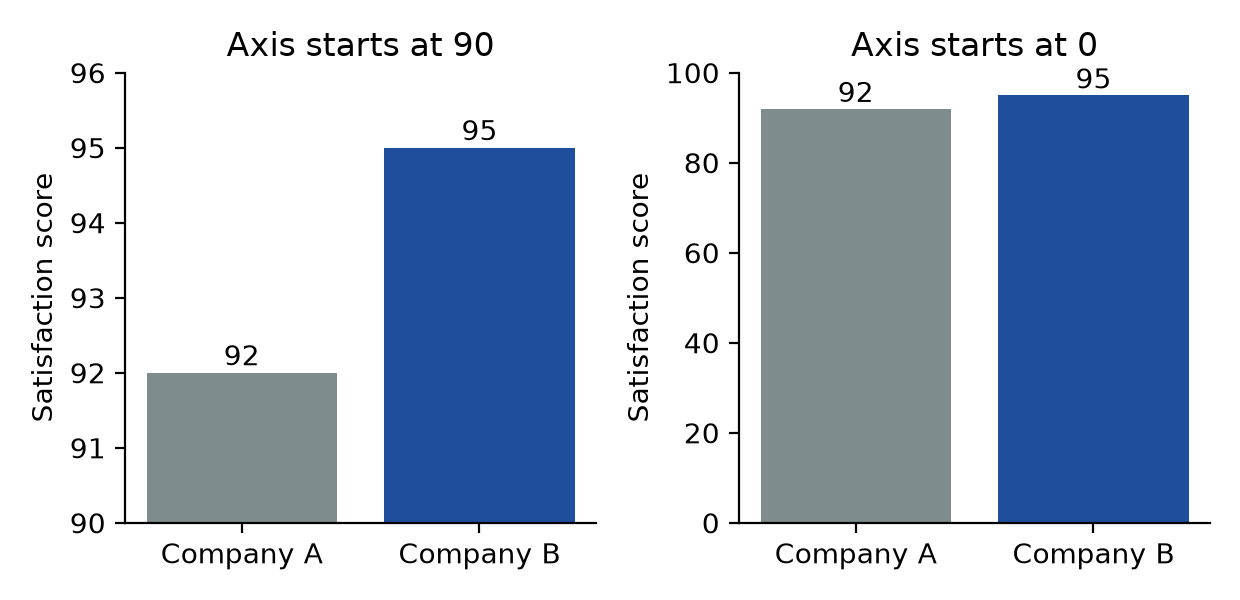
The real comparison: 95 ÷ 92 ≈ 1.033. B’s score is about 3.3% higher, and the difference is 3 points out of 100. The chart turned a small difference into a dramatic-looking one. A truncated axis isn’t always dishonest. It can help show small changes that matter. But it should be clearly marked, and the actual values should be easy to see.
A cherry-picked starting point. Percentage change depends on the starting value (Chapter 9). Pick a month when a price was unusually low as your start, and any rise looks large. Pick a high month, and it looks small. Choosing the starting point to suit the story is called cherry-picking. Ask why a report starts where it does.
An average that hides variation. In the 12 months to September 2026, US consumer prices rose 3.7% overall (CPI-U, all items, not seasonally adjusted; BLS, retrieved October 22, 2026). But inside that average, gasoline rose 34.2%, while motor vehicle insurance fell 5.0% and used cars fell 1.5%. One number summarizes a lot, and it can hide what matters to you.
Check yourself 11.5 A chart’s axis starts at 50. Two bars show 60 and 70. How many times as tall does the second bar look? How many times as large is the second value? Answer: Above 50 the bars are 10 and 20 units tall, so the second bar looks 2 times as tall. The real values give 70 ÷ 60 ≈ 1.17, about 17% larger.
Good stopping point.
11.6 Observation, inference, model, or established result?
MORI books separate four kinds of statement. Numbers can appear in all four.
| Kind | Meaning | Example |
|---|---|---|
| Observation | Something measured or counted | “The BLS reported a 34.2% 12-month rise in the gasoline index to September 2026.” |
| Inference | A conclusion drawn from observations, which could be wrong | “Gas prices are why my budget feels tight this year.” |
| Model | A simplified calculation that rests on stated assumptions | “If my $200 basket rose at 3.7%, it now costs $207.40.” |
| Established result | Something proven or thoroughly confirmed | “Successive changes of +50% and −50% give an overall −25%.” |
Why this matters. An observation can be checked against its source. An inference can be challenged with other evidence. A model is only as good as its assumptions. An established result holds every time. When a claim mixes these together, sort the parts before you agree or disagree.
Worked Example 11.5 · Tracing a dated claim to its source
A post says: “Prices are up 34% this year!”
Step 1: Find the source. The BLS CPI release for September 2026 (https://www.bls.gov/cpi/, retrieved October 22, 2026).
Step 2: Compare. The 34.2% figure is for the gasoline index over the 12 months to September 2026. All items rose 3.7%.
Step 3: Judge. The post turned one category into “prices.” The number is real, but it’s attached to the wrong thing.
Step 4: Rewrite. “US gasoline prices rose about 34% in the 12 months to September 2026, while prices overall rose 3.7% (BLS CPI-U).”
Check yourself 11.6 Classify the statement “A 20% fall needs a 25% rise to recover.” Answer: An established result. It follows from 1 ÷ 0.80 = 1.25, every time.
Good stopping point.
11.7 Rewriting claims honestly
A clear, checkable numerical claim usually has six parts:
- The number, with its unit.
- The reference quantity: percent of what, or compared with what.
- Both absolute and relative values, when risks or changes are involved.
- The time period and the place.
- The source, and the date it was retrieved.
- The kind of claim: observation, inference, model, or established result.
| Misleading | Rewritten |
|---|---|
| “Crime up 200%!” | “Reported burglaries in the district rose from 1 to 3 between the two months (city police data, retrieved [date]).” |
| “Our members love it: 80% approval!” | “Of 300 members who answered (25% of 1,200), 240, or 80% of respondents, approved.” |
| “Rates up 25%!” | “The rate rose from 4% to 5%, which is 1 percentage point (a 25% relative increase).” |
Check yourself 11.7 Which of the six parts is missing from “Rent is 12% higher”? Answer: Most of them: the reference quantity (higher than when, and where?), the time period, the place, the source, and the dollar amounts.
Good stopping point.
Practical activity · Claim clinic
Time: 25 to 35 minutes. Materials: two or three ads, headlines, or posts that contain numbers.
- For each claim, estimate whether it’s plausible before you check anything.
- Name the reference quantity, or write “missing.”
- Check for each technique from this chapter: “up to,” relative risk only, a truncated axis, a chosen starting point, or an average hiding variation.
- Classify each part of the claim as an observation, inference, model, or established result.
- Find the original source if you can, and write down its date.
- Rewrite the claim using the six parts in Section 11.7.
Common mistakes
- Skipping the estimate. Without one, a wrong decimal point looks fine.
- Accepting “up to” as typical. It is the maximum.
- Judging risk from the relative change alone. Ask for the absolute numbers.
- Reading bar heights without checking where the axis starts.
- Treating one category as the whole. Gasoline isn’t “prices.”
- Treating a model as an observation. Check the assumptions.
Going further (optional) · How many people are affected?
A helpful way to state an absolute risk change is to ask how many people would need to change their behavior for one case to be avoided (or caused). If a treatment cuts risk from 4 in 1,000 to 2 in 1,000, the absolute change is 2 in 1,000. So about 1,000 ÷ 2 = 500 people would need the treatment for one of them to avoid the illness. Medical research uses a version of this idea called the “number needed to treat.” It’s a ratio, like the ones in Chapter 4, and it turns an abstract percent into people. U04 Statistics: Samples, Center, and Spread treats it carefully.
Summary
- Estimate first, using rounding, benchmarks, and orders of magnitude.
- Check by reversing, by following the units, and by asking whether the answer is reasonable.
- Ask for the reference quantity, and treat “up to” as a maximum.
- Report absolute and relative risk together.
- Check where a chart’s axis starts, why a comparison starts where it does, and what an average hides.
- Sort claims into observation, inference, model, and established result. Then rewrite them with all six parts.
Key terms: order of magnitude · relative risk · absolute risk · truncated axis · cherry-picking · observation · inference · model · established result
Review questions
Questions 1 to 6 practice single skills. Questions 7 to 9 combine them.
- Estimate 19.8 × 31, and then calculate it exactly.
- Use a reverse check to test whether 23% of 480 is 110.4.
- A car gets 30 mpg. Someone says a 240-mile trip needs 7,200 gallons. Find the error with a unit check.
- Risk goes from 3 in 1,000 to 2 in 1,000. Give the relative and absolute change.
- A chart’s axis starts at 50. The bars show 60 and 70. Compare how the bars look with the real values.
- Classify each statement: (a) “The pump showed $3.459 per gallon today.” (b) “Prices will keep rising next year.” (c) “If I drive 12,000 miles at 30 mpg, I’ll use 400 gallons.” (d) “Up 20% then down 20% leaves 96%.”
- A store has 200 sale items. 3 are 70% off, and 197 are 10% off. Rewrite “Save up to 70%!” honestly, and find what percent of sale items are 10% off.
- A post says “Prices soared 34% this year.” Using the BLS table in Chapter 9, check the claim and rewrite it.
- An ad says a supplement “cuts your risk in half.” The risk went from 4 in 1,000 to 2 in 1,000. Give the relative and absolute changes, and say how many people would need to take it for one to avoid the illness.
Explained answers
1. Estimate: 20 × 30 = 600. Exact: 613.8.
2. 110.4 ÷ 480 = 0.23. Correct. ✓
3. (miles/gallon) × miles doesn’t give gallons. The correct calculation is 240 ÷ 30 = 8 gallons.
4. Relative: −1 ÷ 3 ≈ −33.3%. Absolute: −1 in 1,000 (−0.1 percentage points).
5. The bars are 10 and 20 units above 50, so the second looks twice as tall. The values give 70 ÷ 60 ≈ 1.17, which is only about 17% larger.
6. (a) Observation. (b) Inference, a forecast that could be wrong. (c) Model: 12,000 ÷ 30 = 400 gallons, assuming that mileage and fuel economy. (d) Established result: 1.2 × 0.8 = 0.96.
7. 197 ÷ 200 = 98.5% of sale items are 10% off. A rewrite: “10% off most sale items; 70% off 3 of 200 items.”
8. The 34% is the gasoline index (+34.2%, 12 months to September 2026). All items rose 3.7% (BLS CPI-U, retrieved October 22, 2026). Rewrite: “US gasoline prices rose about 34% in the year to September 2026. Overall consumer prices rose 3.7%.”
9. Relative: (2 − 4) ÷ 4 = −50% (the risk is halved). Absolute: 2 in 1,000 (0.2 percentage points). People needed: 1,000 ÷ 2 = 500 to avoid one case.
Connections
- This chapter draws on every earlier chapter: ratios and chances (Chapter 4), units (Chapter 5), percents (Chapter 8), and change (Chapters 9 and 10).
- Chapter 12 uses all of these checks in a full project.
- Other MORI books: U14 Follow a Claim to Its Evidence (tracing sources) · U04 Statistics: Samples, Center, and Spread (samples, risk, and charts) · U29 Economics: Choices, Markets and Price Changes (price data).
Sources consulted for scope and accuracy: US Bureau of Labor Statistics, Consumer Price Index, https://www.bls.gov/cpi/ (September 2026 data, retrieved October 22, 2026); OpenStax, Contemporary Mathematics, https://openstax.org/details/books/contemporary-mathematics, CC BY 4.0. All examples and exercises are original to MORI University. Sale, chart, and risk figures are illustrative.
Chapter 12 · Project: A Checked Comparison
U01 Ratios, Proportions, and Percent · MORI University · Foundation level
Time needed: about 3 to 5 hours, spread over a week. Each section ends at a good place to stop. You need: a notebook or spreadsheet, a calculator, and access to real prices: store receipts, websites, bills, or job ads.
Learning goals
By the end of this project, you will have:
- Framed a real decision as a comparison with stated options, criteria, units, and assumptions.
- Gathered and recorded numbers with their sources and dates.
- Computed unit rates, scaled quantities, and percent differences as needed.
- Checked every calculation by a second method, and written the checks down.
- Presented a conclusion with its limits and the conditions under which it would change.
Start here
Everything in this book was built for moments like this: you have a real choice, the numbers are scattered across labels and ads, and you want an answer you can trust.
This chapter is a project. Section 12.3 contains a fully worked model, a comparison of three ways to buy a week of staple dinners, with every calculation and every check shown. Then you’ll do your own. Your finished project is a short written comparison of one to two pages, assessed with the rubric in Section 12.6.
12.1 Choosing a decision worth checking
A good project decision is:
- Real. It’s something you, your household, or your workplace actually faces.
- Numerical. The options differ in amounts you can measure: cost, quantity, time, or distance.
- Small enough. Two to four options, and numbers you can actually find.
Ideas: two grocery stores, two phone plans, two job offers, buying versus renting a tool, a bus pass versus paying per ride, two suppliers for paint or flooring.
Write your decision as a question: “Which of these options costs less per week for my household, and by how much?”
Good stopping point.
12.2 The comparison worksheet
Before calculating anything, fill in a worksheet. It keeps you honest.
| Item | What to write |
|---|---|
| Question | The decision, as one sentence |
| Options | Each option, named |
| Criteria | What counts: cost, time, quality, convenience |
| Common unit | The unit every option will be converted to (per week, per ounce, per square foot) |
| Numbers and sources | Each price or quantity, where it came from, and the date |
| Assumptions | Everything you’re taking as given, written as a list |
Assumptions are the most important row. A comparison is a model (Chapter 11). Its answer is only as good as its assumptions. Writing them down lets a reader, or a future you, see exactly when the conclusion would change.
Good stopping point.
12.3 A fully worked model: a week of staple dinners
The worksheet
Question: Which of three ways of getting a week of dinners for a household of four costs least, per week and per serving, and by how much?
Options: - A: Cook from a regular supermarket. - B: Cook from a warehouse club that sells in bulk, with a $65 yearly membership. - C: A meal-kit delivery service.
Criteria: Cost of the food used per week (the main criterion). Cash spent up front. Time and waste are noted but not priced.
Common unit: dollars per week, and dollars per serving.
Recipe (base, serves 4): 0.75 lb rice · 0.5 lb dried beans · 1.5 lb chicken thighs · 1 lb frozen vegetables.
Prices: These are illustrative prices for teaching, of the kind you’d record from shelf tags with the store and date. In your own project, use real ones.
| Item | A: Supermarket | B: Warehouse club | C: Meal kit |
|---|---|---|---|
| Rice | $3.18 per 2-lb bag | $18.99 per 25-lb bag | — |
| Dried beans | $1.89 per 1-lb bag | $11.49 per 8-lb bag | — |
| Chicken thighs | $2.99 per lb | $2.29 per lb | — |
| Frozen vegetables | $2.29 per 1-lb bag | $8.99 per 5-lb bag | — |
| Other | — | $65 membership per year | $9.99 per serving + $10.99 shipping per week |
Assumptions: 1. Seven dinners a week, 4 servings each, so 28 servings. 2. Cooking at home uses the same recipe every night. (This is a simplification. Real menus vary, but a staple list like this captures the main costs.) 3. Leftover rice and beans keep and get used in later weeks. 4. Pantry items such as oil and spices cost about the same across options A and B, and are left out. 5. Travel costs to each store are about equal.
Step 1 · Scale the recipe (Chapter 7)
Seven dinners from a 4-serving recipe means a scale factor of 7.
| Item | Per dinner | × 7 | Week |
|---|---|---|---|
| Rice | 0.75 lb | × 7 | 5.25 lb |
| Beans | 0.5 lb | × 7 | 3.5 lb |
| Chicken | 1.5 lb | × 7 | 10.5 lb |
| Vegetables | 1 lb | × 7 | 7 lb |
Step 2 · Unit prices (Chapter 5)
| Item | A ($/lb) | B ($/lb) |
|---|---|---|
| Rice | 3.18 ÷ 2 = 1.59 | 18.99 ÷ 25 ≈ 0.7596 |
| Beans | 1.89 | 11.49 ÷ 8 ≈ 1.4363 |
| Chicken | 2.99 | 2.29 |
| Vegetables | 2.29 | 8.99 ÷ 5 = 1.798 |
Step 3 · Cost of the food used (Chapter 3 rounding: line items to the cent)
| Item | A | B |
|---|---|---|
| Rice (5.25 lb) | $8.35 | $3.99 |
| Beans (3.5 lb) | $6.62 | $5.03 |
| Chicken (10.5 lb) | $31.40 | $24.05 |
| Vegetables (7 lb) | $16.03 | $12.59 |
| Week total | $62.40 | $45.66 |
Option C: 28 × $9.99 = $279.72, plus $10.99 shipping = $290.71.
Step 4 · Per serving (a rate, Chapter 5)
- A: $62.40 ÷ 28 ≈ $2.23 per serving
- B: $45.66 ÷ 28 ≈ $1.63 per serving
- C: $290.71 ÷ 28 ≈ $10.38 per serving
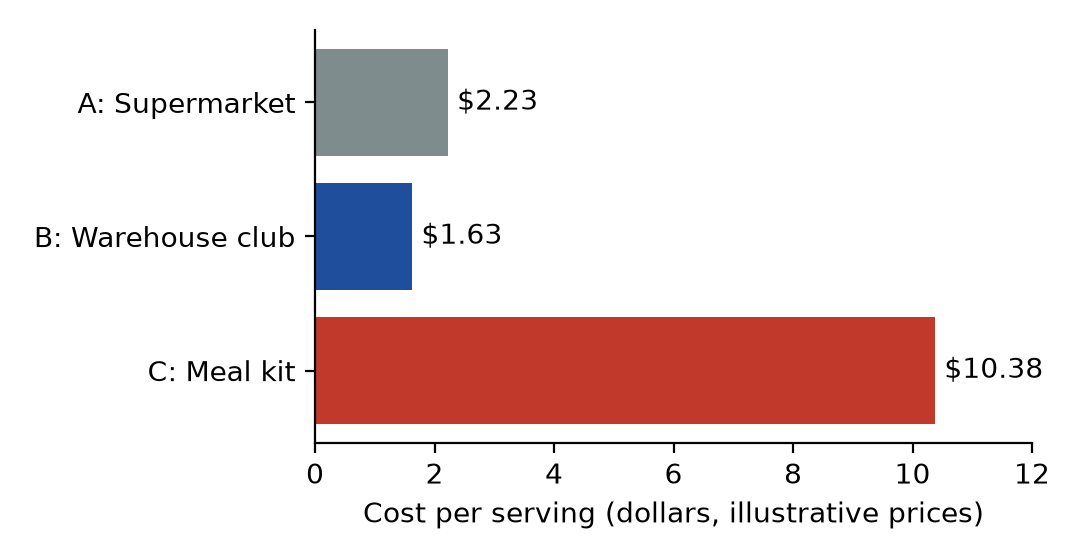
Step 5 · Percent comparisons (Chapters 8 and 9)
B compared with A. The saving is $62.40 − $45.66 = $16.74 a week. With A as the reference quantity, $16.74 ÷ $62.40 ≈ 0.268, so B costs about 26.8% less than A.
C compared with A. $290.71 ÷ $62.40 ≈ 4.66, so C costs about 4.7 times as much as A. That’s an increase of about 366%. (Following house style, we say “times as much,” never “times more.”)
Step 6 · The membership break-even point
A break-even point is the amount of use at which two options cost the same. Here, it’s the number of weeks of savings needed to cover the $65 membership.
$65 ÷ $16.74 per week ≈ 3.88 weeks.
So B pays for its membership after 4 weeks of shopping this way. Over a year (52 weeks), the saving would be 52 × $16.74 = $870.48, minus $65 = $805.48. That’s a model: it assumes the same menu, the same prices, and no waste for a whole year.
Step 7 · Cash up front
Bulk buying needs more money on the first trip, even though it costs less per pound.
- A, week 1: rice, 3 bags (6 lb) = $9.54; beans, 4 bags = $7.56; chicken = $31.40; vegetables, 7 bags = $16.03. Total $64.53.
- B, week 1: rice $18.99 + beans $11.49 + chicken $24.05 + vegetables, 2 bags (10 lb) = $17.98, which is $72.51, plus the $65 membership. Total $137.51.
The 25-lb rice bag lasts 25 ÷ 5.25 ≈ 4.8 weeks, and the beans last 8 ÷ 3.5 ≈ 2.3 weeks. Option B is cheaper per serving, but on week 1 it costs about twice as much in cash ($137.51 ÷ $64.53 ≈ 2.13). For a household with a tight weekly budget, that matters.
Good stopping point.
12.4 Checking: estimate, reverse, units, second method, peer check
Estimate (Chapter 11). For A: chicken is about 10 × $3 = $30, vegetables about 7 × $2.30 ≈ $16, rice about 5 × $1.60 = $8, and beans about 3.5 × $1.90 ≈ $7. That’s roughly $61, close to $62.40. ✓
Reverse. If B is 26.8% less than A, then $62.40 × (1 − 0.268) should be about $45.66. It gives $45.68, which matches to within rounding. ✓ For the break-even: 4 weeks × $16.74 = $66.96, which is more than $65, while 3 weeks gives $50.22, which is less. So 4 weeks is right. ✓
Units. (lb per week) × ($ per lb) = $ per week. ✓ ($ per week) ÷ (servings per week) = $ per serving. ✓
Second method: cost per dinner first. For A, one dinner costs 0.75 × $1.59 + 0.5 × $1.89 + 1.5 × $2.99 + 1 × $2.29 = $8.9125. Then 7 × $8.9125 ≈ $62.39. That matches $62.40 to within a cent. The cent comes from rounding the line items in Step 3. ✓
Peer check. Ask someone else to redo one row from your sources without seeing your answer.
Good stopping point.
12.5 Writing the result: answer, confidence, and limits
A good result statement has three parts: the answer, how confident you are, and what would change it.
Result (model project). For a household of four eating the same staple dinner every night, cooking from the warehouse club (B) costs about $45.66 a week ($1.63 a serving). That’s about 26.8% less than the supermarket (A: $62.40, $2.23 a serving). The meal kit (C) costs $290.71 a week, about 4.7 times as much as A. The $65 membership is paid back after 4 weeks.
Confidence. The arithmetic is checked four ways. The prices are illustrative, so the conclusion is only as good as the prices you record.
Limits, and what would change the answer. B needs about $73 more cash in week 1 ($137.51 against $64.53), plus storage space. If bulk food spoils before it’s used, B’s advantage shrinks. If the household shops at the club less than 4 weeks a year, the membership isn’t recovered. C saves planning and shopping time, which we didn’t price. If that time matters a lot to you, C might still be the right choice.
Good stopping point.
Project sketches
Choose one of these, or your own decision.
Sketch 1 · Two job offers. Job X pays $24.00 an hour for 40 hours a week. Job Y pays a $52,000 yearly salary. Convert both to a common unit: X is 24 × 40 × 52 = $49,920 a year, and Y’s $52,000 is $25.00 an hour at 2,080 hours. Now add commutes: X is 10 miles each way, and Y is 30. At an assumed $0.30 per mile for fuel and wear (state the assumption!), over 250 working days, X costs 20 × 250 × $0.30 = $1,500 and Y costs 60 × 250 × $0.30 = $4,500. After commuting, X comes to $48,420 and Y to $47,500. Does the ranking change? It does. What else matters, such as benefits or commuting time?
Sketch 2 · Flooring from two suppliers. A 12 ft × 15 ft room is 180 sq ft. With a 10% waste allowance (Chapter 7), you need 198 sq ft. Supplier 1 sells boxes of 22 sq ft. Supplier 2 sells boxes of 20 sq ft. Count whole boxes, compare total cost, and convert to dollars per square foot actually installed. Express the area in square meters too (1 sq ft ≈ 0.0929 m²).
Sketch 3 · Phone plans. Plan P is $35 a month with 5 GB of data and $10 per extra GB. Plan Q is $50 a month with unlimited data. Find the break-even data use: 35 + 10 × (GB − 5) = 50 gives 6.5 GB. Then check your own last three bills.
12.6 Assessment rubric
| Criterion | Developing (1) | Competent (2) | Strong (3) |
|---|---|---|---|
| Framing | Question is vague | Question and options are clear | Question, options, criteria, and a common unit are all stated |
| Sources | Numbers have no sources | Most numbers have sources | Every number has a source and a date |
| Calculations | Errors affect the answer | Correct, with minor slips | Correct, organized, with units throughout |
| Checks | None shown | One check per main result | Estimate, reverse, units, and a second method, all shown |
| Percent language | Reference quantities unclear | Mostly clear | Every percent names its reference quantity, and “times more” is avoided |
| Result and limits | Answer only | Answer and some limits | Answer, confidence, limits, and what would change it |
Scoring: 6 to 9 is developing, 10 to 14 is competent, and 15 to 18 is strong. Revise and resubmit as often as you like. Projects at MORI University are for learning, not for ranking.
Common mistakes
- Comparing in different units. Convert every option to the same unit first.
- Confusing cost of food used with cash spent. Bulk buying lowers the first and raises the second.
- Hiding assumptions. If an assumption isn’t written down, nobody can check it.
- Showing no checks. An unchecked answer is a guess.
- Saying “B is 26.8% cheaper” without naming the reference quantity. Say “26.8% less than A.”
Going further (optional) · Sensitivity
A sensitivity check asks how much the answer moves if one assumption changes. Suppose chicken at the warehouse club rises from $2.29 to $2.79 a pound. Then B’s weekly cost rises by 10.5 × $0.50 = $5.25, to $50.91. The saving falls to $11.49, and the break-even rises to $65 ÷ $11.49 ≈ 5.7, so about 6 weeks. B still wins, so the conclusion is robust to that change. If one small change flips the answer, say so in your limits. U20 Account for Stock and Flow and U29 Economics: Choices, Markets and Price Changes use sensitivity checks widely.
Summary
- Frame the decision: question, options, criteria, common unit, sources, and assumptions.
- Calculate with the tools from this book: scaling, unit prices, percents, and break-even points.
- Check with an estimate, a reverse calculation, the units, a second method, and a peer.
- Report the answer, your confidence, its limits, and what would change it.
Key terms: criteria · common unit · assumption · break-even point · sensitivity check
Review questions
Questions 1 to 6 practice single skills. Questions 7 to 9 combine them.
- Scale a recipe of 0.75 lb rice per dinner to 5 dinners.
- Find the unit price of a 25-lb bag of rice at $18.99.
- Option B costs $45.66 a week and A costs $62.40. What percent less does B cost than A?
- A $65 membership saves $16.74 a week. How many whole weeks until it pays for itself?
- Write the units check for (lb per week) × ($ per lb).
- Why might a cheaper-per-pound option be a poor choice for some households?
- In Sketch 1, does Job X or Job Y pay more before commuting costs, and which comes out ahead after them?
- In Sketch 2, how many boxes does each supplier require? (The room needs 198 sq ft.)
- In Sketch 3, what is Plan P’s cost at 8 GB, and which plan is cheaper at that level of use?
Explained answers
1. 0.75 × 5 = 3.75 lb.
2. $18.99 ÷ 25 ≈ $0.76 per lb ($0.7596).
3. ($62.40 − $45.66) ÷ $62.40 = $16.74 ÷ $62.40 ≈ 26.8% less than A.
4. $65 ÷ $16.74 ≈ 3.88, so 4 weeks. Check: 3 weeks saves $50.22 and 4 weeks saves $66.96. ✓
5. lb/week × $/lb: the pounds cancel, leaving $/week. ✓
6. It needs more cash up front, plus storage space, and food may spoil before it’s used. The cost per pound only counts if you use the whole bag.
7. Before commuting, Y pays more: $52,000 against $49,920. After commuting, X is ahead: $49,920 − $1,500 = $48,420 against $52,000 − $4,500 = $47,500. Under the assumed $0.30 a mile, the ranking flips.
8. Supplier 1: 198 ÷ 22 = 9, so 9 boxes exactly. Supplier 2: 198 ÷ 20 = 9.9, so 10 boxes (round up).
9. P: $35 + 3 × $10 = $65, which is more than Q’s $50. So Q is cheaper at 8 GB. (The break-even point is 6.5 GB.)
Connections
- This project uses every chapter in the book: ratios (4), rates and units (5), scaling (7), percents (8 to 10), and checks (11).
- Other MORI books: F16 Nutrition, Meal Planning, and Kitchen Economics (food budgets) · F24 Personal Finance and Consumer Decision-Making (job offers, plans, and contracts) · U22 Measure and Lay Out Before Making (flooring and materials) · U14 Follow a Claim to Its Evidence (sources) · U20 Account for Stock and Flow (sensitivity).
All examples, prices, and exercises are original to MORI University and are illustrative. In your own project, record real prices with their sources and dates.
Glossary
Each entry gives a short definition and the chapter where the term is introduced.
absolute risk — The actual chance of an event, such as 2 in 10,000. (Ch. 11)
assumption — A stated condition that a model relies on but does not prove. (Ch. 12)
break-even point — The point at which two options cost the same. (Ch. 12)
chance — The probability of an event, a part-to-whole ratio: 1 winning ticket in 5 is a 1/5 chance. (Ch. 4)
cherry-picking — Choosing only the data, dates, or comparisons that support a conclusion. (Ch. 11)
common denominator — A shared denominator, needed to add or subtract fractions. (Ch. 2)
common factor — A number that divides two or more numbers evenly. (Ch. 2)
common unit — The single unit all options are converted to so that they can be compared. (Ch. 12)
comparison by difference — Comparing two amounts by subtracting: “A is 6 more than B.” Also called an additive comparison. (Ch. 1)
comparison by multiplication — Comparing two amounts by how many copies of one make the other: “A is 3 times as much as B” means A = 3 × B. Also called a multiplicative comparison. (Ch. 1)
compounding — Repeating a percentage change on each new value, so changes build on changes. (Ch. 10)
Consumer Price Index (CPI) — The US Bureau of Labor Statistics’ monthly measure of the prices urban consumers pay for a fixed basket of goods and services. (Ch. 9)
conversion factor — A fraction whose top and bottom are equal amounts in different units, such as 12 in / 1 ft. Multiplying by it changes the unit, not the amount. (Ch. 5)
convert — To rewrite an amount in a different unit without changing its size, such as 2 ft = 24 in. (Ch. 1)
criteria — The things that matter in a decision and that each option is judged on. (Ch. 12)
cross-multiplication — Solving a proportion by setting the cross-products equal. (Ch. 7)
cross-products — For a : b and c : d, the products a × d and b × c. The ratios are equivalent exactly when these are equal. (Ch. 6)
decimal — A number written with place values of tenths, hundredths, and smaller, after a decimal point. (Ch. 3)
decimal point — The dot that separates the whole-number part from the fractional part of a decimal. (Ch. 3)
denominator — The bottom number of a fraction: how many equal parts make the whole. It can never be zero. (Ch. 2)
difference — The result of subtracting: how much larger one amount is than another. (Ch. 1)
digits — The ten symbols 0 to 9 used to write numbers. (Ch. 1)
equivalent fractions — Fractions that name the same number, such as 3/4 and 9/12. (Ch. 2)
equivalent ratios — Ratios that describe the same relationship, such as 2 : 3 and 8 : 12. Multiply or divide both terms by the same nonzero number. (Ch. 6)
established result — A statement that holds in every case, such as a mathematical fact. (Ch. 11)
estimate — A quick, approximate answer used to plan or to check an exact calculation. (Ch. 3)
factor — In a comparison by multiplication, the number that does the comparing (the 3 in “3 times as much”). Also, a number that divides another evenly. (Ch. 1)
fixed charge — A cost that stays the same however much you use. It makes a relationship non-proportional. (Ch. 7)
fraction — A number written a/b that describes a equal parts out of b equal parts of a whole, or a ÷ b. (Ch. 2)
improper fraction — A fraction whose numerator is at least as large as its denominator, such as 7/4. (Ch. 2)
inference — A conclusion drawn from observations, which could be wrong. (Ch. 11)
inflation — A general rise in prices over time, usually measured as a percentage change in a price index. (Ch. 9)
markup — A percentage added to cost to set a selling price. (Ch. 10)
metric system — The decimal system of units (meters, grams, liters) used by most of the world and by science; officially the SI. (Ch. 3)
mixed number — A whole number together with a fraction, such as 1 3/4. (Ch. 2)
model — A calculation built on stated assumptions. It is only as good as those assumptions. (Ch. 11)
multiplier — The number that turns the starting value into the new value: 1 + rate for an increase, 1 − rate for a decrease. (Ch. 9)
nominal value — An amount in the dollars of its own time, not adjusted for inflation. (Ch. 10)
numerator — The top number of a fraction: how many parts are taken. (Ch. 2)
observation — A statement of something measured or counted. (Ch. 11)
odds — A part-to-part ratio of outcomes for and against: 1 winner to 4 losers is odds of 1 to 4. (Ch. 4)
order of magnitude — The rough size of a number in powers of ten (tens, hundreds, thousands). (Ch. 11)
overall multiplier — The product of the multipliers of successive changes. (Ch. 10)
part-to-part ratio — A ratio comparing one part of a group with another part (women : men). (Ch. 4)
part-to-whole ratio — A ratio comparing one part with the whole group (women : everyone). It can be written as a fraction or percent. (Ch. 4)
per — “For each”. Written with a slash, as in $/lb. (Ch. 5)
percent — Per hundred: 30% means 30 out of every 100, or 0.30 as a decimal. (Ch. 8)
percentage change — The change divided by the starting value, written as a percent. (Ch. 9)
percentage point — The unit for the simple difference between two percentages: 4% to 5% is 1 percentage point (a 25% increase). (Ch. 9)
percent Daily Value (%DV) — On a US food label, the amount of a nutrient in one serving as a percent of a set daily reference amount. (Ch. 8)
place value — The value a digit has because of its position. In 4,507 the 5 means 5 hundreds. (Ch. 1)
price index — A number that tracks the cost of a fixed basket relative to a base period. (Ch. 9)
product — The result of multiplying. (Ch. 1)
proportion — An equation stating that two ratios are equal, such as 4/6 = 10/x. (Ch. 7)
proportional relationship — A relationship in which one quantity is always the same multiple of the other. Its graph is a straight line through zero. (Ch. 6)
purchasing power — The quantity of goods and services that an amount of money can buy. (Ch. 10)
quotient — The result of dividing. (Ch. 1)
rate — A ratio that compares quantities in different units, such as miles per hour. (Ch. 5)
ratio — A comparison of two amounts by division, written a : b, a to b, or a/b. (Ch. 4)
ratio table — A table of equivalent ratios used to find matching amounts. (Ch. 6)
real value — An amount adjusted for inflation, showing what it can actually buy. (Ch. 10)
reciprocal — The fraction turned upside down: the reciprocal of 3/4 is 4/3. A number times its reciprocal is 1. (Ch. 2)
reference amount — The amount you compare against: the “than what?” or “of what?” of a comparison. (Ch. 1)
reference quantity — The whole that a percent is taken of: the “of what?”. (Ch. 8)
relative risk — A risk compared with another by multiplication (“twice the risk”). (Ch. 11)
remainder — What is left over when a whole number does not divide evenly. 17 ÷ 5 = 3 remainder 2. (Ch. 1)
repeating decimal — A decimal whose digits repeat forever, such as 1/3 = 0.333… (Ch. 3)
rounding — Replacing a number with a nearby, simpler one to a chosen place, such as $4.367 → $4.37. (Ch. 3)
scale factor — The number every quantity is multiplied by when scaling up or down. (Ch. 7)
scale (of a drawing or map) — The ratio of a length on the drawing to the real length, such as 1 : 24,000. (Ch. 7)
sensitivity check — Changing an assumption to see whether the conclusion still holds. (Ch. 12)
simplest form — A fraction whose numerator and denominator have no common factor other than 1. (Ch. 2)
starting value — The original amount, which is the reference quantity for a percentage change. (Ch. 9)
successive changes — Percentage changes applied one after another. Each new percent uses the latest value as its reference. (Ch. 10)
sum — The result of adding. (Ch. 1)
terms (of a ratio) — The numbers in a ratio. (Ch. 4)
trailing zero — A zero added at the right end of a decimal, which does not change its value (0.6 = 0.60). (Ch. 3)
truncated axis — A graph axis that does not start at zero, which can exaggerate differences. (Ch. 11)
unit — The kind and size of thing being counted or measured: dollars, pounds, miles, hours. (Ch. 1)
unit price — A unit rate for cost: price per ounce, per pound, or per item. (Ch. 5)
unit rate — A rate expressed for one unit of the second quantity, such as 55 miles per 1 hour. (Ch. 5)
US customary units — The units in everyday US use: inches, feet, miles, ounces, pounds, cups, gallons. (Ch. 3)
waste allowance — Extra material added for cuts, breakage, and mistakes, usually 5% to 15%. (Ch. 7)
whole — The complete amount that a fraction is a part of. (Ch. 2)
whole numbers — The counting numbers and zero: 0, 1, 2, 3, and so on. (Ch. 1)
Notation guide
| Symbol or form | Read it as | Example |
|---|---|---|
| + − × ÷ | plus, minus, times, divided by | 12 ÷ 4 = 3 |
| a/b | a divided by b, or the fraction “a over b” | 3/4 = 0.75 |
| a : b | the ratio “a to b” | 2 : 3 |
| 1 3/4 | the mixed number “one and three-fourths” | 1 3/4 = 7/4 |
| 0.333… | a repeating decimal; the 3s go on forever | 1/3 |
| % | percent, “per hundred” | 25% = 0.25 |
| % pt | percentage point | 4% → 5% is +1 % pt |
| ≈ | is approximately equal to | 1/3 ≈ 0.33 |
| ✓ | checked | 3 × 4 = 12 ✓ |
| / in a unit | per | $/lb, mi/h |
| × 1.10, × 0.70 | multiplier for +10%, −30% | $50 × 1.10 = $55 |
| 1 : 24,000 | a map or drawing scale | 1 in on the map is 24,000 in on the ground |
House style. “3 times as much” means × 3. This book never uses “times more” (see Chapter 1). A change between two percentages is given in percentage points, with the percentage change alongside when it helps.
Unit conversion card
These definitions are exact unless marked ≈. Source: NIST Special Publication 811 and NIST Office of Weights and Measures.
| US customary | Metric |
|---|---|
| 1 inch (in) | 2.54 centimeters (cm), exactly |
| 1 foot (ft) = 12 in | 0.3048 meter (m), exactly |
| 1 yard (yd) = 3 ft | 0.9144 m, exactly |
| 1 mile (mi) = 5,280 ft | 1.609344 kilometers (km), exactly |
| 1 square foot (sq ft) | 0.09290304 square meter (m²), exactly |
| 1 fluid ounce (fl oz) | ≈ 29.57 milliliters (mL) |
| 1 cup = 8 fl oz | ≈ 236.6 mL (US nutrition labels use 240 mL) |
| 1 quart (qt) = 4 cups | ≈ 0.946 liter (L) |
| 1 gallon (gal) = 4 qt = 128 fl oz | 3.785411784 L, exactly |
| 1 ounce (oz, weight) | ≈ 28.35 grams (g) |
| 1 pound (lb) = 16 oz | 0.45359237 kilogram (kg), exactly |
Going the other way (≈): 1 m ≈ 3.281 ft · 1 km ≈ 0.6214 mi · 1 L ≈ 0.2642 gal · 1 kg ≈ 2.205 lb · 1 cm ≈ 0.3937 in.
Within metric: kilo- = 1,000 · centi- = 1/100 · milli- = 1/1,000. So 1 km = 1,000 m, 1 m = 100 cm, and 1 L = 1,000 mL.
Temperature is not proportional: °F = 1.8 × °C + 32. For example, 100 °C = 212 °F and 0 °C = 32 °F.
Bibliography
All of these sources were consulted for scope and accuracy. Their links were checked on October 22, 2026. No text was copied from them.
Open textbooks
- OpenStax. Prealgebra 2e. Houston, TX: OpenStax, Rice University, 2020. CC BY 4.0. https://openstax.org/details/books/prealgebra-2e (Chapters 1, 4, 5, and 6; Section 5.6, “Ratios and Rate”).
- OpenStax. Contemporary Mathematics. Houston, TX: OpenStax, Rice University, 2023. CC BY 4.0. https://openstax.org/details/books/contemporary-mathematics (Chapter 6, “Money and Personal Finance”; Section 6.1, “Understanding Percent”).
- OpenStax. Elementary Algebra 2e. Houston, TX: OpenStax, Rice University, 2020. CC BY 4.0. https://openstax.org/details/books/elementary-algebra-2e (proportion and percent applications).
- Lippman, David. Math in Society. CC BY-SA 3.0. https://www.opentextbookstore.com/mathinsociety/ (Used for reference only. It has a share-alike license, so none of its text or examples were adapted.)
Standards and measurement
- Common Core State Standards Initiative. “Grade 6: Ratios and Proportional Relationships (6.RP).” https://www.thecorestandards.org/Math/Content/6/RP/
- National Institute of Standards and Technology. Guide for the Use of the International System of Units (SI), NIST Special Publication 811. https://www.nist.gov/pml/special-publication-811
- National Institute of Standards and Technology, Office of Weights and Measures. “SI Units.” https://www.nist.gov/pml/owm/metric-si/si-units
- National Institute of Standards and Technology. “Approximate Conversions from U.S. Customary Measures to Metric.” https://www.nist.gov/pml/owm/approximate-conversions-us-customary-measures-metric
- US Geological Survey, National Geospatial Program. “Topographic Maps” (the 1:24,000-scale 7.5-minute quadrangle series). https://www.usgs.gov/programs/national-geospatial-program/topographic-maps
Government data and regulations
- US Bureau of Labor Statistics. Consumer Price Index. https://www.bls.gov/cpi/ (CPI-U, 12 months ending September 2026, not seasonally adjusted; retrieved October 22, 2026. Used in Chapters 9 to 11.)
- US Food and Drug Administration. “Daily Value on the Nutrition and Supplement Facts Labels.” https://www.fda.gov/food/nutrition-facts-label/daily-value-nutrition-and-supplement-facts-labels (sodium Daily Value of 2,300 mg; Chapter 8).
- Code of Federal Regulations, Title 21, §101.9(b)(5)(viii), “Nutrition labeling of food” (“a cup means 240 mL”). https://www.ecfr.gov/current/title-21/chapter-I/subchapter-B/part-101/subpart-A/section-101.9 (checked October 22, 2026; Chapter 7).
- US Department of Housing and Urban Development, Office of Policy Development and Research. “Consolidated Planning/CHAS Data: Background.” https://www.huduser.gov/portal/datasets/cp/CHAS/bg_chas.html (housing cost burden: more than 30% of income; Chapter 8).
Research
- Larrick, Richard P., and Jack B. Soll. “The MPG Illusion.” Science 320, no. 5883 (2008): 1593–1594. https://doi.org/10.1126/science.1154983 (Chapter 5).
License
- Creative Commons. “Attribution 4.0 International (CC BY 4.0).” https://creativecommons.org/licenses/by/4.0/
Index of key terms
Bold chapter numbers show where a term is introduced. Other numbers show chapters where it is used again.
- absolute risk: 11
- assumption: 12; 5, 11
- break-even point: 12
- chance: 4; 9, 11
- cherry-picking: 11
- common denominator: 2; 4
- common factor: 2; 4
- common unit: 12
- comparison by difference: 1
- comparison by multiplication: 1; 6
- compounding: 10
- Consumer Price Index (CPI): 9; 10–11
- conversion factor: 5
- convert: 1; 2–5, 7–9, 12
- criteria: 12
- cross-multiplication: 7
- cross-products: 6; 7
- decimal: 3; 1–2, 4, 8–9, 11
- decimal point: 3; 8, 11
- denominator: 2; 3–4
- difference: 1; 2–6, 9, 11–12
- digits: 1; 3
- equivalent fractions: 2; 3, 6
- equivalent ratios: 6; 4
- established result: 11; 1–3, 5, 7, 10
- estimate: 3; 2, 5, 7, 10–12
- factor: 1; 2–5, 7, 12
- fixed charge: 7
- fraction: 2; 1, 3–6, 8–9
- improper fraction: 2
- inference: 11; 8
- inflation: 9; 10
- markup: 10
- metric system: 3
- mixed number: 2
- model: 11; 4, 7, 9–10, 12
- multiplier: 9; 6–7, 10
- nominal value: 10
- numerator: 2; 3
- observation: 11; 5, 8–10
- odds: 4
- order of magnitude: 11
- overall multiplier: 10
- part-to-part ratio: 4
- part-to-whole ratio: 4; 8
- per: 5; 1–4, 6–8, 11–12
- percent: 8; 1–7, 9–12
- percentage change: 9; 8, 10–11
- percentage point: 9; 11
- percent Daily Value (%DV): 8
- place value: 1; 3
- price index: 9; 10–11
- product: 1; 4–8, 10
- proportion: 7; 1–6, 8–12
- proportional relationship: 6; 4
- purchasing power: 10
- quotient: 1; 2
- rate: 5; 1, 3–4, 6–12
- ratio: 4; 1–3, 5–12
- ratio table: 6; 5
- real value: 10; 11
- reciprocal: 2
- reference amount: 1
- reference quantity: 8; 9–12
- relative risk: 11
- remainder: 1; 2
- repeating decimal: 3
- rounding: 3; 6–8, 11–12
- scale factor: 7; 12
- scale (of a drawing or map): 7; 1–6, 8, 12
- sensitivity check: 12
- simplest form: 2; 3–4
- starting value: 9; 8, 11
- successive changes: 10; 8, 11
- sum: 1; 2–4, 8
- terms (of a ratio): 4; 1–3, 5–12
- trailing zero: 3
- truncated axis: 11
- unit: 1; 3–7, 11–12
- unit price: 5; 3, 7, 11–12
- unit rate: 5; 6–7, 11–12
- US customary units: 3
- waste allowance: 7; 12
- whole: 2; 1, 3–4, 6–12
- whole numbers: 1; 2–4